Posted on 11/14/2023 1:00:22 PM PST by Red Badger
These two galaxies, magnified by a gravitational lens, have properties that support the basic picture of galaxy formation as described in the Big Bang theory.
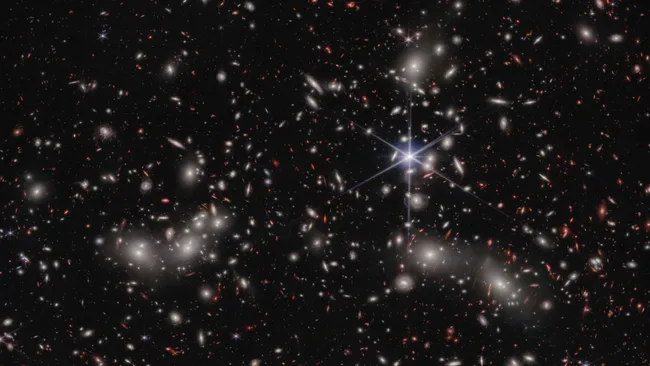
The JWST's view of Pandora's Cluster. This is the cluster that served as a gravitational lens for the new galactic findings. (Image credit: NASA, ESA, CSA, I. Labbe (Swinburne University of Technology), R. Bezanson (University of Pittsburgh), A. Pagan (STScI)) The second and fourth most distant galaxies ever seen have been spotted by the eagle eye of the James Webb Space Telescope (JWST), supporting the basic picture of galaxy formation as described by the Big Bang theory.
The discovery was made possible thanks to a huge helping hand from a massive gravitational lens in the form of the galaxy cluster known as Abell 2744, nicknamed Pandora's Cluster, which is located about 3.5 billion light-years away from us. The immense gravity of the cluster warps the very fabric of space-time sufficiently to magnify the light of more faraway galaxies.
Using the James Webb Space Telescope to search for early galaxies magnified by this cosmic lens, Bingjie Wang of the Penn State Eberly College of Science and member of the JWST UNCOVER (Ultradeep NIRSpec and NIRCam Observations before the Epoch of Reionization) team discovered two of the highest redshift galaxies ever seen.
Cosmological redshift is the stretching of light wavelengths, provoked by the continuous expansion of the universe. The more distant a galaxy is, the more the universe had expanded while that galaxy’s light traveled across space to reach us, and therefore, the more the wavelengths of that light are stretched. As wavelengths get stretched out in this manner, they go from tighter, blueish ones to redder ones, eventually falling into the invisible, infrared region of the electromagnetic spectrum. Galaxies that existed just between 300 and 400 million years after the Big Bang have had their light stretched into those infrared wavelengths that can't be seen by humans, but can indeed be detected by the JWST’s Near-Infrared Camera (NIRCam) and Near-Infrared Spectrometer (NIRSPec).
Wang and her team were able to identify the lensed images of two high-redshift galaxies. One, designated UNCOVER-z13 ("z" is shorthand for "redshift"), has a redshift of 13.079, confirming it to be the second most distant galaxy known. (The most distant confirmed galaxy is JADES-GS-z13-0, which was also discovered by the JWST in 2022 and has a redshift of 13.2.) We see UNCOVER-z13 as it existed just 330 million years after the Big Bang.
The other galaxy recently discovered, UNCOVER-z12, has a redshift of 12.393, placing it in fourth place in the all-time list of most distant galaxies. We see this realm as it was just 350 million years after the Big Bang.
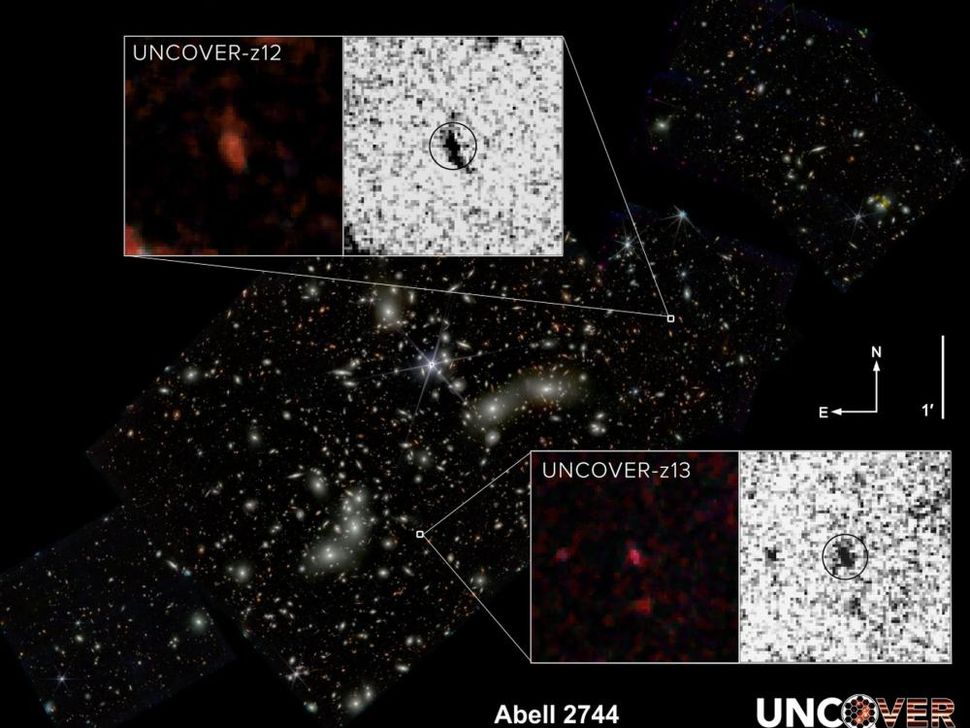
An image of Abell 2744, Pandora’s Cluster, with the two high-redshift galaxies discovered by the JWST seen as insets. (Image credit: Cluster image: NASA/UNCOVER (Bezanson et al.); Insets: NASA/UNCOVER (Wang et al.); Composition: Dani Zemba/Penn State.) What marks the two UNCOVER galaxies out as different is their appearance. Other galaxies seen at similarly high redshifts seem to be point-like, indicating they are very small — just a few hundreds of light years across. The UNCOVER galaxies, on the other hand, have structure.
"Previously discovered galaxies at these distances … appear as a dot in our images," Wang said in a statement. "But one of ours appears elongated, almost like a peanut, and the other looks like a fluffy ball."
These galaxies are also bigger, with UNCOVER-z12 sporting an edge-on disk about 2,000 light years across, which is six times larger than other galaxies seen in this era.
"It is unclear if the difference in size is due to how the stars formed or what happened to them after they formed, but the diversity in the galaxy properties is really interesting," said Wang. "These early galaxies are expected to have formed out of similar materials, but already they are showing signs of being very different than one another."
Although the dichotomy in galaxy properties, even at this early stage in the universe, is eye-opening, both of the newfound realms have general characteristics that are strongly supportive of the Big Bang model. This model describes how, in the aftermath of our universe's creation, galaxies began life small before growing rapidly through mergers with other galaxies and gas clouds.
This growth, in turn, spurred more star formation, which ultimately increased the abundance and variety of elements contained within the young galaxies, introducing substances to them that are heavier than hydrogen and helium. The galaxies uncovered by UNCOVER — if you’ll pardon the pun — are young, small, have a low abundance of heavy elements and are actively forming stars, all of which supports "the whole paradigm of the Big Bang theory," Joel Leja, who is an assistant professor of astronomy and astrophysics at Penn State University and a co-researcher on Wang’s team, said in the statement.
Interestingly, the JWST has the ability to see even higher redshift galaxies than UNCOVER-z13 and -z12, meaning they'd be even younger — but it didn’t detect any being lensed by the Pandora Cluster. "That could mean that galaxies just didn’t form before that time and that we’re not going to find anything farther away," said Leja. "Or it could mean we didn’t get lucky enough with our small window."
Astronomers will keep looking, using a multitude of lensing clusters to open up new windows into the deep universe in search of some of the first galaxies.
The discovery was reported on Monday (Nov. 13) in Astrophysical Journal Letters.
Join our Space Forums to keep talking space on the latest missions, night sky and more! And if you have a news tip, correction or comment, let us know at: community@space.com.
Save taht title. We can re-use it again..............
That was a pretty big bang, as far as bangs go.
Pretty amazing, the last frontier...and it seems rather big.
The first one is always the biggest................
The strawberry galaxy.
So that’s where I left it!
Even if we could wormhole to that galaxy, it’s still 2000 light years across, and I get bored easily.
Besides if you wormhole into a galaxy that is 3.5 billion light years away, it’s changed so much since you last looked. How do you know you’re not jumping into a massive hell hole?
I’m deeming this galaxy is not a threat by virtue of being to far.
Of course, if I’m wrong, and they are a threat, their tech-fu is far greater than our tech-fu and we are doomed.
Every time I scan a headline about this telescope I think of the old Hubble telescope and see the name Webb
My minds Merges it to Chelsea’s dad “Webb Hubble telescope”
But what about Uranus
You've got a point!
Nickname: The Last Frontier

Look at how much Lane Kiffin has changed in 14 years. LOL
2009:
2023:
“...described in the [b]ig [b]ang theory.”
I’ve come to the conclusion these eggheads just take random pictures of space and maked shit up. They can’t prove a damn thing.
How do you know you’re not jumping into a massive hell hole?
Right, maybe it will morph into dowtown LA
When will it find the many habitable planets we were assured it would find?
Look at how much Lane Kiffin has changed in 14 years. LOLHe's lost some weight.

Does the massive gravitational pull of the lens distort the information gleaned from the distant galaxy giving us incorrect information about the distant galaxy?
UNCOVER-z13 (”z” is shorthand for “redshift”), has a redshift of 13.079 billion years, and is the first home after the Big Bang of the Xeelee. They long ago left and are putting the finishing touches on the Great Attractor - so called because everything in this Universe is moving toward it.
When the accumulation of galaxies is completed, accessing the inner ring will send them to another Universe because they determined several billion years ago that this Universe is doomed.
Could the incorrect information you speak of be thought of as being fundamentally distanced information?
Disclaimer: Opinions posted on Free Republic are those of the individual posters and do not necessarily represent the opinion of Free Republic or its management. All materials posted herein are protected by copyright law and the exemption for fair use of copyrighted works.