Posted on 11/02/2023 12:02:27 PM PDT by MtnClimber
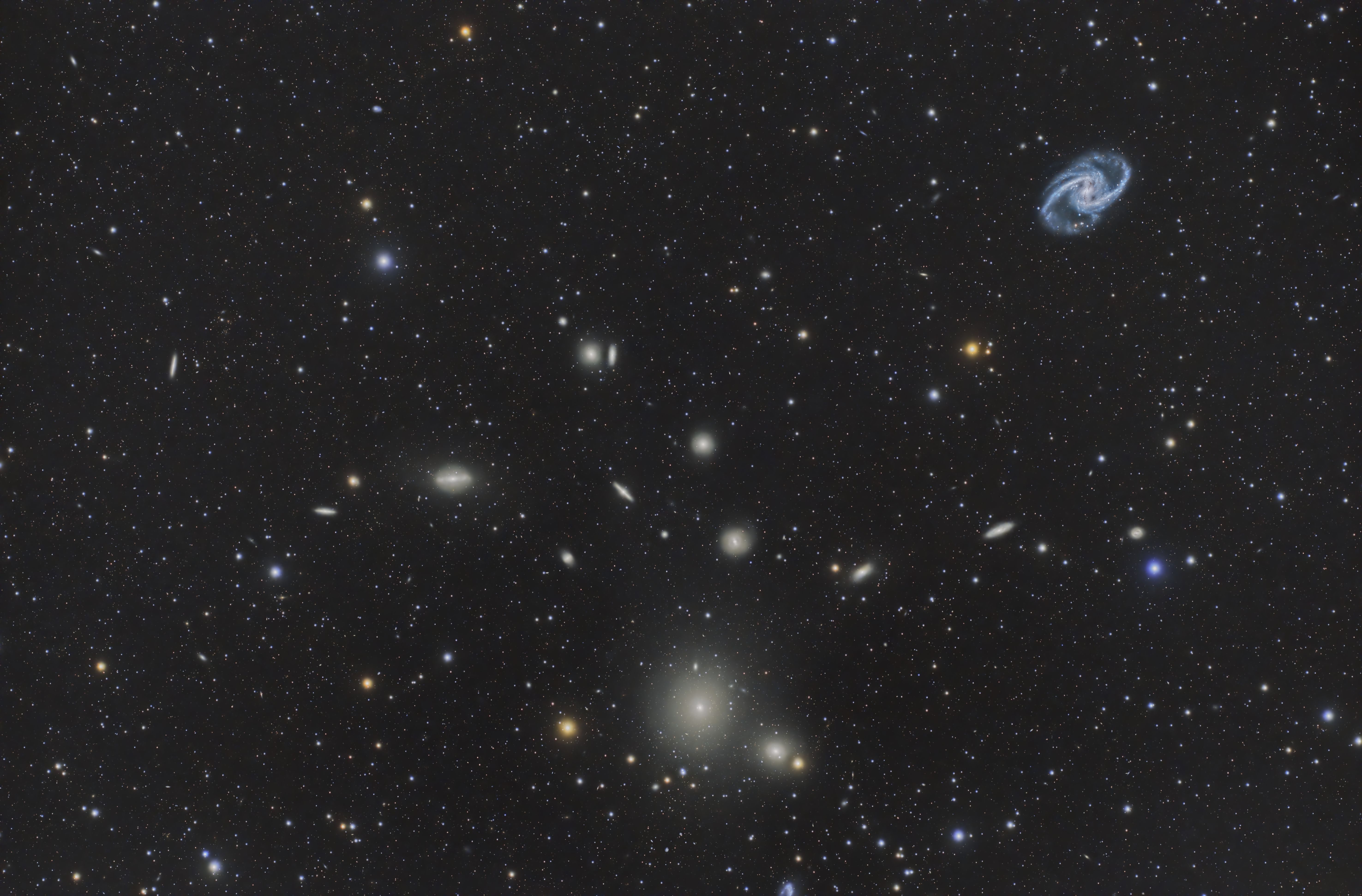
Explanation: Named for the southern constellation toward which most of its galaxies can be found, the Fornax Cluster is one of the closest clusters of galaxies. About 62 million light-years away, it's over 20 times more distant than our neighboring Andromeda Galaxy, but only about 10 percent farther along than the better known and more populated Virgo Galaxy Cluster. Seen across this three degree wide field-of-view, almost every yellowish splotch on the image is an elliptical galaxy in the Fornax cluster. Elliptical galaxies NGC 1399 and NGC 1404 are the dominant, bright cluster members toward the bottom center. A standout, large barred spiral galaxy, NGC 1365, is visible on the upper right as a prominent Fornax cluster member.
For more detail go to the link and click on the image for a high definition image. You can then move the magnifying glass cursor then click to zoom in and click again to zoom out. When zoomed in you can scan by moving the side bars on the bottom and right side of the image.
The universe is very cliquey. All the popular galaxies hang out together.
Wow.
I’ve seen some of this cluster from South Georgia, but, it was low on the horizon.
NGC 1365 is considered by some in the Southern Hemisphere to be their version of M31.
A neat area of the sky to just browse through.
I wonder if there is a Mean Girls Galaxy Cluster.
If so, I figure it's a bunch of Globulars
There was a time when humans thought our Milky Way galaxy was the universe. Some of those weird, diffuse smudges we saw with rudimentary telescopes were actually other galaxies.
As the telescopes improved, we began to collect images of amazing galaxies, of all shapes and sizes. There are even images of galaxies that are, or have, collided with each other.
When a Hubble astronomer decided to take long look (photo exposure over time) at a very small, but ‘empty’ part of the night sky, the result changed everything. Before this Hubble Deep Field Image, we estimated there were about 200 galaxies in the known universe. When we let Hubble view this tiny, ‘empty’ spot, thousands of galaxies were revealed. After the Deep Field revelations, we now estimate there may be 2 trillion galaxies.
Recently, the James Webb telescope reaches further into the universe. They are finding galaxies that ‘shouldn’t exist’ that do not go along with what is/was the current theory. Before Webb, they estimated the age of the universe at 14-15 billion years old. Since Webb is peering ever deeper, our estimates of size and age of the known universe will change. I love putting the adjective ‘known’ before universe. We use what God gave us to explore and theorize. We now know that what Hubble gave us as the known universe is not everything. Webb will peer further and further. What is beyond the limit that Webb can detect? We shall see. Webb is an Infrared telescope. Cosmic shhhtuff that might not be visible to our eyes is found with Webb. The Big Bang always seemed logical, and that 21cm background radiation comes from somewhere. Some of us today will not live to see what is beyond what Webb can detect, but it will be fascinating nonetheless.
Before this Hubble Deep Field Image, we estimated there were about 200 galaxies in the known universe.
~~~~~~~~~~~~~~~~~~~~
Nice post but are you sure about this number? 200 strikes me as low. I would have guessed the estimate was maybe in the millions even in pre-Hubble times.
The skies where I’m at, in northern Illinois, are lousy. I’ve only seen the brightest members of the Virgo Cluster, but that was some years ago.
Too much light pollution around here…
Ans some would tell you there is no one out there.
Of course, it does not matter, with the distance involved.
Well, if it’s only 62 million light years, I’m just wondering it if has any nice beachfront...
And before that they had everything orbiting around earth.
Some of us today will not live to see what is beyond what Webb can detect, but it will be fascinating nonetheless.
Death could change all that.
Beachfront is highly overrated when you factor in the constant corrosion issues from salt air, and storm damage.
Better to live on a hill up from the beach.
My club has a dark sky site about 60 miles from where I lived. Low horizons and only a few light domes. Summer in South Georgia doesn’t really work for astronomy, but, in the fall and winter it’s fabulous.
Look into the Urban Astronomy Club through the Astronomical League.
I lived in the middle of Savannah, GA with a couple of Hospitals, several major roads and shopping centers in the area and, a LOT of street lights around the back yard. I made a shaded area using some trees and a beach umbrella on a pole leaning on my shed. I ended up with an area about 15 square feet to set up in. VERY bad lighting.
The list has galaxies, globulars, open clusters, bright nebula, planetary nebulas and double stars.
You don’t have to go for the club membership to enjoy following the list, but, if you want to be “In the Club” you have to find them by hand. NO Go To allowed.
Take a look here: https://www.astroleague.org/urban-observing-program/
It’s not all that bad. WE live on a sailboat in the Florida ICW about 1 mile from the beach. The sky mostly is awful, but, mostly because we are in the middle of a medium sized town. I’ve a small 5” refractor on board (the 12.5 dob wouldn’t fit), and have had no issues with corrosion on the scope, or, eyepieces. I occasionally drag it ashore and have a look around, but, hoping to, at some point, finally get out on an island in the Bahamas, or, Fiji or something, and, do some real dark sky astronomy.
Before we left home (Savannah, Ga) my club would occasionally do stuff on the pier over the ocean. Never had any corrosion issues there, but, it was occasionally.
Even did a session once with Al Nagler on a dock off of Hilton Head Island. It was ‘interesting’ to say the least.
I took the reference to beachfront as to living there, not good night skies.
I live a mile or so back and 500 feet up and find a lot of haze from humidity reflects light from around. December when if/when the humidity drops gives good night sky. And no skeeters for the most part.
Finding objects in the sky without GOTO is part of the fun. It brings a sense of accomplishment, and it is great experience. I have a GOTO mount, but I never use it as such.
Where I live, just North of Rockford IL, is residential, with street lights and trees, and lots of both. Our club’s observatory is in a local park where we have a 10” refractor. The park district is building an equestrian center right next door to the observatory that will see use at night, which means a LOT more lights than there already are. So for our public nights, we will be reduced to showing the Moon, planets, and brighter star clusters.
BUT, they are our host, so that’s just the way it is.
https://rockfordamateurastronomers.com/
Disclaimer: Opinions posted on Free Republic are those of the individual posters and do not necessarily represent the opinion of Free Republic or its management. All materials posted herein are protected by copyright law and the exemption for fair use of copyrighted works.