Posted on 10/27/2023 12:01:07 PM PDT by Red Badger
The Beta Technologies electric aircraft flew from Vermont down to Florida, where the Air Force will check out what it can do.
~~~~~~~~~~~~~~~~~~~~~~~~~~~~~~~~~~~~~~~~~~~~~~~~~~~~~~~~~
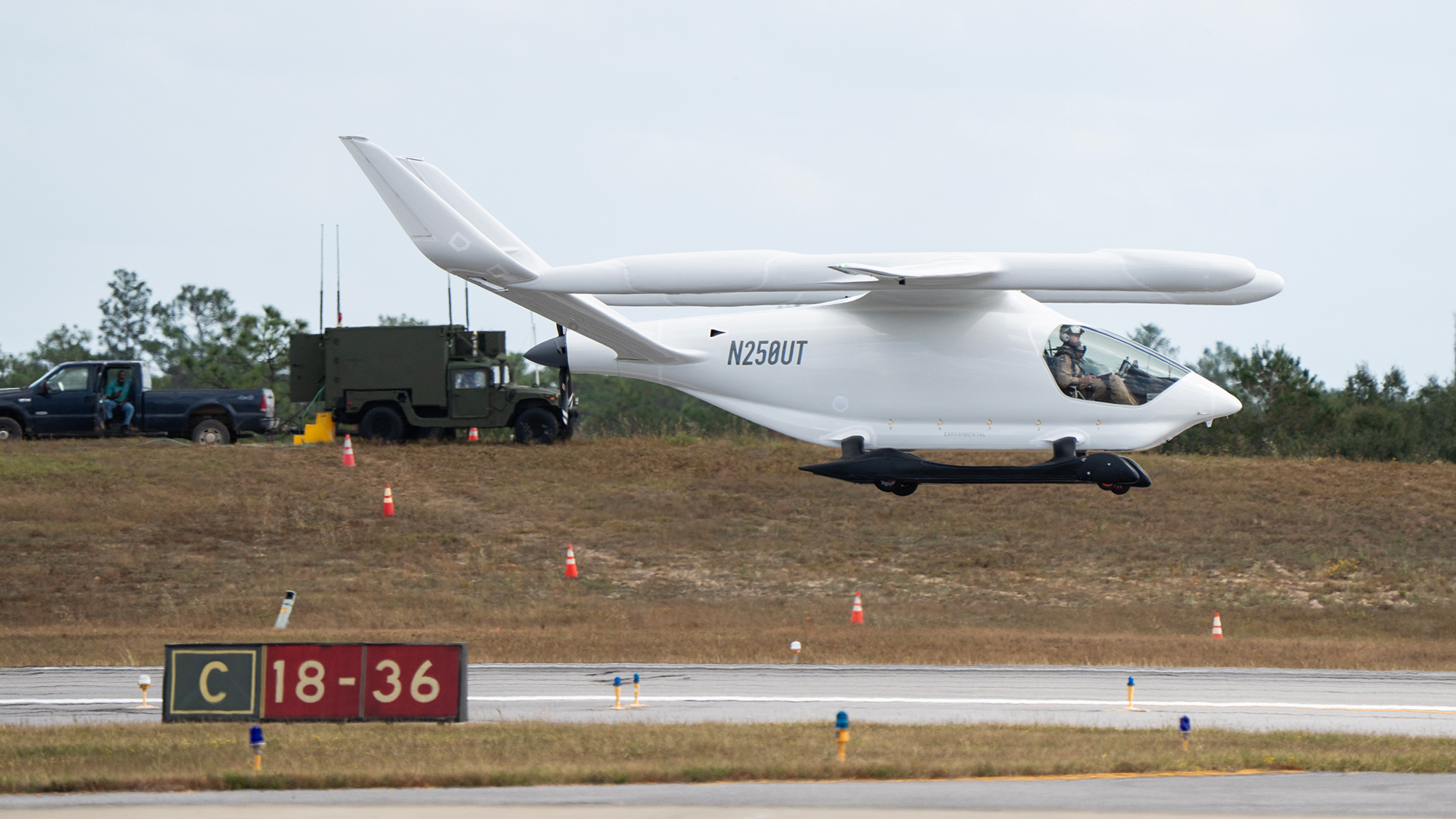
The aircraft landed at Duke Field (Eglin AFB) in Florida on Oct. 26. Beta Technologies
~~~~~~~~~~~~~~~~~~~~~~~~~~~~~~~~~~~~~~~~~~~~~~~~~~~~~~~~~
On Wednesday, October 18, an electric aircraft powered by a single propeller flew into, and then out of, Joint Base Andrews, the military facility famous for hosting Air Force One. That planned stop at the Maryland base was part of a long journey from Vermont to Florida.
Today, the aircraft, created by Vermont-based Beta Technologies, finally arrived in Florida, touching down at Duke Field airport, which is part of Eglin Air Force Base. The reason for the long trip from north to south is for Beta to give the US Air Force a chance to test the battery-powered aircraft and see how it handles tasks like moving cargo.
The testing the Air Force carries out will involve gathering “both ground and flight data,” says Maj. Riley Livermore, the flight commander for the 413th Flight Test Squadron. The exercises will involve “flying from point A to point B,” testing the plane at “different speeds,” simulating “different payloads,” and in general “seeing how the aircraft performs.” During these tests the aircraft will be crewed, meaning that it will be flown by a pilot who is on board the plane. The accouterments at Duke Field also include a Beta-installed charger to give the aircraft the juice it needs.
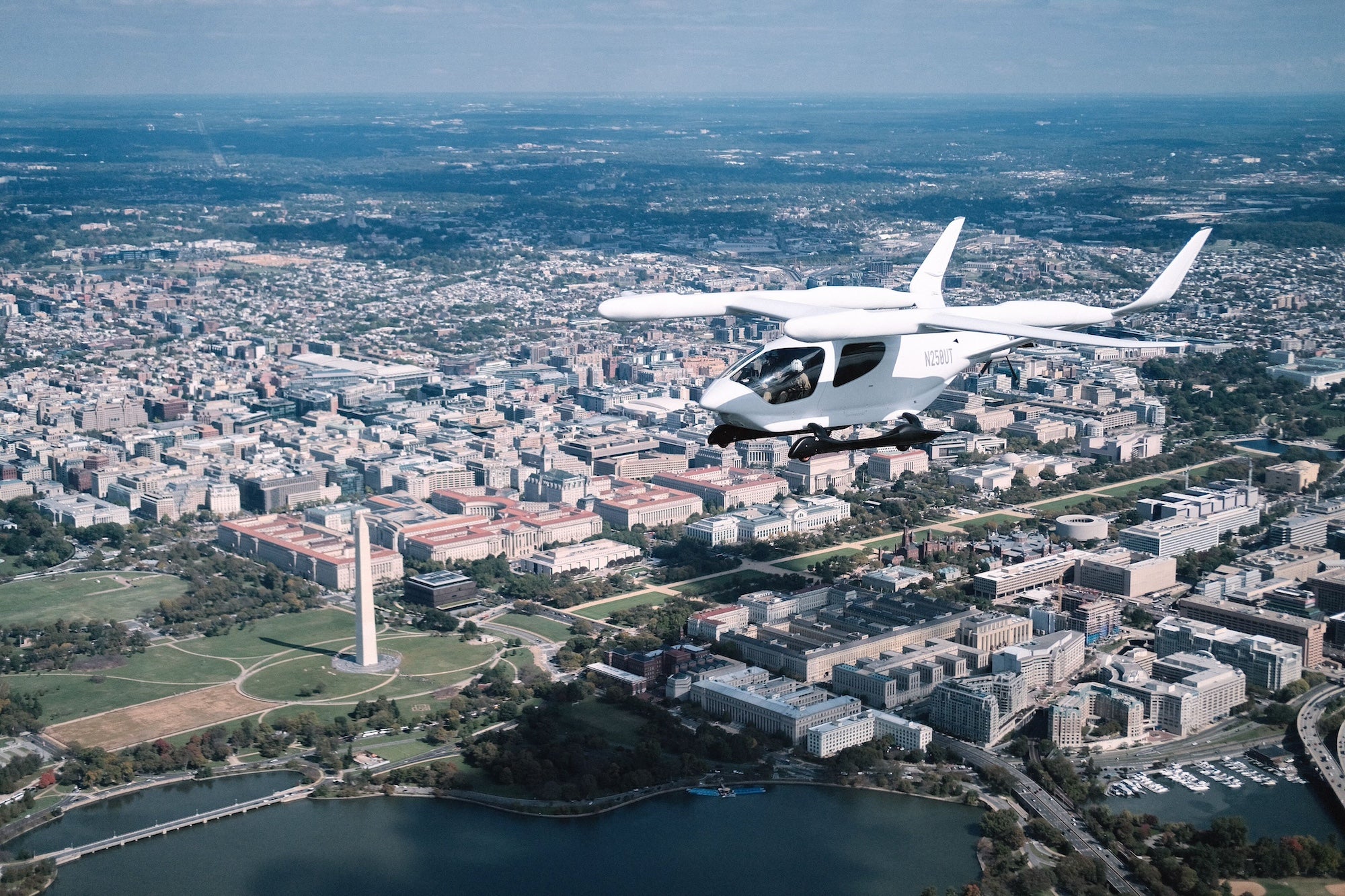
The Beta aircraft with the Washington Monument in the background. Beta Technologies The aircraft, called Alia, has a 50-foot-long wing, seats for two pilots up front, and cargo space behind them. Beta is developing two different versions of the electric plane. One is called a CTOL aircraft, which stands for “conventional take-off and landing.” The aircraft that the Air Force will have on hand in Florida is outfitted for CTOL flight, meaning it takes off and lands by cruising down a runway, like a regular plane. A second version is designed for VTOL flight, an acronym that stands for “vertical take-off and landing.” That variant utilizes four propellers that are parallel to the ground to allow it to take off and land in that fashion. Both variants have a propeller in the back to push it through the air. Beta has a contract with UPS to eventually sell the package-carrier 10 planes, with an option for more, and also has a contract with United Therapeutics. The goal is to sell zero-emissions aircraft to companies that will use them for schlepping packages, cargo, and logistics.
[Related: Futuristic aircraft and robotic loaders dazzled at a Dallas tech summit]
Livermore says that having the aircraft for testing will allow them to compare how it stacks up against Alia’s “glossy brochure” in real-world use. “Actually doing it for months on end is gonna really give us good exposure to where it’s really strong, and where more development or investment is needed,” he adds. Part of that could involve monitoring how much it costs to charge up the aircraft’s batteries and keeping an eye on its maintenance needs.
The arrival of this electric aircraft at an Air Force base parallels a similar development that occurred in September, when Joby Aviation delivered their electric flying machine to Edwards Air Force Base in California. That VTOL aircraft from Joby will be flown in an uncrewed, remote fashion at first, and the Air Force says they might use the Joby aircraft for tasks like keeping an eye on the base’s perimeter. The Air Force, through a program called AFWERX and Agility Prime, will be testing out both the Beta aircraft in Florida and the Joby aircraft in California. “The data we’re generating here for Beta—that same kind of data is being collected for Joby” at Edwards, says Livermore, even if it’s not precisely an “apples-to-apples comparison.” Still, information regarding how long it takes to charge up a plane like this applies to both aircraft, as does answering questions about their ranges.
Beta and Joby are not the only two companies working on electric flight, to be sure. Other notable players in the new industry include Wisk, which is part of Boeing, and Archer, which just said it had flown its Midnight aircraft for the first time. Joby has also announced that it will build a large production facility to make its aircraft in Ohio, while Beta has opened a large production facility to do the same in Vermont. That Beta facility in Vermont measures 188,500 square feet—that’s about the size of 67 tennis courts—and has solar panels on the roof for power and geothermal wells for the climate system.
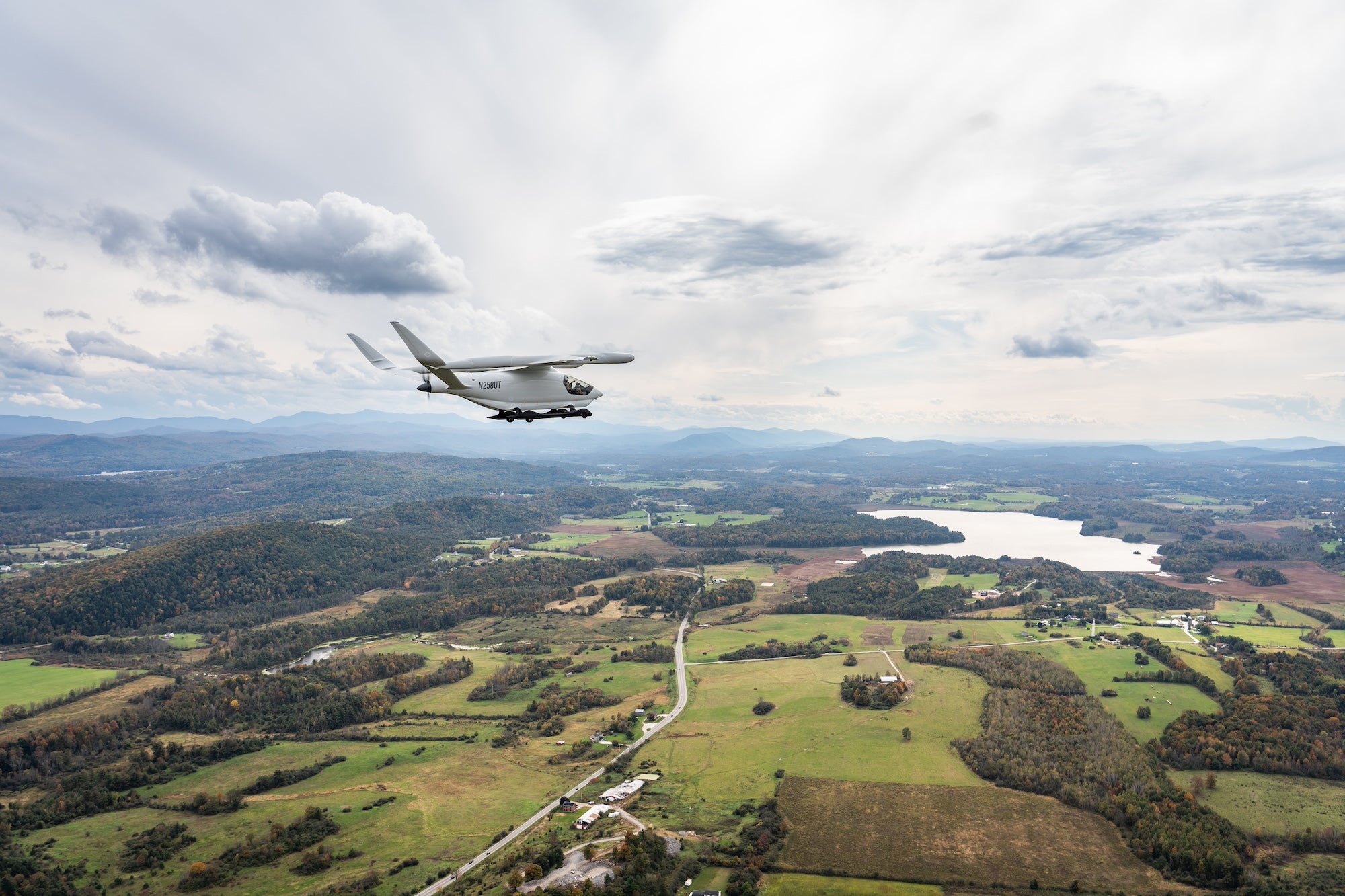
The electric airport departed Burlington, Vermont on October 10.
The electric aircraft departed Burlington, Vermont on October 11. Beta Technologies To get down to Florida, the Beta aircraft made more than a dozen stops along the way, departing Burlington, Vermont on October 11 and flying 84 miles to Glens Falls, New York, a hop that took 49 minutes. It eventually left New York, flying through states such as Massachusetts, Connecticut, Pennsylvania, Virginia, and the Carolinas, and finally ended up in Florida. The distance covered for the entire mission was 2,000 miles, according to Beta.
Several different pilots took turns operating it, including Nate Moyer, who has military experience flying aircraft such as F-16s. He was also the pilot at the controls for when the aircraft flew in and out of Joint Base Andrews. “The responsiveness is unbelievable,” he says, describing what it’s like to fly Alia. “It’s sensitive enough that I just kind of breathe on the stick and it does exactly what I want it to do.” In that sense it’s like the control stick for an F-16, which is also known for being very sensitive to pilot inputs.
Like a trip that this same Beta aircraft took last year out to Arkansas, this journey down south was a chance for regular people to see a neat new plane. “People come up and they ask really interesting questions that I never would have expected. We had a 5-year-old ask if we came from Mars,” Moyer mentions. “We didn’t actually remember to tell him ‘no,’ so I don’t know what he actually believes.”
From a military perspective, it should be heat-seeker proof. And if the fuselage and wing system are carbon fiber and RAM, it should be radar proof. So noise reduction isn't the only stealth reason. Again, I say "if".
Took a full week, multiple stops and pilots to get there.
What an achievement.

“I didn’t see speeds either”
Flying slowly doesn’t save power; it uses more. Like a boat going just below up-on-plane speed. Way more drag in both cases.

I’d sooner trust a rubber-band powered plane.
Fair enough. But we already have battery powered drones for those types of missions. I guess the point is, unless something is classified here, which I doubt, the battery technology isn’t anywhere near the point to make a piloted military aircraft remotely practical. And, with the stated range of 250 miles (probably under superior conditions) basically this thing can fly to the nearest McDonald’s for lunch and back.
Can is carry a passenger bigger than a cat?
Payload? Speed? Get real. Nothing but a gimmick.
Thanks.
Answers my question.
No way am I going to fly in one of those. Imagine a fire in the battery compartment, flying.
Head Shake.
I’m a bit daring, still climb towers, but I pass on an electric airplane.
Also pass on an electric Auto.
I love how people pooh-pooh new tech. Is this craft going to have a huge impact n the military? Nope.
But each step is part of learning. Thirty years from now it might evolve into something amazing.
Stupid just based on energy density of av fuel/gas vs. batteries.
Get the battery tech to where you’re in the ballpark, then we can talk. Otherwise, this is just another EV boondoggle, worth than most.
Is this the inferno or the non-inferno model?
Thanks for the link.
You know, I used to get real excited about advancements in technology and science in general.
I’ve let politics and money cloud my interests.
Speed matters for purpose.
The perfect battery is still a long ways off.
Quick Charge
Huge Energy Density
Never wear out.....................
We need a reincarnation of Nikola Tesla.
I’ll settle for Musk...............
I hope that thing has proven 0-0 Ejection Seats in the cockpit.
Disclaimer: Opinions posted on Free Republic are those of the individual posters and do not necessarily represent the opinion of Free Republic or its management. All materials posted herein are protected by copyright law and the exemption for fair use of copyrighted works.