Posted on 06/28/2023 1:00:38 PM PDT by MtnClimber
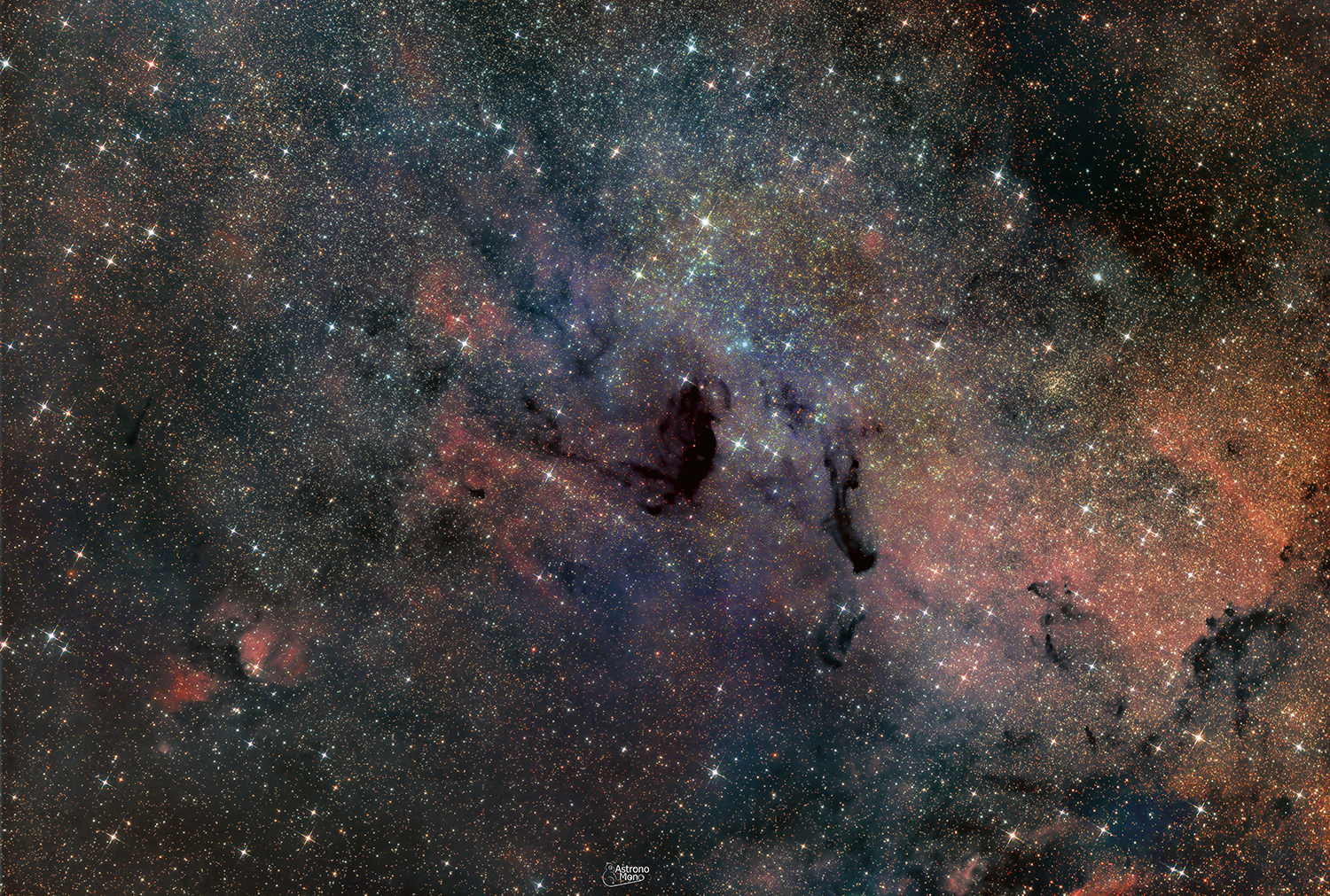
Explanation: Unlike most entries in Charles Messier's famous catalog of deep sky objects, M24 is not a bright galaxy, star cluster, or nebula. It's a gap in nearby, obscuring interstellar dust clouds that allows a view of the distant stars in the Sagittarius spiral arm of our Milky Way galaxy. Direct your gaze through this gap with binoculars or small telescope and you are looking through a window over 300 light-years wide at stars some 10,000 light-years or more from Earth. Sometimes called the Small Sagittarius Star Cloud, M24's luminous stars fill this gorgeous starscape. Covering over 3 degrees or the width of 6 full moons in the constellation Sagittarius, the telescopic field of view includes dark markings B92 and B93 near center, along with other clouds of dust and glowing nebulae toward the center of the Milky Way.
For more detail go to the link and click on the image for a high definition image. You can then move the magnifying glass cursor then click to zoom in and click again to zoom out. When zoomed in you can scan by moving the side bars on the bottom and right side of the image.
Wow 😯.
I’m sorry, but I don’t know what I’m looking at exactly. Is the bright pinkish area in the center right (right of the dark clouds and continuing to the edge of the photo) the bright spot that Messier cataloged as M24?
Thanks, for an explanation. Thanks also, for posting this and all the amazing photos in the past.
Oldplayer
I think that the bright area and all except the dark spots are a gap in the dust band where the Sagittarius spiral arm of our Milky Way galaxy can be seen. The dust bands obscure much of the spiral arms of the Milky Way Galaxy viewed from Earth.
Wonderful image as always. I really do want to spend a great portion of my Eternity exploring all these places.
It’s certainly messier than the Pleiades.
Yes, in a smaller scope like Messier had, it would look like a cloud or a large comet (that’s what Mr. Messier was looking for anyway).
He would not have see the color, but, he may have noticed the darker regions against the starcloud behind.
There are also a few galactic clusters embedded in the cloud.
Disclaimer: Opinions posted on Free Republic are those of the individual posters and do not necessarily represent the opinion of Free Republic or its management. All materials posted herein are protected by copyright law and the exemption for fair use of copyrighted works.