Free Republic
Browse · Search
General/Chat
Topics · Post Article

Skip to comments.

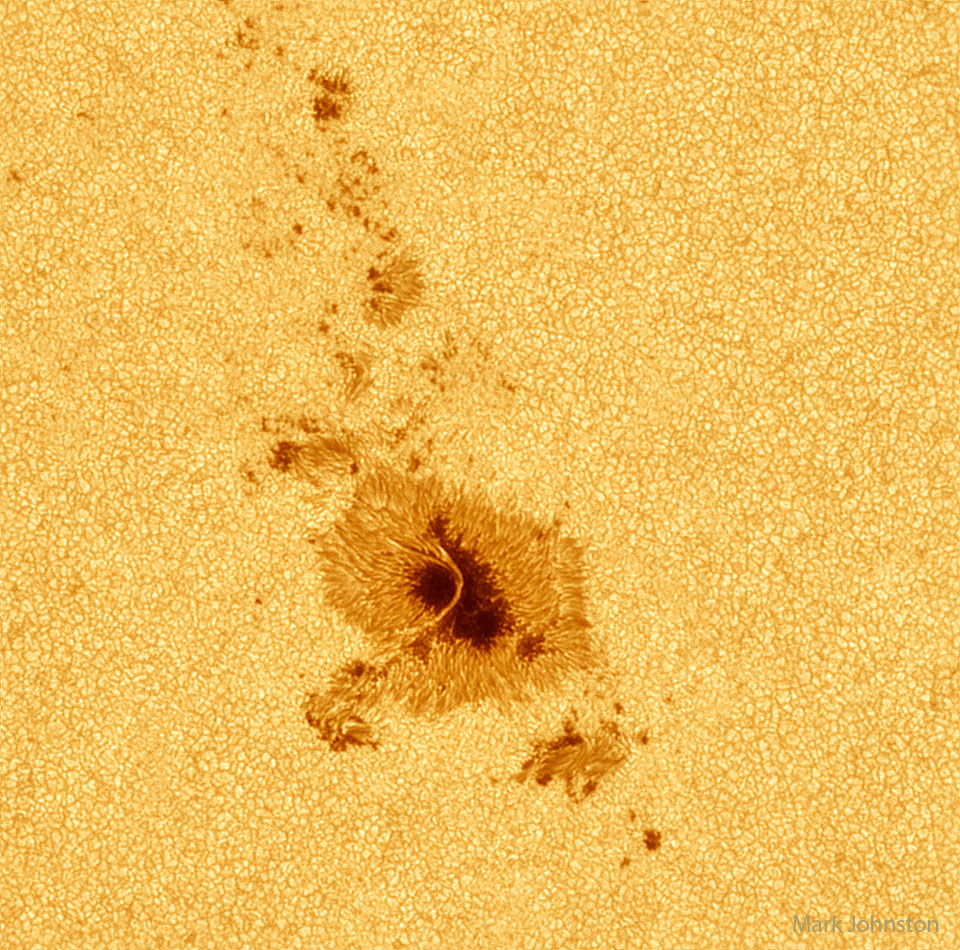
Astronomy Picture of the Day - Sunspot with Light Bridge
https://apod.nasa.gov/apod ^ | 17 May, 2023 | Image Credit & Copyright: Mark Johnston

Posted on 05/17/2023 1:40:47 PM PDT by MtnClimber

Explanation: Why would a small part of the Sun appear slightly dark? Visible is a close-up picture of sunspots, depressions on the Sun's surface that are slightly cooler and less bright than the rest of the Sun. The Sun's complex magnetic field creates these cool regions by inhibiting hot material from entering the spots. Sunspots can be larger than the Earth and typically last for about a week. Part of active region AR 3297 crossing the Sun in early May, the large lower sunspot is spanned by an impressive light bridge of hot and suspended solar gas. This high-resolution picture also shows clearly that the Sun's surface is a bubbling carpet of separate cells of hot gas. These cells are known as granules. A solar granule is about 1000 kilometers across and lasts for only about 15 minutes.


TOPICS: Astronomy; Astronomy Picture of the Day; Science
KEYWORDS: nasa
To be added or removed from the Astronomy Picture of the Day ping list please send me a request via "Private Reply" (Mail).

For more detail go to the link and click on the image for a high definition image. You can then move the magnifying glass cursor then click to zoom in and click again to zoom out. When zoomed in you can scan by moving the side bars on the bottom and right side of the image.

1 posted on 05/17/2023 1:40:47 PM PDT by MtnClimber
[ Post Reply | Private Reply | View Replies]

To: MtnClimber

2 posted on 05/17/2023 1:41:04 PM PDT by MtnClimber (For photos of Colorado scenery and wildlife, click on my screen name for my FR home page.)
[ Post Reply | Private Reply | To 1 | View Replies]

To: 21stCenturion; 21twelve; 4everontheRight; abb; AFB-XYZ; AFPhys; Agatsu77; America_Right; ...
Pinging the APOD list.

πŸͺ 🌟 🌌 πŸ”


3 posted on 05/17/2023 1:41:51 PM PDT by MtnClimber (For photos of Colorado scenery and wildlife, click on my screen name for my FR home page.)
[ Post Reply | Private Reply | To 2 | View Replies]

To: MtnClimber

“Sunspots can be larger than the Earth...”

Whoa.


4 posted on 05/17/2023 1:44:32 PM PDT by moovova ("The NEXT election is the most important election of our lifetimes!β€œ LOL...)
[ Post Reply | Private Reply | To 1 | View Replies]

To: moovova
Some sunspots are so big that they can be seen from Earth with just a sun filter. The sun is nominally about 850,000 miles in diameter, which makes it over 100 times the diameter of the Earth -- a million times Earth's volume. The distance scales involved are mind-bending, and as astronomical phenomenon go, this is just the beginning.

By my rough calculations, I estimate the big spot in the picture to be at least 40,000 kilometers in diameter (25,000 miles), which makes that part alone three times the size of our little blue marble.

5 posted on 05/17/2023 2:13:31 PM PDT by Joe Brower ("Might we not live in a nobler dream than this?" -- John Ruskin)
[ Post Reply | Private Reply | To 4 | View Replies]

To: Joe Brower

I had my telescope out last week, looking at sunspots. There was a nice grouping- the total amount of real estate they inhabit for a time is hard to imagine. I can’t wait for a really clear day to get it out again.


6 posted on 05/17/2023 2:35:47 PM PDT by telescope115 (My feet are on the ground, and my head is in the stars. A Man, and proud of it!)
[ Post Reply | Private Reply | To 5 | View Replies]

To: Joe Brower

Think about this ...
In comparison to our sun, UY Scuti, our Sun’s radius is 1,700 times smaller.

About 5 billion Suns could fit inside UY Scuti.


7 posted on 05/17/2023 2:49:06 PM PDT by justme4now (Our Right's are God given and I don't need permission from politicians or courts to exercise them!)
[ Post Reply | Private Reply | To 5 | View Replies]

To: justme4now
UY Scuti... red hypergiant. How such an immense mass could sustain itself in a stable fashion is not very well understood -- still much physics to be learned there.

If it was where Sol resides, its volume would extend almost to the orbit of Saturn.

But even this is but a spark compared to things like quasars and similar objects. Entire galaxies that emit as much energy in a second as the Milky Way generates in a billion years.

Doesn't give organized life such as us much of a chance. If more people appreciated stuff like this, I'd like to think we'd be a lot more humble.

8 posted on 05/17/2023 2:57:14 PM PDT by Joe Brower ("Might we not live in a nobler dream than this?" -- John Ruskin)
[ Post Reply | Private Reply | To 7 | View Replies]

To: MtnClimber

The Sun has acne..........................


9 posted on 05/18/2023 5:02:07 AM PDT by Red Badger (Homeless veterans camp in the streets while illegal aliens are put up in hotels.....................)
[ Post Reply | Private Reply | To 2 | View Replies]

Disclaimer: Opinions posted on Free Republic are those of the individual posters and do not necessarily represent the opinion of Free Republic or its management. All materials posted herein are protected by copyright law and the exemption for fair use of copyrighted works.

Free Republic
Browse · Search
General/Chat
Topics · Post Article

FreeRepublic, LLC, PO BOX 9771, FRESNO, CA 93794
FreeRepublic.com is powered by software copyright 2000-2008 John Robinson