Posted on 05/13/2023 6:23:13 PM PDT by MtnClimber
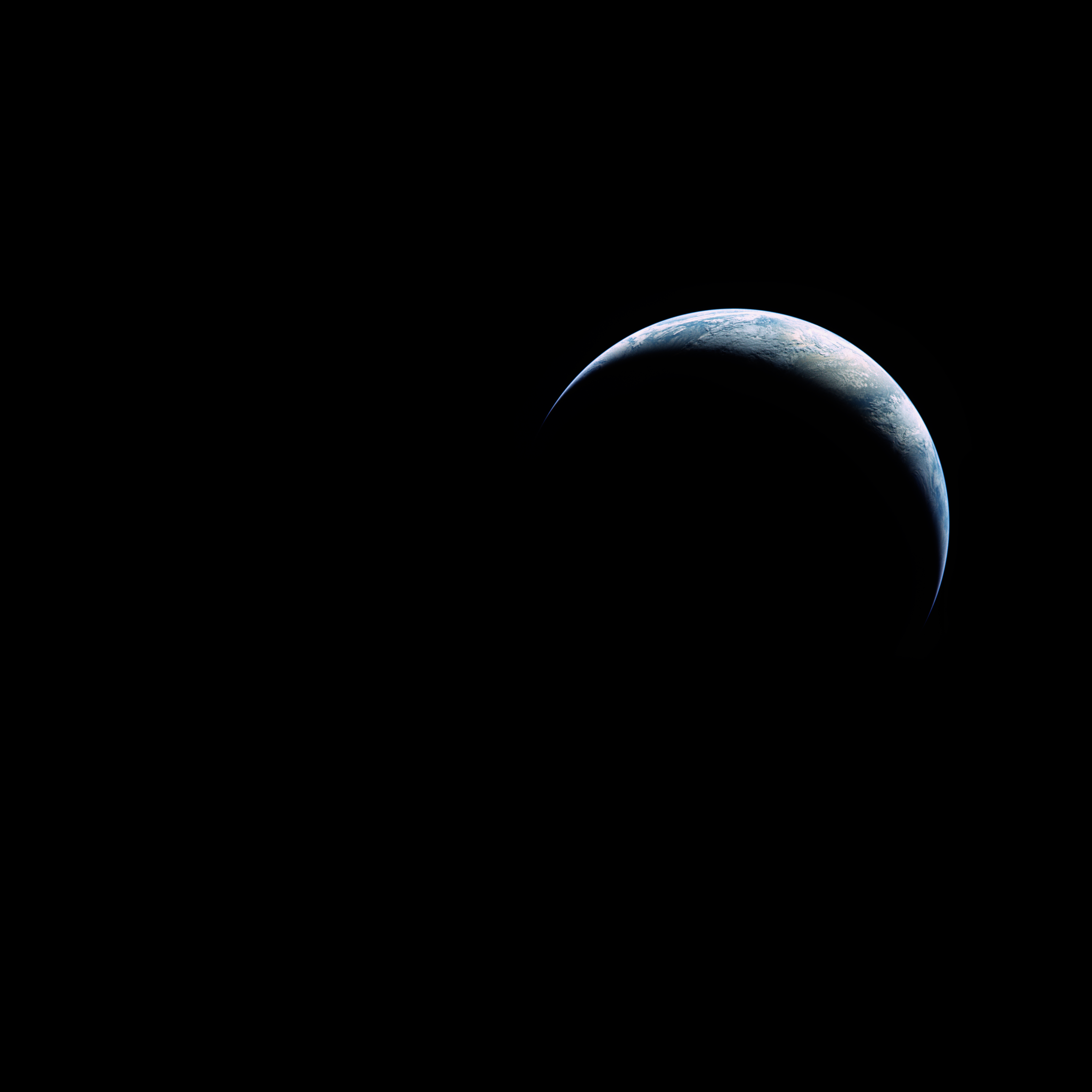
Explanation: Our fair planet sports a curved, sunlit crescent against the black backdrop of space in this stunning photograph. From the unfamiliar perspective, the Earth is small and, like a telescopic image of a distant planet, the entire horizon is completely within the field of view. Enjoyed by crews on board the International Space Station, only much closer views of the planet are possible from low Earth orbit. Orbiting the planet once every 90 minutes, a spectacle of clouds, oceans, and continents scrolls beneath them with the partial arc of the planet's edge in the distance. But this digitally restored image presents a view so far only achieved by 24 humans, Apollo astronauts who traveled to the Moon and back again between 1968 and 1972. The original photograph, AS17-152-23420, was taken by the homeward bound crew of Apollo 17, on December 17, 1972. For now it is the last picture of Earth from this planetary perspective taken by human hands.
For more detail go to the link and click on the image for a high definition image. You can then move the magnifying glass cursor then click to zoom in and click again to zoom out. When zoomed in you can scan by moving the side bars on the bottom and right side of the image.
24?
As I recall, there were six missions to the moon; and while a total of twelve walked on the moon, six more stayed
in lunar orbit aboard the command ship, “minding the store,” for the return trip — so would not the total number who could have seen this view been eighteen?
let me amend that — six landings, and one loop-around.
So, maybe 21 is a better number?
Well Apollos 8, 10 and 13 looped the moon without landing. At least one of those, Lovell, was on two trips: 8 and 13. I’m guessing 26.
Maybe two others went twice for 24.
Young and Cernan were on 10 and then went again later, and got to land their 2nd times. Total: 24.
When you contemplate it for a moment, a stupendous picture.
Proof that the Earth is hollow. You can see stars through it.
Wait no. That’s dirt on my screen.
Close call Earth. Close call.
There is no way that thin spaceship went through the radiation belt.
When I expand the image, what am I looking at? Are the white areas clouds? Do we know what part of our planet I’m looking at? And do I see any land, or is it all ocean?
The orbit the Apollo missions took went through the thinnest portion of the Van Allen Radiation Belts and the type of radiation can be blocked be thin metal shielding. The orbit avoided the really strong radiation that the Moon Landing Hoax proponents love to cite in the Dunning-Kruger certainty they are in their ignorance the smartest people in the room.
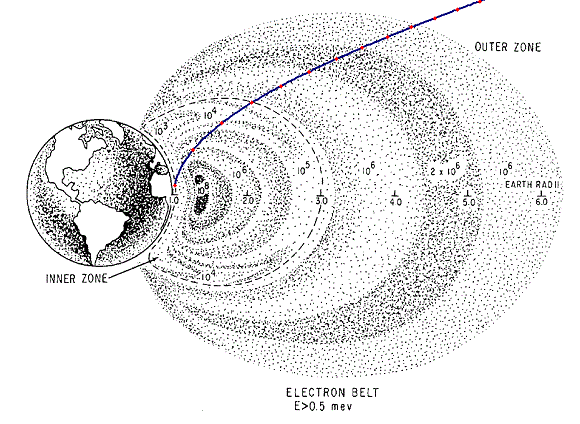
As it was, the Astronauts spent 3 hours traversing through the Van Allen Belts, but most of the radiation is free flowing electrons, that once the lunar space ship received an electric charge, that charge acted as a shield, and more were repelled away and around the craft. When the lunar lander take-off module re-docked with the command module, a length of conductor was the first thing that made contact between the two before docking to re-equalize charges.
It’s estimated the Apollo crews received the equivalent approximately 75 whole body X-ray exposures during their trips, with those who landed on the moon getting slightly more than the Astronauts who remained in orbit in the Command Module. Another estimate said that Astronauts walking on moonwalks received about 3 to 5 times the radiation equivalent per hour of passengers flying at 35,000 feet cross country in six hours.
An out of left field, counter-intuitive, proof the Moon expeditions occurred comes from a study of the long term health consequences to the men who made these perilous trips. Comparing Astronauts in NASAs space program with long term coronary problems later in life, among those who never flew to space, 9% developed coronary problems; among those who flew to low Earth orbit, below the Van Allen belts, 11% developed coronary problems. Among those who went to or around the moon, an astonishing 43% developed coronary problems. It is a strange proof, but proof nonetheless.
I think you’re right. 100%
I don't know. NASA generates the description and they did not say.
Disclaimer: Opinions posted on Free Republic are those of the individual posters and do not necessarily represent the opinion of Free Republic or its management. All materials posted herein are protected by copyright law and the exemption for fair use of copyrighted works.