Posted on 05/11/2023 6:03:11 AM PDT by Red Badger
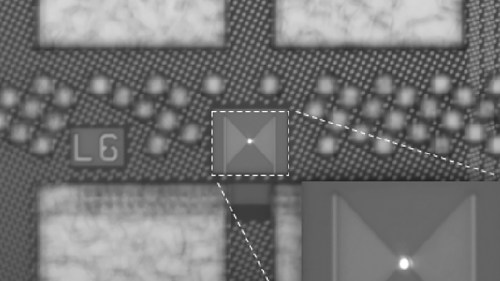
a closeup of a tiny LED in the middle of a microchip - Credit: Singapore-MIT Alliance for Research and Technology (SMART)
Scientists at MIT’s Singapore-based research center have built the world’s smallest LED — and then used it to create the world’s smallest holographic microscope, a breakthrough that foreshadows a future in which smartphones could do high-res microscopy.
Chips of light: In most of our devices, currents of electrons travel across microchips, where tiny features called “transistors” act as on/off switches controlling their flow — but electronic microchips aren’t the only kind.
There are also photonic microchips, which manipulate the flow of tiny particles of light. Those chips have several advantages over electronic ones, including faster data transmission, less heat generation, and a smaller size.
Holographic microscopes are cheaper, more compact, and more portable than optical microscopes.
One thing holding photonic microchips back has been the need for the light source to usually come from off the chip, which reduces the chips’ efficiency and limits their scalability.
To solve this issue, researchers at the Singapore-MIT Alliance for Research and Technology (SMART) developed the world’s smallest light emitting diode (LED) — less than a millimeter wide.
In February 2023, they reported that they’d integrated their tiny LED into a microchip alongside other photonic and electronic components. Now, they’ve demonstrated another application of the LED, creating the world’s smallest holographic microscope.
How it works: Lensless holographic microscopes work differently than optical microscopes, the kind you likely experimented with in science class.
While optical microscopes have lenses that bend light to magnify whatever is being studied, the holographic kind illuminate objects in a way that produces measurements a computer algorithm can use to construct a high-res, three-dimensional image.
SMART’s holographic microscope has a resolution of 20 microns — about one-fifth the diameter of a strand of hair.
A holographic microscope’s primary components are a light source, a microchip, and an image sensor, while an optical microscope requires light, lenses, and mirrors. This allows holographic microscopes to be cheaper and more compact, as well as more portable.
To create the world’s smallest holographic microscope, the SMART team not only integrated their LED into the microchip, but also developed a novel algorithm to improve its resolution to 20 microns — about one-fifth the diameter of a strand of hair.
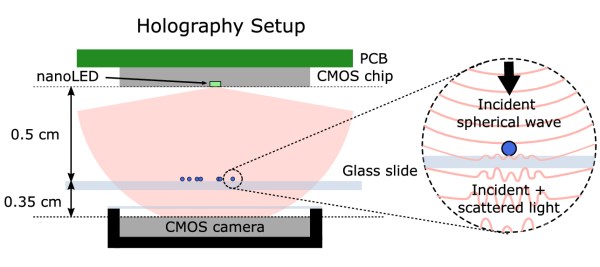
A diagram of the holographic microscope’s components. Credit: Singapore-MIT Alliance for Research and Technology (SMART)
Looking ahead:
The researchers say their tech is small enough that it could be used to turn smartphone cameras into holographic microscopes simply by modifying their chips and software.
These kinds of handheld microscopes could have countless uses. Healthcare workers could study human tissues with them, for example, while farmers could whip out their smartphones to study the cells of their plants on the spot.
Meanwhile, SMART’s tiny LEDs could have even more uses beyond microscopy, both in photonic microchips and perhaps in light-controlled medical implants, which have been used to control hunger, relieve pain, and more in animal studies.
“Our breakthrough represents a proof of concept that could be hugely impactful for numerous applications requiring the use of micro-LEDs,” said lead author Iksung Kang.

Coming soon to an iPhone near you!......................
Tricorder coming.
Expect to see alot of microscopic selfie zit picks on Tik Tok...
Wow! Just the other day I was looking at my phone muttering to myself: “Man, I wish this was a microscope.”
tiny features called “transistors” act as on/off switches...
~~~~~~~~~~~~~~~
...said Dr. Evil while doing air quotes around “transistors”...
Yeah, at what cost…$$$$$
Apple-ophiles don’t care!
They have to have it!........................FIRST DAY!................
LOL!
I still have my iPhone 11 Pro, I was gonna get the 14, but I sprung for new hearing aids instead.
“Man, I wish this was a microscope.”
Back in 1959, when I was using our black, corded desk AT&T telephone, I thought to myself “Man, I wish I could fit this phone in my pocket and cut the cord. And wouldn’t it be great if I could send text messages? And get travel maps. And do my banking. And listen to music. And watch any tv show I ever wanted at any time. And chat with friends on FR.”
Why Singapore and not Baltimore or St. Louis?
Are you a veteran?................
They didn’t want to get shot.....................
No, I wish I was, then they would’ve been free. Making monthly payments.
Not the super expensive ones-
https://www.lexiehearing.com/us/
Disclaimer: Opinions posted on Free Republic are those of the individual posters and do not necessarily represent the opinion of Free Republic or its management. All materials posted herein are protected by copyright law and the exemption for fair use of copyrighted works.