Posted on 04/29/2023 12:22:35 PM PDT by MtnClimber
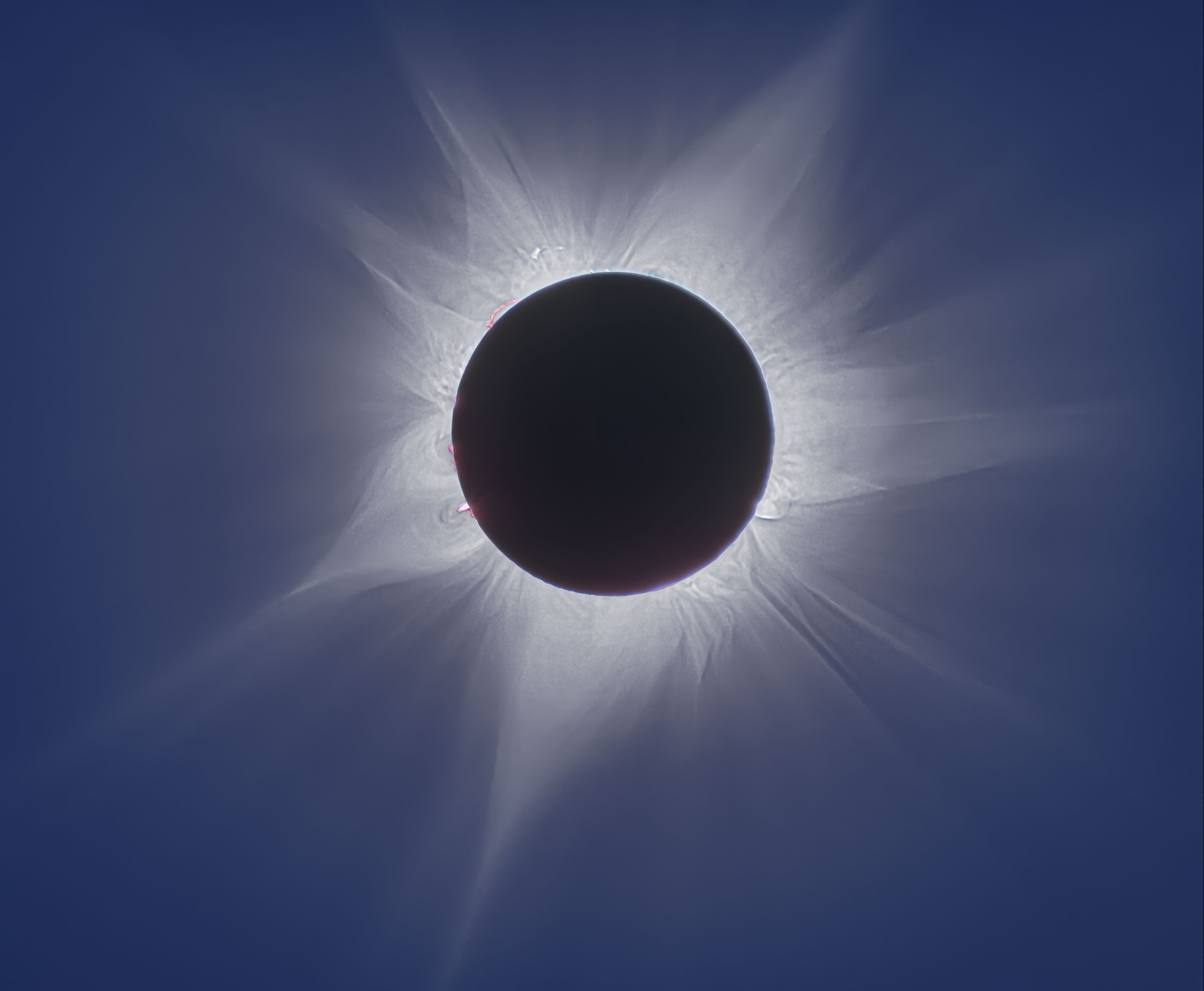
Explanation: Along a narrow path that mostly avoided landfall, the shadow of the New Moon raced across planet Earth's southern hemisphere on April 20 to create a rare annular-total or hybrid solar eclipse. From the Indian Ocean off the coast of western Australia, ship-borne eclipse chasers were able to witness 62 seconds of totality though while anchored near the centerline of the total eclipse track. This ship-borne image of the eclipse captures the active Sun's magnificent outer atmosphere or solar corona streaming into space. A composite of 11 exposures ranging from 1/2000 to 1/2 second, it records an extended range of brightness to follow details of the corona not quite visible to the eye during the total eclipse phase. Of course eclipses tend to come in pairs. On May 5, the next Full Moon will just miss the dark inner part of Earth's shadow in a penumbral lunar eclipse.
For more detail go to the link and click on the image for a high definition image. You can then move the magnifying glass cursor then click to zoom in and click again to zoom out. When zoomed in you can scan by moving the side bars on the bottom and right side of the image.
Wow Amazing
Thanks for posting.
650 million tons per second of exploding hydrogen nuclei playing games with the moon. I saw the 2017 total solar eclipse from my hometown of Salem Or. I spent the majority of it trying to focus my camera on it like an idiot when I should have just looked. It’s not my worse lost opportunity though, since it only lasted a few seconds.
I don’t get the 650 million tons per second. About 4.26 million tons of mass is converted to energy per second on the sun. All the nuclear fusion on the sun takes place in the core, where is it intensely hot, and there is extremely high pressure. It takes about a million years for heat generated in the core to percolate to the surface, where is it “only” about 5700 Kelvin.
The specific heat of the sun, in watts per cubic meter, is about the same as a bale or rotting hay, about a quarter of a watt per cubic meter.
Alright then. I calculated the mass based on the total wattage of the sun, E=MC^2, and that 0.73% of matter is converted to energy in a fusion reaction of H to He4. I got the 0.73% by comparing the atomic mass of the two. I’ve heard estimates ranging from 400 megatons to 600, but that is my own calculation so whatever.
I just googled “how much mass does the sun convert to energy per second”. At the radius of earth’s orbit the radiation density is about 1600 Watts/meter^2. The radius of the earth’s orbit is roughly 150e9 meters, so a sphere of that diameter would have an area A = 4*pi*R^2 = 2.8274e+23 square meters. A x 1600 W/meter square = 4.5239 E 26 Watts. (Google gives 3.846 E 26 W). If I approximate c with 3e8 m/sec, then m = E/c^2 (per second understood) = 5.0265e+09 kg ~ 5 million metric tons. Google gives 4.26 million. Close enough.
That is mass to energy. I was referring to Hydrogen converted to helium, and only 0.73% of that is converted to energy.
Must be a pretty big ship!.........................
Disclaimer: Opinions posted on Free Republic are those of the individual posters and do not necessarily represent the opinion of Free Republic or its management. All materials posted herein are protected by copyright law and the exemption for fair use of copyrighted works.