Posted on 04/04/2023 5:43:20 AM PDT by MtnClimber
Bill Ponton’s new Report, “The Cost of Increasing Wind Power: A Reality Check,” contains a short but pithy section addressing the question of energy storage. Here’s the question to be addressed: If after the first round of overbuilding, adding new wind generation resources adds little useful energy and most of the added generation ends up getting “curtailed,” then why not just add some batteries or other energy storage to the system? Wind energy advocates suggest that some form of batteries can store the excess electricity production until it is needed, and everything will then just balance out in perfect equilibrium.
Is there any problem here? Ponton does the simple calculations with his UK 2022 spreadsheet to derive how much storage in GWh will be needed, and what its functional characteristics must be. His results are very similar to the results of comparable exercises previously undertaken by Roger Andrews for California and Germany, and Ken Gregory for the U.S.
The main problem identified by Ponton is the same one previously identified by Andrews and Gregory. Before you even get to the very high cost of storing electricity, there is another huge hurdle, which is that the availability of wind to generate electricity varies with a seasonal pattern. Therefore, to match electricity supplied to electricity demanded, the storage balance must be built up over about a six month period to an enormous level, and then discharged over the following six month period.
Ponton considers the case of a tripling of UK wind generation rated capacity, from the current 28 GW to 84 GW. Average usage is about 35 GW, and peak usage is about 45 GW; so the 84 GW of rated wind capacity provides plenty of spare electricity to charge the batteries when the wind is blowing at full strength, or even close to that.
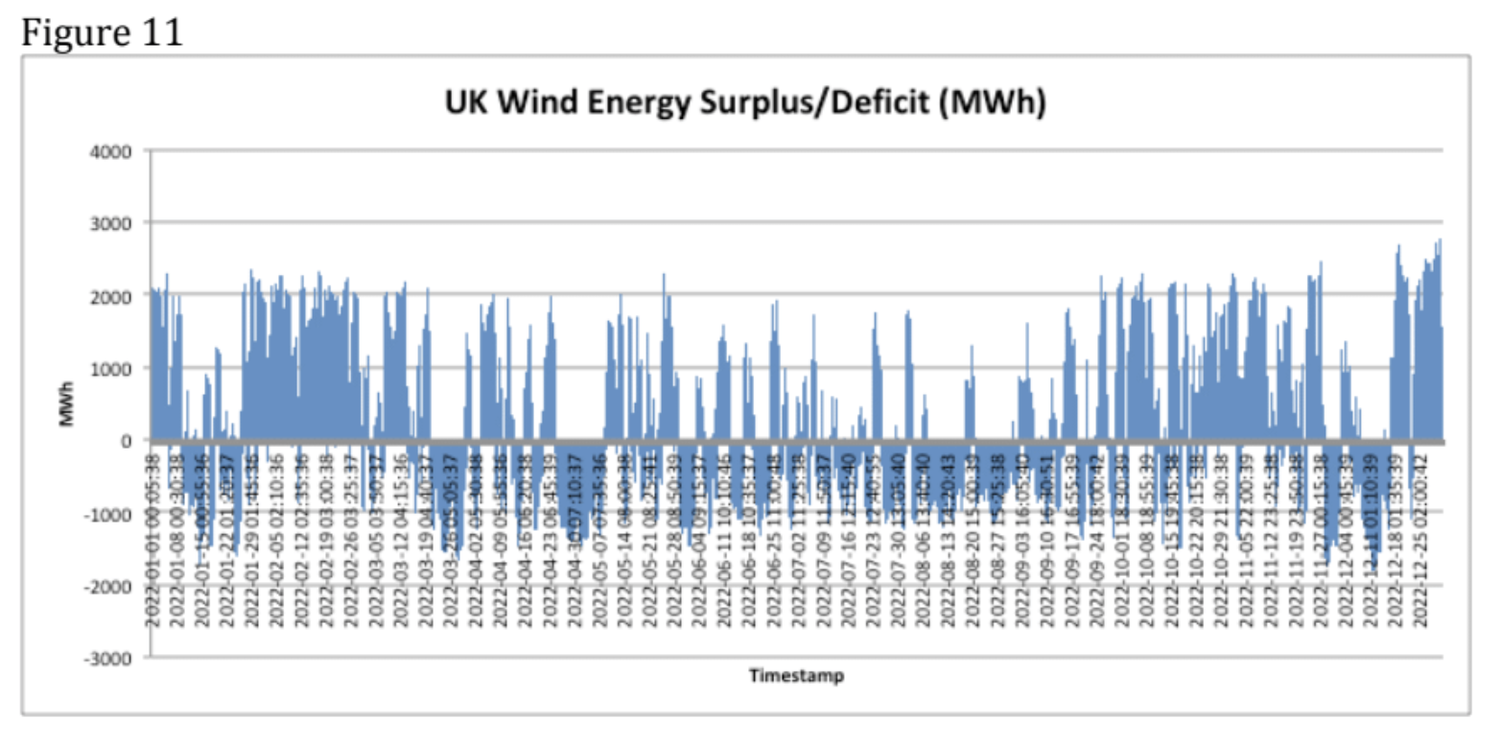
Ponton next assumes purchase of 12,000 GWh of battery storage capacity. With that in place, here is his chart of additions and withdrawals from storage based on the UK 2022 data:
You can immediately see that the wind is much stronger and more consistent in the Spring and Fall than in the Summer. Then, here is the chart of the storage balance, assuming you initialized the system with zero storage at January 1, 2022:
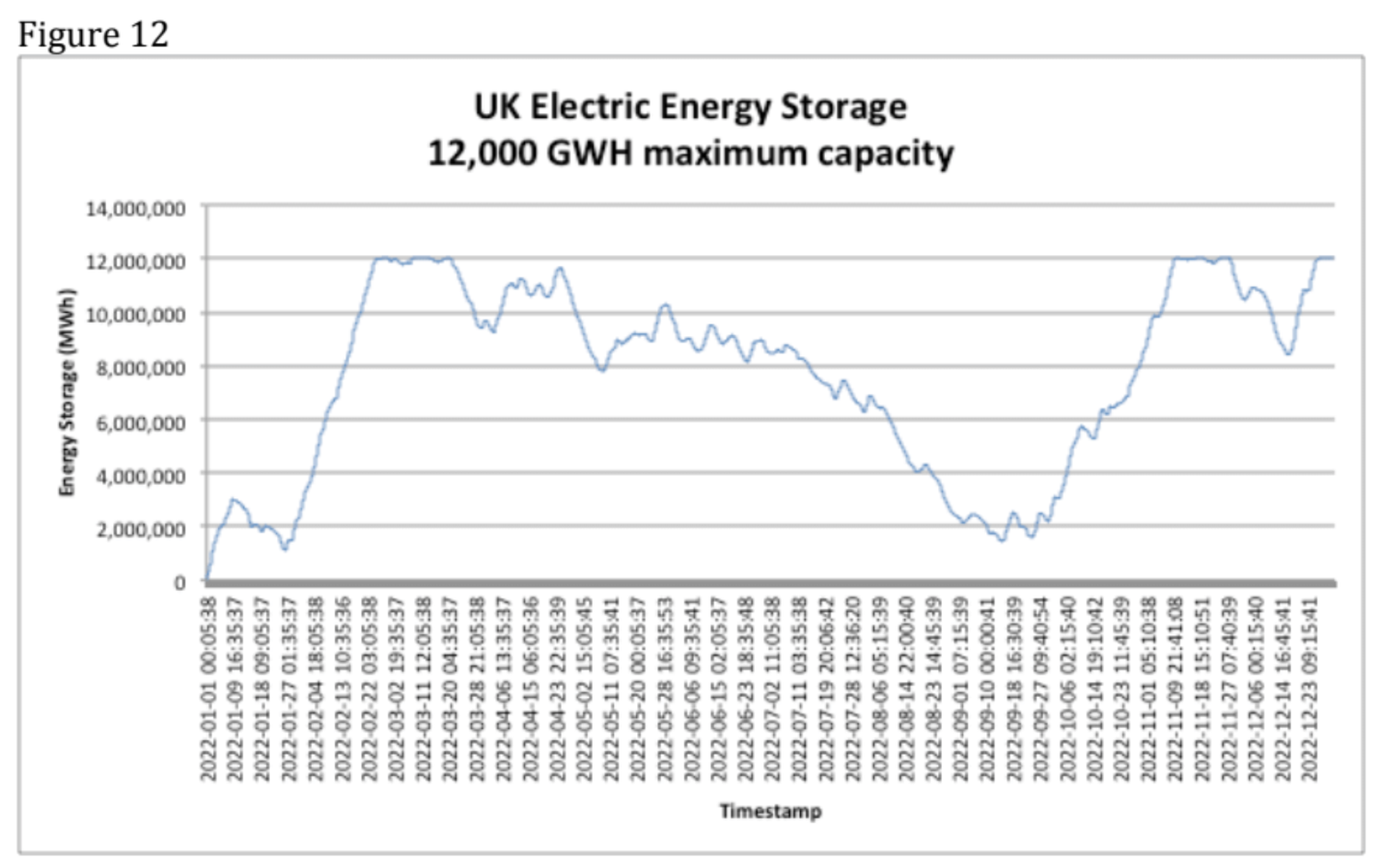
The batteries build up to the 12,000 GWh maximum by about March, then discharge through September, and then begin building the storage balance back up starting in October. On the particular weather pattern of 2022, the 12,000 GWh of storage capacity was sufficient to get through the year, with the minimum stored amount in September being more than 1,000 GWh.
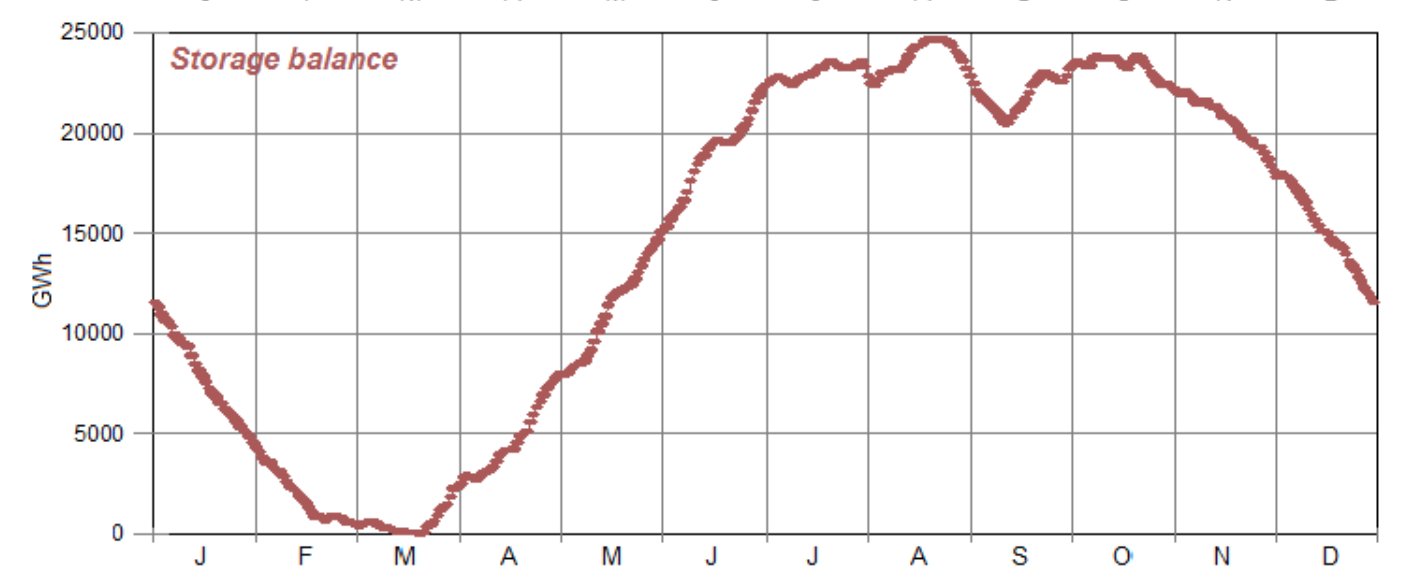
For readers who don’t recall the previous results from Andrews and Gregory, here is Andrews’s comparable chart for California based on 2017 data:
And here is Gregory’s chart for the U.S. with two different lines representing 2019 and 2020 data, both again showing the characteristic seasonal pattern:
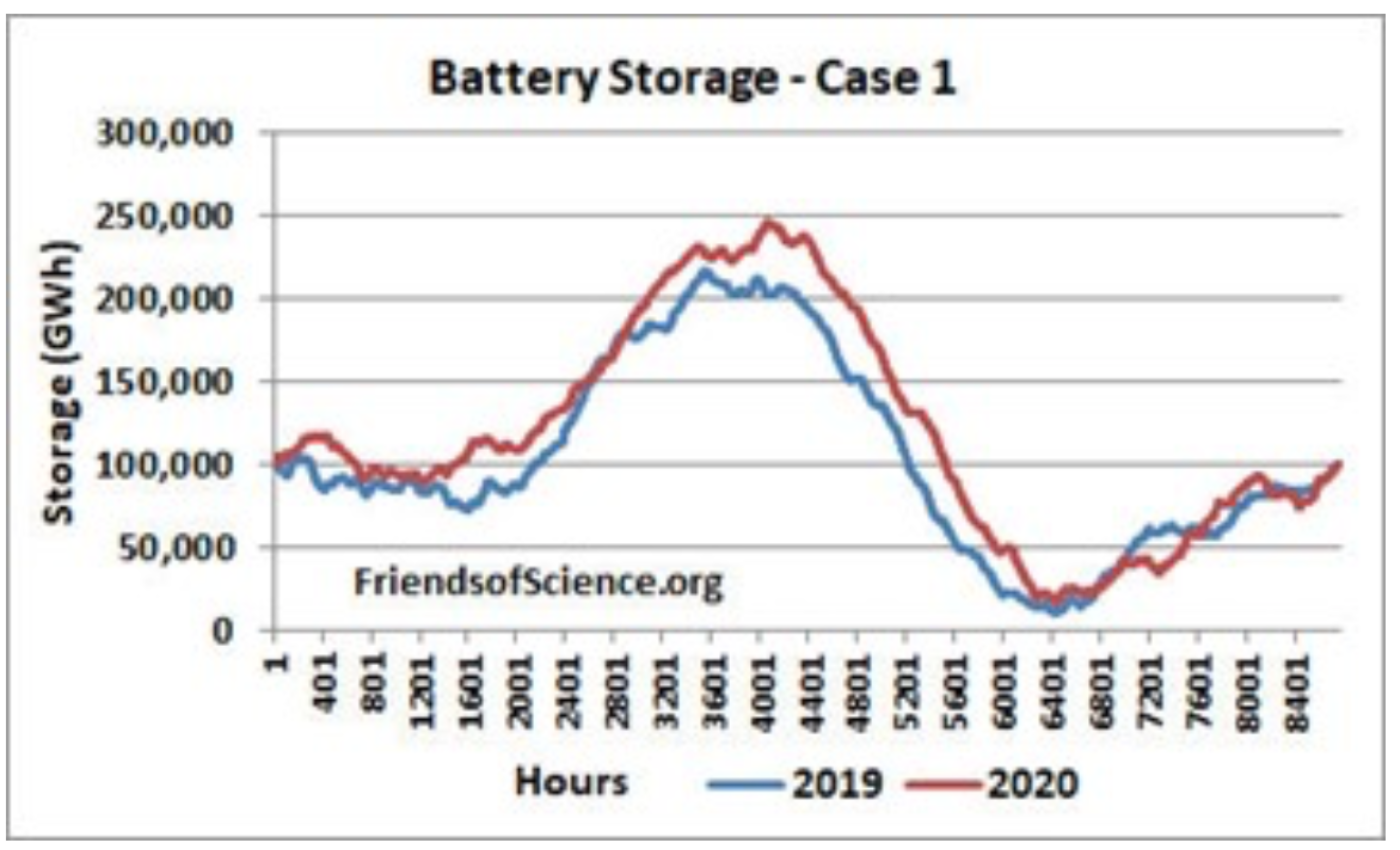
All these results clearly illustrate the problem that the energy storage to accomplish the task of using the excess production from wind must have both very large capacity and the ability to charge and discharge in one grand annual cycle. Ponton’s comment:
Batteries do not exist that are up to the task of such long-term energy storage.
Pumped water storage does at least theoretically have the ability to charge and discharge to meet this criterion of an annual cycle, but it also has the problems of enormous cost and, even more important, complete lack of sufficient suitable sites. Ponton:
If there were sites in the UK for pumped storage, it would cost $2 trillion. The UK would have to construct 500 pumped storage facilities with 24,000 MWh capacity [each]. Each would be comparable in size to the largest facility in existence at Bath, VA, which cost $4 billion to construct.
My own comment: Ponton’s illustration of 12,000 GWh of storage needed to get through the year represents about 14-15 days of average usage in the UK. That figure is quite low compared to the amounts of storage found by Andrews and Gregory to be needed for California and the for entire U.S., which are in the range of 25-30 days of average usage. I think the difference is explained by the following things:
- Andrews and Gregory assumed a renewables mix of wind and solar facilities in similar proportion to what exists currently in California and in the entire U.S., respectively. Ponton assumes only wind as the renewable addition. This makes a substantial difference because solar generation is much more seasonal even than wind, and operates at a much lower average annual capacity factor. (Note that both California and the full U.S. have substantial solar in the mix. Since solar is strongest in the summer, the peak of the annual charge/discharge cycle in the Andrews and Gregory spreadsheets is later in the year than in the Ponton spreadsheet. But the annual cyclical pattern is basically the same.)
- Ponton assumes that the “other” category of generation currently existing in the UK remains in place. This “other” category consists of a mix of things like coal, nuclear, hydro and biomass, most or all of which may well be on the environmentalists’ chopping block. As shown on Ponton’s charts, the “other “ category operates at a quite steady 10 or so MW, covering almost a third of the UK’s average usage like a “baseload” generator. The continued existence of this “other” category substantially reduces the annual seasonality of production over what would be the case of wind was expected to take over all power generation.
- Ponton has no assumptions for losses in storage, such as the loss from every charge/discharge cycle, or the dissipation loss from having energy stored in a battery for months on end. Since the costs he comes to are already ridiculous before adding these additional elements, he can be forgiven for not continuing to beat the dead horse.
Ponton does not compute prices for 12,000 GWh of storage using lithium ion batteries, which is reasonable since those batteries are not up to the job of storing energy for 6 months to a year without catastrophic loss. But just to give an idea, at $250 per kWh (lower than current prices for grid-scale storage), 12,000 GWh would run about $3 trillion — approximately equal to the entire annual GDP of the UK. If you start trying to shift the coal and nuclear production in the UK to wind, and if you then consider major losses from trying to store power for up to a year before use, you can multiply that $3 trillion by a factor of 2 or 3 or maybe 4. Whatever.
As stated many times at this site, this will never happen. The only question is how disastrous the crash will be when it all falls apart.
Again, many thanks to Bill Ponton for putting in the work to demonstrate these issues, all without compensation.
I think rationing has always been the goal.
Some guy came to our door wearing shabby clothing driving an old Suburban trying to sell us on solar. I humored him for a couple minutes and asked him about how long his panels last. He said in the first ten years they drop to 85% efficiency then hold at 85% for the rest of their lifespan of 25 years.
I told him that made absolutely no sense since everything breaks down over time. He told me it was guaranteed. Uh huh.
Then he told us the whopper that the battery holds two weeks of charge.
That type of battery doesn’t exist. It might hold a charge for two weeks as long as you don’t turn on your bathroom light.
Solar salesmen are outright liars.
Pumped water storage does at least theoretically have the ability to charge and discharge to meet this criterion of an annual cycle, but it also has the problems of enormous cost and, even more important, complete lack of sufficient suitable sites. Ponton: If there were sites in the UK for pumped storage, it would cost $2 trillion. The UK would have to construct 500 pumped storage facilities with 24,000 MWh capacity [each]. Each would be comparable in size to the largest facility in existence at Bath, VA, which cost $4 billion to construct.
The reason the Al Gore's, John Kerry's and AOC's of the world can demand the impossible is because they can't do simple math.
i agree....they will control the meters
I hope the end-of-the-world energy stories this past winter in Europe will affect the public’s perception of energy dependability and show in their voting.
Nuclear seems to be gaining respect, for instance, even here in America.
I say store it all in glass jars and hope there isn’t an earthquake.
I love nuclear from a physical science perspective, but hate it from a political science perspective. In other words, it's too easy for the Dims to later regulate away because "nuclear is dangerous, doncha know". If I had my way we'd quit trying to satisfy their ever changing definition of what's clean energy is.
For example, am I the only one who remembers the Dims less than 7 years ago demanding we all switch to "clean burning" natural gas? Now they talk like natural gas is killing us faster than red dye #2. If they can change their minds (and regulations) that quickly over natural gas they can do it with nuclear.
So we should quit seeing nuclear as something they'll be happy with and instead demand that dependable energy be made in the cheapest way possible regardless of Dim hissy fits.
The perfect is nice but right now getting nuclear into place is a good thing for our energy needs.
Coal, oil, gas, nuclear, water all store power conveniently.
Wind and solar do not. If there is no wind and it is cloudy or a different season or night time you have zero to very limited power. Batteries are very limited in storage and very expensive.
Disclaimer: Opinions posted on Free Republic are those of the individual posters and do not necessarily represent the opinion of Free Republic or its management. All materials posted herein are protected by copyright law and the exemption for fair use of copyrighted works.