
Posted on 01/09/2023 5:02:20 AM PST by MtnClimber
Supposedly, we are rapidly on our way toward a zero-carbon, all electric energy future. But has anybody done the arithmetic to see if this adds up?
I’m carving myself out a niche as the guy who does a few simple calculations to check if the grand schemes of our central planners make any sense. So far I’ve taken that approach to the question of energy storage to back up a wind/solar electricity grid, and on that one the schemes of the central planners most definitely do not add up. But the energy storage question, although involving no math beyond basic arithmetic, does have some complexities. How about something somewhat simpler, like: If we convert our entire automobile fleet to all-electric cars, where is the electricity going to come from?
With the big push currently on to get rid of internal combustion vehicles and replace them with electrics, surely someone has done the calculations to be sure that the electricity supply will be ample. Actually, that does not appear to be the case. Once again, the central planners have no idea what they are doing.
A few things in the recent news make this issue highly topical. First, in the days just before Christmas, much of the country experienced a severe cold snap. Severe, that is, but not record-breaking. Almost everywhere that had very cold temperatures during those days had had even colder temperatures in the past, not necessarily every year, but multiple times over the course of decades. Second, several utilities found themselves with insufficient electricity to meet demand, and had to impose rolling blackouts on their customers, even in the face of freezing cold temperatures. Examples of utilities imposing rolling blackouts during the severe cold wave included Duke Energy (covering most of North and South Carolina, and parts of Florida, Indiana, Ohio and Kentucky) and TVA (covering all of Tennessee and parts of Alabama, Mississippi and Kentucky). Both of those utilities, and many others, have spent the last decade and more shuttering reliable coal power plants, and building lots of wind turbines and solar panels, along with some (but obviously not enough) natural gas plants, as replacements.
As of today, electric vehicles are a tiny fraction of all vehicles (less than 1% in the U.S., says Reuters as of February 2022), particularly in these Midwestern and Southern states. Yet even with only the tiniest level of electricity demand coming from electric vehicles, already major utilities are short of electricity when a not-out-of-the-ordinary cold snap hits.
And now, where are things headed in the near future? The Wall Street Journal had a big piece with a January 1 date (it appeared in the print edition on January 3) about the coming rush of electric vehicles, headline “Shift to EVs Triggers Biggest Auto-Factory Building Boom in Decades.” The gist is that the industry is gearing up to build factories at a breakneck pace for the imminent supply of electric cars for all. Excerpt:
The U.S. auto industry is entering one of its biggest factory-building booms in years, a surge of spending largely driven by the shift to electric vehicles and new federal subsidies aimed at boosting U.S. battery manufacturing. Through November, about $33 billion in new auto-factory investment has been pledged in the U.S., including money for the construction of new assembly plants and battery-making facilities, according to the Center for Automotive Research, a nonprofit organization based in Michigan. . . . The capital outlays amount to a collective bet by the car industry that buyers will embrace battery-powered models in numbers large enough to support these investments. The global auto industry plans to spend a collective $526 billion on electric vehicles through 2026, according to consulting firm AlixPartners.
Whew! It’s the total transformation of the industry, from internal combustion engines to battery-electric. And if you look at the websites of the manufacturers themselves, they are almost all saying that they are committed to the rapid conversion to electric vehicles, with all internal-combustion manufacturing banished by some early date. Here is GM on its “path to an all-electric future” (by 2035); and here is Ford’s claim that it will “lead America’s shift to electric vehicles” (50% by 2030!). Numerous other manufacturers are making comparable claims.
OK, then, how much electricity is this going to take? I’ll start with this handy (if somewhat complicated) chart from the U.S. Energy Information Administration showing production (by source) and use (by sector) of all energy in the U.S. for the year 2021 (I do not find a chart for 2022 available as of yet.):
Here are a few key number from this chart:
- The total amount of energy consumed in the U.S. in 2021 is given as 73.5 quadrillion Btus.
- Of the 73.5 quadrillion Btus consumed, only 12.9 quadrillion Btus was in the form of electricity. That’s only 17.6% of total energy consumption.
- Almost all of the electricity was consumed in the household, commercial and industrial sectors, and almost none (less than 1%) in the transportation sector.
- The transportation sector consumed 26.9 quadrillion Btus of energy. That’s 37% of total energy consumption — and more than double the entire amount of electricity consumed in all sectors.
OK, but the transportation sector is a lot more than just automobiles. It also includes everything from airplanes to freight trains to ocean shipping. What part of that 26.9 quadrillion Btus of energy in the transportation sector consisted of automobiles and light trucks (like SUVs and pick-ups) which are the things that are supposedly about to get electrified? Looking around, I find something called the Transportation Energy Data Book, put out by the Oak Ridge National Laboratory — another part (like the EIA) of the U.S. Department of Energy. Here are two key facts from the introductory “Quick Facts” section: (1) “Petroleum comprised 90% of U.S. transportation energy use in 2020,” and (2) “Cars and light trucks accounted for 62% of U.S. transportation petroleum use in 2018.”
Assuming that those percentages held approximately true for 2021, then cars and light trucks consumed approximately some 26.9 x 0.9 x 0.62 = 15.0 quadrillion Btus in the form of gasoline or diesel in 2021 — well more than the entire amount of energy consumed in the country in that year in the form of electricity.
So have we now shown that converting all cars and light trucks to electric would require more than doubling the size of our electricity generation system? Unfortunately, it’s not quite that simple. There are a few other factors that need to be taken into account. Unfortunately, these additional factors are not subject to a great deal of precision, and can only be fairly rough approximations:
- Electric vehicles have about 85-90% efficiency in translating the stored energy in the battery into movement of the vehicle. That compares to only about 15-25% efficiency of ICE vehicles. That is a large difference.
- However, two other factors offset that advantage. One is that the batteries of electric vehicles experience an approximate 15% loss of charge in the turnaround between charge and discharge. The other is that the process of producing electricity in a power plant is in the range of 35-50% efficient, depending on the type of power plant. Some of the latest power plants even claim upwards of 50% efficiency, but note that the EIA chart above shows that the overall efficiency of electricity production in the U.S. is 35% (which also includes losses in transmission).
Put these factors together, and here is the calculation:
For an internal combustion vehicle, if you start with 10 Btus of energy in gasoline, you get about 2 Btus of motion from your car.
For an electric vehicle, if you start with the same 10 Btus of fuel, you get 10 x 0.35 = 3.5 Btus of usable electricity, 3.5 x 0.85 = 3.0 Btus of electricity in your battery after charging losses, and 3.0 x 0.87 = 2.6 Btus of motion from your car.
So overall, and remembering that this is approximate, an all-electric car and light truck fleet can run on about three-quarters (2 divided by 2.6) the number of Btus of energy input as can a comparable internal combustion-powered fleet. Instead of the 15 quadrillion Btus annually that we use for our current ICE vehicles, we could theoretically get it down to 11.25 quadrillion Btus, which would produce 11.25 x .35 = 3.93 quadrillion Btus of electricity to run the vehicles.
Recall that the current amount of electricity produced annually in the U.S., from the chart above, is 12.9 quadrillion Btus. So the additional 3.93 quadrillion Btus of electricity would represent approximately a 30.5% addition to the current capacity of our electricity generation system.
Are there any plans afoot for anything like that? Here’s another chart from EIA showing their projections of growth in U.S. electricity generation capacity out to 2050, from their 2022 Annual Energy Outlook:
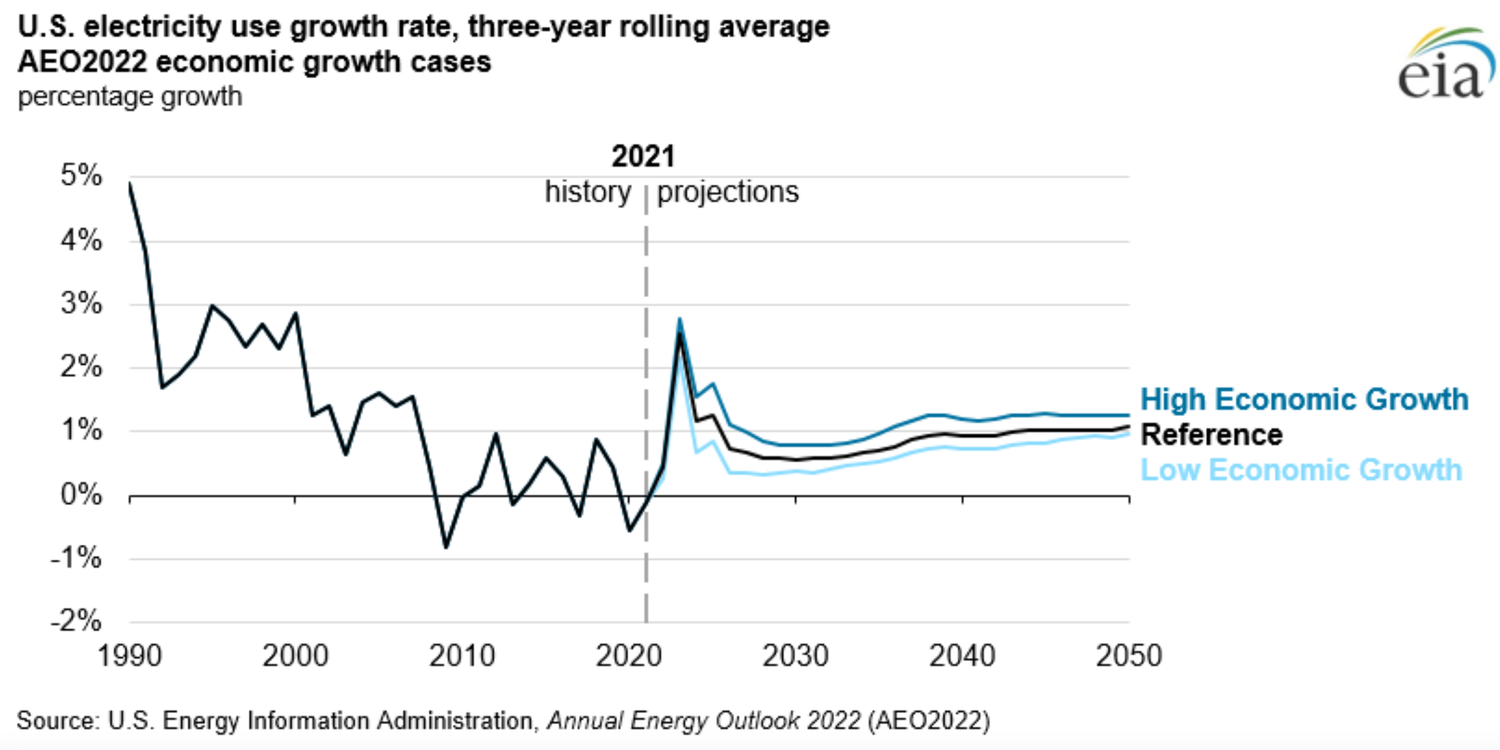
Basically, after the current rebound from the 2020-21 Covid-induced decline, they project 1% annual increase in consumption as far as the eye can see. The “high economic growth” and “low economic growth” scenarios do not differ meaningfully from the median “reference” case. This growth includes growing demand for everything, including from growing population and every sort of new electric gizmo that might be invented over the period. And note that this projection, at least for the earlier years, is largely based on the plans of utilities to add capacity — or not. And to the extent anyone is adding capacity, it is likely to be wind and solar, which will be completely useless for charging these vehicles on calm nights and lots of other times.
So where is the surge in generation capacity to support a 30% or so additional need for electricity to electrify all cars? It sure doesn’t look to me like it is there. Could it be that nobody really believes that this conversion to electric cars is actually going to occur? That would be my take.
“EVs will not replace gas cars - most will be on public transportation which is the real goal”
Nailed it. Hopefully, the counter revolution will succeed before then and each and every leftist will be worm bait.
The future is "no vehicles", that's how it adds up. Plenty of gasoline for the elites' armored vehicles - no electricity for your golf cart.
I think they are counting on having total government control by then, perhaps in a dictatorship, and having herded the population into big cities, and controlling purchases with a new digital currency. Only the ultra rich elite will be able to afford an EV, or have access to electricity.
They already have a plan to make up for this difference. They are going to lower global population by 50% in the next five years.
Lots of engineers have done the math and know well this whole EV thing won’t work and is insanity. It will hit its brick wall eventually to where its unreality cannot be denied.
Another huge Marxist deception......
And I could have had a V8. Oh, wait...I have two. I have a 5.0L V8 in my truck and a 6.2L Supercharged V8 in my car.
Legislation needs to be advanced that in order to be certified “green” and qualified for any future tax incentives, an EV owner must use ONLY certified NON-fossil electricity through their lifetime ownership. The impact of this evolution needs to be realized by its adopters.
Hydrogen power cells
The research will have to take place since it is not currently commercially viable.
The good thing we keep discovering more petroleum.
I just watched a YouTube video about Namibia.
12 Billion barrels.
The good thing is that it is in an African country that will gladly pump it out of the ground and sell it on the world market. Shell is the main company involved in developing the resource.
This discovery rivals the size of the reserves just to its north in Angola. There is so much oil there OPEC wants them to join their consortium.
Notice the 12% of the energy in the chart comes from renewables. I could not find a breakdown in the article what percentages make up those renewables. I would suspect that HYDRO makes up the largest majority.
I predict these new EV factories will be closed or converted to ICE production vehilces over the next 5 years or so.
Menton’s analysis is great. If anything, he’s too optimistic. Other sources have estimated that a 50% increase in electrical energy would be needed, just for EVs. He didn’t estimate home heating, and several states are already mandating electric heat for new construction.
EV has no future.
It will be interesting to hear your report in the next month or two. You are fully charged, but what will it be like when everyone else is drawing down the grid during the colder months to come? Please take notes for us. Also, watch what is happening in Switzerland. They are having forced rationing of electricity because they cannot keep up with demand. Travel has been severely restricted. So it will be interesting to see how your experience compares with theirs.
I can syphon gas out of my car and use it in my 10K genset. I have done that many times. Same thing. Big deal.
Many car companues will go out of business. What a waste of capital.
Math is racist...
I think people are missing the point. Electric vehicles are a ruse. The real end game is to separate people from private vehicles, slowly and over time.
Bait-and-switch.
They just want to get us out of private vehicles.
The only goal is to “end fossil fuels” because “fossil” fuels provide prosperity to the masses.
“Renewables” are a phantom replacement that will never come to pass.
Disclaimer: Opinions posted on Free Republic are those of the individual posters and do not necessarily represent the opinion of Free Republic or its management. All materials posted herein are protected by copyright law and the exemption for fair use of copyrighted works.