Posted on 01/01/2023 12:31:28 PM PST by MtnClimber
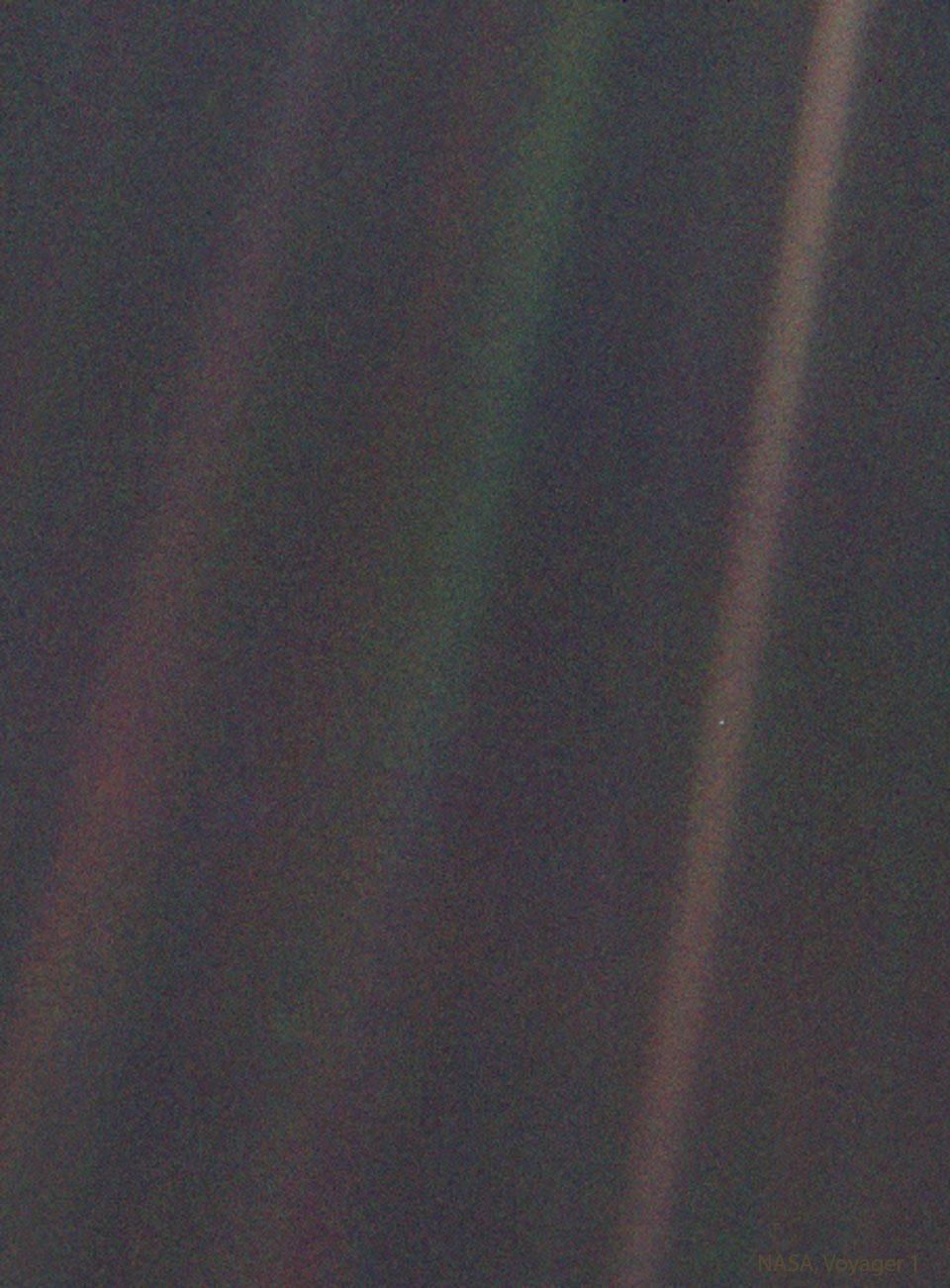
Explanation: There, that dot on the right, that's the largest rock known in our Solar System. It is larger than every known asteroid, moon, and comet nucleus. It is larger than any other local rocky planet. This rock is so large its gravity makes it into a large ball that holds heavy gases near its surface. (It used to be the largest known rock of any type until the recent discoveries of large dense planets orbiting other stars.) The Voyager 1 spacecraft took the featured picture -- famously called Pale Blue Dot -- of this giant space rock in 1990 from the outer Solar System. Today, this rock starts another orbit around its parent star, for roughly the 5 billionth time, spinning over 350 times during each trip. Happy Gregorian Calendar New Year to all inhabitants of this rock we call Earth.
For more detail go to the link and click on the image for a high definition image. You can then move the magnifying glass cursor then click to zoom in and click again to zoom out. When zoomed in you can scan by moving the side bars on the bottom and right side of the image.
Voyager 1 has travelled so far and yet it is miniscule compared to our galaxy and even less compared to the vastness of the known universe.
Look again at that dot. That’s here. That’s home. That’s us. On it everyone you love, everyone you know, everyone you ever heard of, every human being who ever was, lived out their lives. The aggregate of our joy and suffering, thousands of confident religions, ideologies, and economic doctrines, every hunter and forager, every hero and coward, every creator and destroyer of civilization, every king and peasant, every young couple in love, every mother and father, hopeful child, inventor and explorer, every teacher of morals, every corrupt politician, every “superstar,” every “supreme leader,” every saint and sinner in the history of our species lived there—on a mote of dust suspended in a sunbeam.
The Earth is a very small stage in a vast cosmic arena. Think of the rivers of blood spilled by all those generals and emperors so that, in glory and triumph, they could become the momentary masters of a fraction of a dot. Think of the endless cruelties visited by the inhabitants of one corner of this pixel on the scarcely distinguishable inhabitants of some other corner, how frequent their misunderstandings, how eager they are to kill one another, how fervent their hatreds.
Our posturings, our imagined self-importance, the delusion that we have some privileged position in the Universe, are challenged by this point of pale light. Our planet is a lonely speck in the great enveloping cosmic dark. In our obscurity, in all this vastness, there is no hint that help will come from elsewhere to save us from ourselves.
The Earth is the only world known so far to harbor life. There is nowhere else, at least in the near future, to which our species could migrate. Visit, yes. Settle, not yet. Like it or not, for the moment the Earth is where we make our stand.
It has been said that astronomy is a humbling and character-building experience. There is perhaps no better demonstration of the folly of human conceits than this distant image of our tiny world. To me, it underscores our responsibility to deal more kindly with one another, and to preserve and cherish the pale blue dot, the only home we’ve ever known.
— Carl Sagan, Pale Blue Dot, 1994
It’s not 5 billion years old….
Do you have a better number?
The creation story in Genesis 2 is the story of the creation of the salvation plan. It happened in Eden 6000 years ago. The creation story in Genesis 1 covers the the first googleplex of years of the universe with “let there be light” happening about 15 billion years ago. During those 15 billion years the things that required the salvation plan took place. The best radioactive dating we have is that the oldest rocks on the Earth are about 4.5 billion years old.
A rock (mostly silicates) with an iron-nickel ball at the center. Maybe in the very center some lead, uranium, and a Mediterranean Sea of gold.

Third Rock from the Sun.
We are alone...
I’d look for a number that allows carbon-14 to be found in diamonds.
Is there an explanation for the muted color bands in the picture? Probably not just coincidence that the tiny blue/green dot appears to be in one of the bands.
I attended a lecture by Buckminster Fuller once at which
he explained that if you took the typical classroom globe,
the difference between the bottom of the Marianas Trench
and the top of Mt.Everest was the same as the thickness
of the ink.
Earth is really like a very smooth ball bearing floating
in space.
Yes the earth is very smooth in terms of highest mountain and lowest undersea trench, but it’s not nearly as round as a bearing ball. It’s an oblate spheroid, only about 99.66% round in terms of equatorial to polar diameter. Bearing balls are much more precise.
And according to liberals a tiny bit more CO2 is going to destroy that rock.
Disclaimer: Opinions posted on Free Republic are those of the individual posters and do not necessarily represent the opinion of Free Republic or its management. All materials posted herein are protected by copyright law and the exemption for fair use of copyrighted works.