Posted on 11/03/2022 6:42:44 PM PDT by MtnClimber
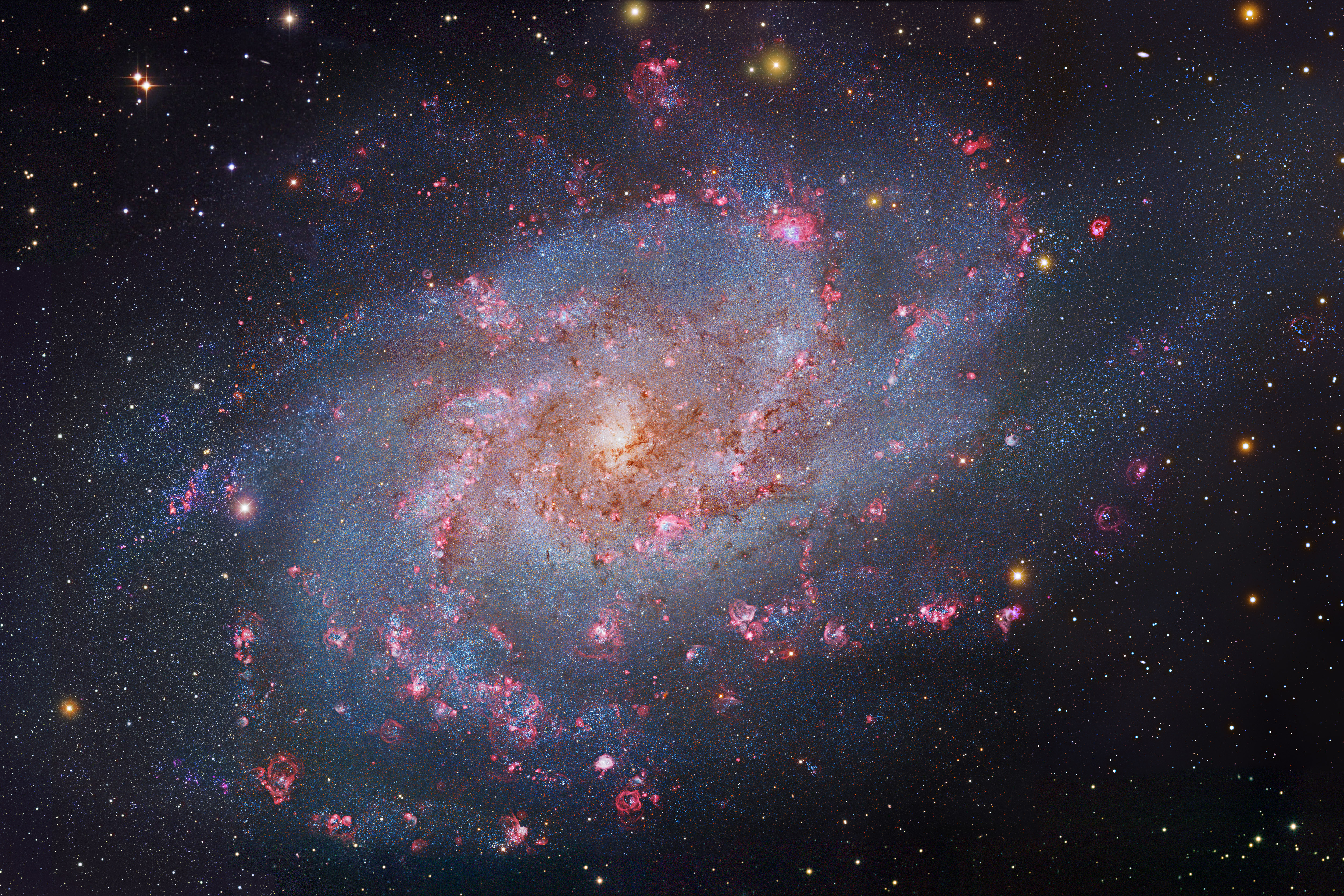
Explanation: The small, northern constellation Triangulum harbors this magnificent face-on spiral galaxy, M33. Its popular names include the Pinwheel Galaxy or just the Triangulum Galaxy. M33 is over 50,000 light-years in diameter, third largest in the Local Group of galaxies after the Andromeda Galaxy (M31), and our own Milky Way. About 3 million light-years from the Milky Way, M33 is itself thought to be a satellite of the Andromeda Galaxy and astronomers in these two galaxies would likely have spectacular views of each other's grand spiral star systems. As for the view from the Milky Way, this sharp image combines data from telescopes on and around planet Earth to show off M33's blue star clusters and pinkish star forming regions along the galaxy's loosely wound spiral arms. In fact, the cavernous NGC 604 is the brightest star forming region, seen here at about the 1 o'clock position from the galaxy center. Like M31, M33's population of well-measured variable stars have helped make this nearby spiral a cosmic yardstick for establishing the distance scale of the Universe.
For more detail go to the link and click on the image for a high definition image. You can then move the magnifying glass cursor then click to zoom in and click again to zoom out. When zoomed in you can scan by moving the side bars on the bottom and right side of the image.
I used to be able to see it at a dark sky site with my 10x50 binoculars, but that was a long time ago. The skies are too bright around here now.😢
There is a really cool rose-like nebula directly below the center of the galaxy. The full size pic has it well.
This is actually the closest galaxy to our Milky way system.
About half way closer than the more known Andromeda galaxy, and pretty close to it on the sky.
It is face on, and spread over quite a large area of the sky, so it is quite hard to see.
Most people just look through it without noticing.
But, if you get great dark sky, it becomes suddenly visible and it is very impressing!
I find galaxies fascinating. I captured this image of Galaxy NGC253 a few days ago. It's also know as the Sculptor Galaxy, Silver Coin, Silver Dollar Galaxy.
Research into NGC 253 indicates a there is a supermassive black hole in the center of this galaxy, with a mass estimated to be 5 million times that of our Sun. From earth, the distance to NGC253 is about 11 million light years.
This was 184 frames at 45 seconds each, all combined into this image below.

Technically the Magellanic Clouds are our nearest galaxies even though I disagree since they orbit our Milky Way and are small in comparison to M32 and M33. They are more satellites to ours than separate entities IMHO but astronomy geeks can argue I suppose.
Sorry meant M31 The Andromeda Galaxy not M32
Thanks. That is a great image!
These pics never seem to change. I realize that telescopic photography is a relatively new science, being only about 150 or so years old, and these objects are far, far away, but it seems like they should change a little bit over the years.............
I just looked it up and for the Earth to make one revolution around the Milky Way it is estimated to take 225-250 million years. So one degree of rotation would take the better part of 700,000 years. I don’t think we will live long enough to see a galaxy make much of a change except for the occasional supernova.
Magellanic clouds as well as maybe two dozens of dwarf galaxies are parts of Milky Way system.
M31 and likely M33 have satellite galaxies too.
Milky Way as well as M31 and M33 are parts of Local group of galaxies, itself on the edge of Virgo supercluster of galaxies.
M31, M33 and Milky way are gravitationally bound and will all collide few billions of years from now!
Just do not tell that to Brandon! He may start making precautions!
Is it safe to say that M31 and M33 are the largest objects we can see with the naked eye? Our own Milky Way might qualify but since we are within it we can never see the whole at the same time.
Sometimes there are changes. It’s why I examine the images/data closely against objects I photographed months or years earlier.
In fact, some people have made discoveries and they don’t own a telescope..They simply go through thousands of images on line and compare them to earlier images.
Disclaimer: Opinions posted on Free Republic are those of the individual posters and do not necessarily represent the opinion of Free Republic or its management. All materials posted herein are protected by copyright law and the exemption for fair use of copyrighted works.