Posted on 09/09/2022 3:45:25 PM PDT by MtnClimber
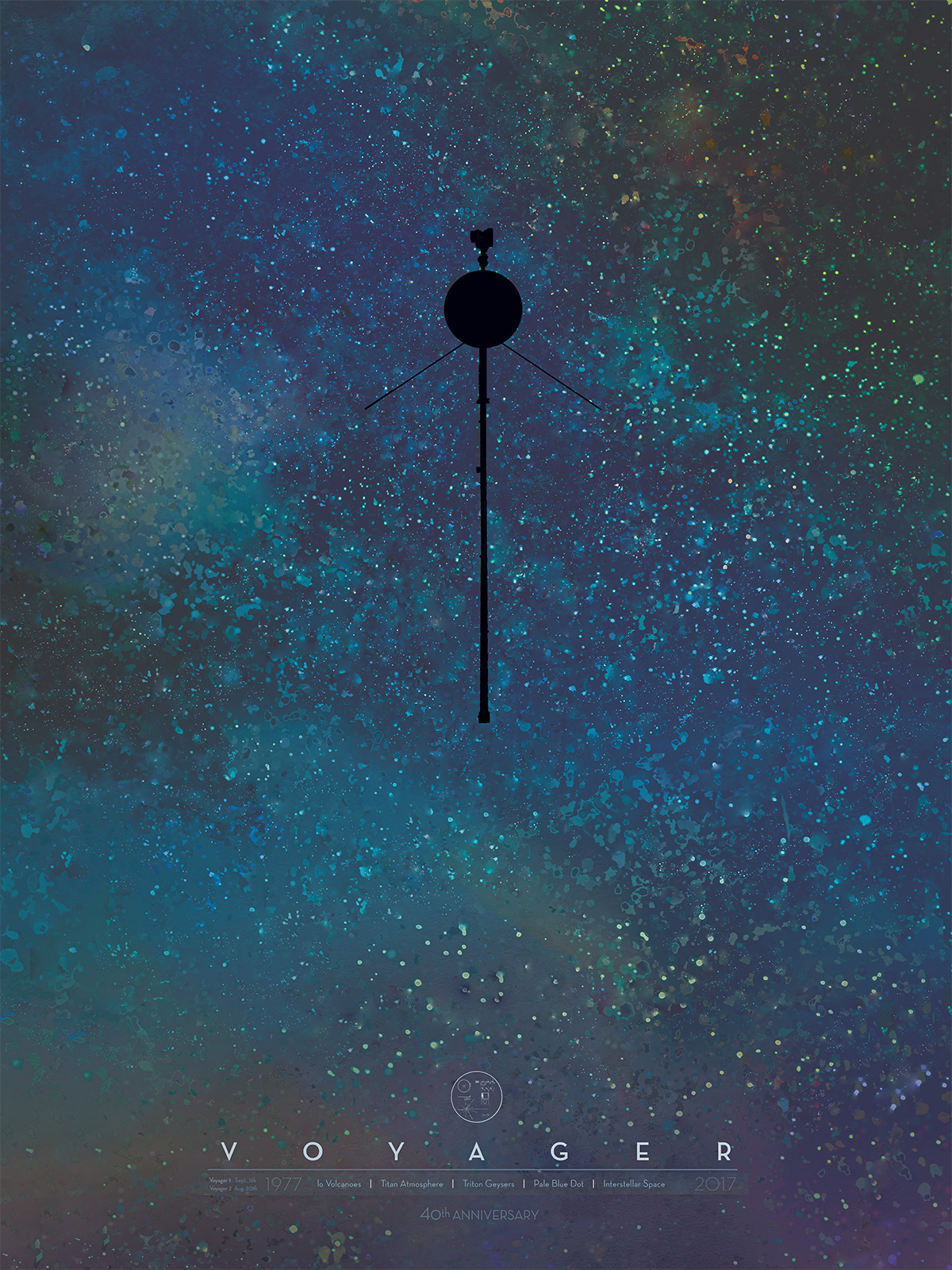
Explanation: Voyager 1 and Voyager 2 were launched in 1977 on a grand tour of the outer planets of the Solar System. They have become the longest operating and most distant spacecraft from Earth. Both have traveled beyond the heliosphere, the realm defined by the influence of the solar wind and the Sun's magnetic field. On the 45th year of their journey toward the stars Voyager 1 and 2 reached nearly 22 light-hours and 18 light-hours from the Sun respectively and remain the only spacecraft currently exploring interstellar space. Each spacecraft carries a 12-inch gold-plated copper disk with recordings of sounds, pictures and messages. The Golden Records are intended to communicate a story of life and culture on planet Earth, preserved in a medium that can survive an interstellar journey for a billion years.
For more detail go to the link and click on the image for a high definition image. You can then move the magnifying glass cursor then click to zoom in and click again to zoom out. When zoomed in you can scan by moving the side bars on the bottom and right side of the image.
Back in Junior High I did a report on Voyager. My daughter did a report in Jr. High awhile ago and wrote about one of them (Voyager II?) leaving the solar system. I think that even though II was launched later it had a more direct trajectory or something. IIRC we are still getting limited data from one of them, or both of them.
I didn’t realize that they were so close together to be able to take that cool photograph! /s
Voyager’s thoughts on nuclear power:
“It’s fine, as long as the reactor is in someone else’s back yard.”
My Dad led the project at GE to build the power plants on both Voyager spacecraft. Still going strong! Yay, Dad. Way to go. I hope you can see your work from heaven!
Oops. Voyager 1 is farther away than 2. But Voyager 2 was launched first! But only by a couple of weeks or so.
That is pretty cool!
It really was. I was in college studying to be a mechanical engineer at the time. It was fun talking with dad about the technical details of the project.
How long until a Berserker finds it?
Why do you think there is no sign of technology in all the vastness of space?
Those rascally Berserkers. All the Democrats think they can be goodlife, but they’re in for a big and unpleasant surprise.
I didn’t realize that they were so close together to be able to take that cool photograph! /s
**********************************
I didn’t see your sarcasm tag at first. As you know, that is definately not a photograph. I think they would be over 2000,000,000 miles apart.
Here’s a cool website I look at now and again that tracks Voyager 1 and 2.
https://voyager.jpl.nasa.gov/mission/status/
This is mind blowing....
Velocity with respect to the Sun (estimated)
38,026.77 mph (look how fast the miles add up)
Yet even at that speed: “In about 40,000 years, Voyager 1 will drift within 1.6 light-years (9.3 trillion miles) of AC+79 3888, a star in the constellation of Camelopardalis which is heading toward the constellation Ophiuchus.”
So THAT’S the heaven where lost puzzle pieces go!
I have worked on several satellite projects, but never a NASA probe. It is amazing that they are still working! Most satellites only last 15 years or so with the space radiation environment.
The distances are unimaginable. If the Sun were the size of a pea the nearest star (4 ly away in reality) would be 130 miles away. Space is that empty.
And those things were engineered by guys with pocket protectors and slide rules!

Yes! And what is also mostly empty space are atoms!
Steve L
·
Follow
B.S. in Physics (college major) & English (minor college), University of Missouri-Columbia4y
For the hydrogen atom, if the nucleus were the size of the sun, the actual atom size (Bohr Radius) would extend about 6 times farther than the distance to Pluto.
For heavier atoms, they would extend to about 36 times farther than Pluto.
The size of the hydrogen atom is about 23,000 times greater than the size of its nucleus.
The sun is about one million miles in diameter. The distance from sun to earth is nearly 100 times that.
Pluto, at its most distant point, is about 40 times farther from the sun than Earth, or 3.7 billion miles.
The closest star is about 25 trillion miles away, about 7000 times the distance of Pluto from our sun.
So the hydrogen atom would extend about 4% of the way to the nearest star.
And the heavier atoms, almost a quarter of the way to the nearest star.
Disclaimer: Opinions posted on Free Republic are those of the individual posters and do not necessarily represent the opinion of Free Republic or its management. All materials posted herein are protected by copyright law and the exemption for fair use of copyrighted works.