Posted on 09/03/2022 2:47:01 PM PDT by MtnClimber
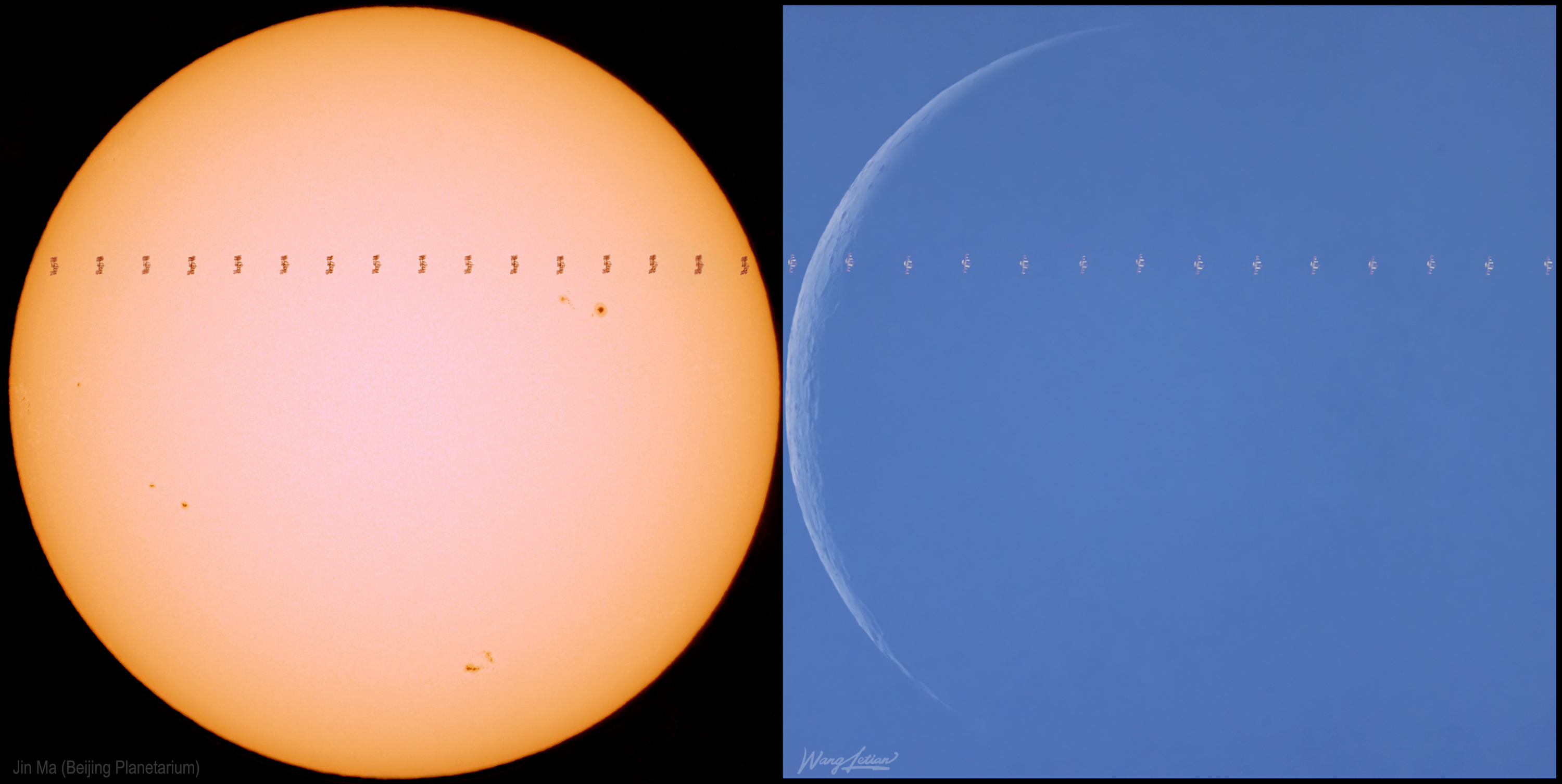
Explanation: On August 25 Sun and Moon could both be seen in planet Earth's daytime skies. And so could the International Space Station. The ISS crossed the disk of the waning crescent Moon as seen from Shunyi district, Beijing, China at about 11:02 am local time. Some 40 kilometers to the southwest, in Fengtai district, the ISS was seen to cross the Sun's disk too. The solar transit was observed only 29 seconds later. Both transits are compared in these panels, composed of processed and stacked video frames from the two locations. The coordinated captures were made with different equipment, but adjusted to show the Sun and Moon at the same scale. The ISS was at a calculated range of 435 kilometers for the lunar transit and 491 kilometers when passing in front of the Sun.
For more detail go to the link and click on the image for a high definition image. You can then move the magnifying glass cursor then click to zoom in and click again to zoom out. When zoomed in you can scan by moving the side bars on the bottom and right side of the image.
In before the flerfers say this is proof that the sun and moon are the same size.
I’ve seen the ISS, as well as many other artificial satellites. They would say those are balloons or airplanes, constantly flying around just to fool everyone. And that all the satellite companies are conspirators, as well as the communication companies, the shipping companies, basically half the planet trying to fool the other half. Oh well, as long as their delusions harm no one but themselves.
It’s always fun to go outside and watch the ISS go overhead.
There are all kinds of apps for alerting us to the Space Station going overhead.
I’m curious to know if there is a way to know if weather balloons will be visible in my area. I accidentally spied one a few years ago through my binoculars
(it was daytime) and never did find out where it came from, or where it landed.
I’ve seen pictures of the ISS transiting the Sun, but transiting the Moon, that was a first for me.
I have an app on my phone, Stellarium, that shows real-time positions of various satellites. I don’t know about weather balloons. The first time I saw the ISS, I didn’t know what it was, so it surprised me a little. They say it’s a full magnitude brighter than Venus, which it looked, before disappearing in Earth’s shadow.
$ $ $ $ $ $ $
Those pictures must have been taken at something like ten frames per second.
I think some colleges, or universities may do some of them.
Maybe NOAA…
Disclaimer: Opinions posted on Free Republic are those of the individual posters and do not necessarily represent the opinion of Free Republic or its management. All materials posted herein are protected by copyright law and the exemption for fair use of copyrighted works.