Posted on 06/23/2022 1:43:12 PM PDT by MtnClimber
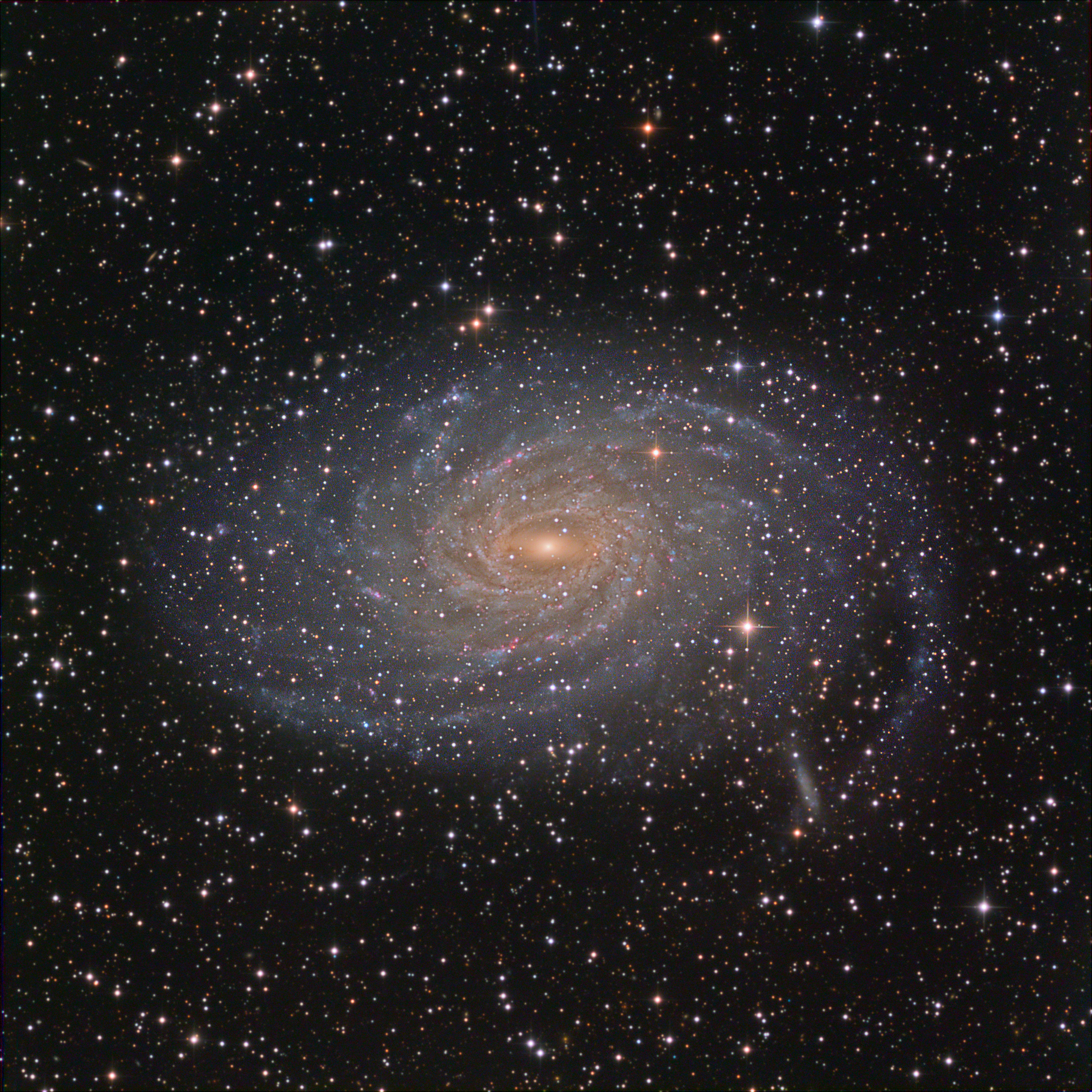
Explanation: Beautiful spiral galaxy NGC 6744 is nearly 175,000 light-years across, larger than our own Milky Way. It lies some 30 million light-years distant in the southern constellation Pavo but appears as only a faint, extended object in small telescopes. We see the disk of the nearby island universe tilted towards our line of sight in this remarkably detailed galaxy portrait, a telescopic view that spans an area about the angular size of a full moon. In it, the giant galaxy's elongated yellowish core is dominated by the light from old, cool stars. Beyond the core, grand spiral arms are filled with young blue star clusters and speckled with pinkish star forming regions. An extended arm sweeps past smaller satellite galaxy NGC 6744A at the lower right. NGC 6744's galactic companion is reminiscent of the Milky Way's satellite galaxy the Large Magellanic Cloud.
For more detail go to the link and click on the image for a high definition image. You can then move the magnifying glass cursor then click to zoom in and click again to zoom out. When zoomed in you can scan by moving the side bars on the bottom and right side of the image.
That’s purty.
“That’s purty.”
But I’ve looked into the night sky with and without a telescope and have never seen those colors. Therefore I don’t like the colors. The images show them but my eyes don’t.
In the Southern Hemisphere galaxies circle the center in the opposite direction.
Well, I guess they enhance the images to show what the stars really are IF you could see the variations with your eyes.
I was thinking of the spiral shape. But when I see these pictures I’m most impressed with just how many stars there are, and how many potentially have planets around them.
Even one galaxy, much less the Universe, is impossible to wrap one’s mind around...
Somehow, I don’t think so...
That's very odd. I was just out last night under beautiful dark Arizona skies and was able to clearly see blue, reddish, gold, and orange stars with the unaided eye as well as through my telescope.
My eyes aren’t the greatest, but I can sometimes see variations in color without a telescope.
The human eye is not very good at seeing colors in dim light, which is why most astronomical objects appear black and white even through a telescope. Photos using time exposures can reveal more color, but what really brings them out is when color filters are used. The colors are real, just enhanced.
“was able to clearly see blue, reddish, gold, and orange stars “
I can see that too. You’re correct, there’s color in our heavens. But while I don’t mind the angular magnification of a telescope, I just don’t care for the coloration. Maybe I’m prejudiced toward those beautiful black and white photos taken years ago by the large telescopes.

The brighter yellow star makes a striking color contrast with its fainter blue companion star. Albireo is about 430 light-years away from the Earth.
Which were essentially manipulated by in camera processing and film, which was only capable of black and white images.
Today's cameras and image processing are superior in every aspect.
In fact it was black and white as well as color film photography which turned me off years ago due to tracking constraints, it was time consuming, not to mention the expensive film processing costs, and it took days to get your images back...Digital changed all that.
Bottom line, objects in space are not black and white.
I can confirm that they look like that in my 115mm refractor.
dragnet2, can I ask you what equipment you used?
(Lord the Artist)
10” Schmidt Cassegrain on a fork mount. And this image was obtained with a consumer grade Canon Camera, with a 6.3 focal reducer in the optical train. Without looking it up, I believe these were combined 10 images, at 30 seconds exposure each.
And they are commonly ruled by super intelligent Pandas and Kangaroos. :)
I would like to get into imaging, but I can’t afford to go to a decent dark sky site.
I would be happy with planetary, lunar, and double star imaging, for now.
Well, I guess I really don’t need a dark sky site for those, but where we live, there are a lot of trees, and lights. My view of the night sky is limited.
I recently bought a cell phone holder made by Celestron that clamps onto an eyepiece. I can’t wait to try it out. Curious as to what my iPhone 11 will do.
My main scope is a 115mm f/7 triplet with a Losmandy G8.
Some of the phone images are impressive.
Btw, I too have to deal with trees, mine basically take out some of my low northwest view. But the beautiful Cedars are worth the loss. My mount is permanent. I can take the scope off and put it on tripod to move it, but it gives me the heebiejeebies thinking of doing a precise polar alignment all over again. And it still isn’t as good as I’d like it now. The scope hasn’t moved for over 3 years.
Btw, I imaged in So. CA for years and got some images that were not too bad considering as dark skies go, that venue was like trying to image from the sun. The land of a billion street lights...(And crime is still through the roof). ☺
Disclaimer: Opinions posted on Free Republic are those of the individual posters and do not necessarily represent the opinion of Free Republic or its management. All materials posted herein are protected by copyright law and the exemption for fair use of copyrighted works.