Posted on 02/16/2022 7:29:04 AM PST by Red Badger
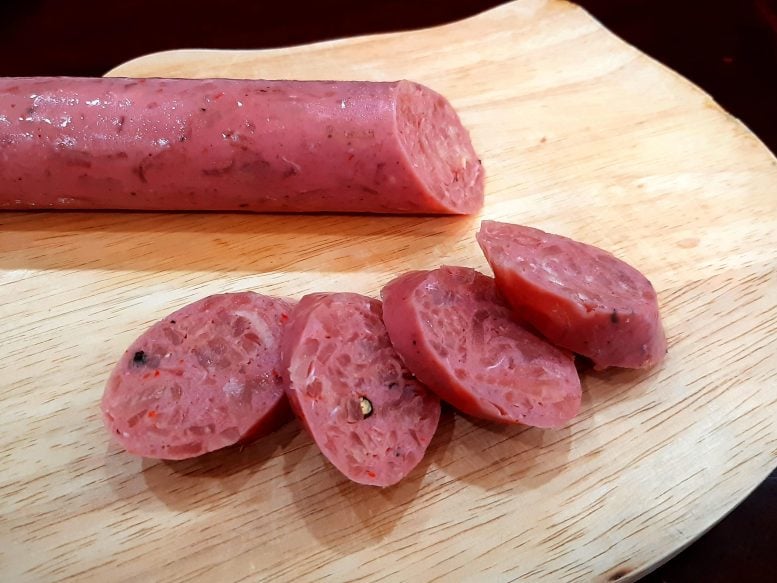
Vietnamese fermented pork snack, Nem Chua. Credit: RMIT University
==================================================================================
Fermented meat snack is helping researchers develop a safe, all-natural food preservative.
A traditional Vietnamese meat snack could hold the key to developing a safe and natural food preservative, addressing the twin global problems of food waste and food-borne illnesses.
Bacteria-killing compound discovered in Nem Chua, a fermented pork snack
Toxic to bacteria but safe for humans, it’s a natural alternative to artificial food preservatives
Study reveals ideal growth conditions to potentially make the bacteria-killer at industrial scales
The fermented pork snack, Nem Chua, is eaten raw but does not cause food poisoning when prepared correctly.
This is because friendly bacteria that thrive in the fermented meat make a special compound that destroys more dangerous bacteria.
Now researchers at RMIT University in Melbourne, Australia, have shown how this natural bacteria-killing compound could be used to keep food fresh for longer.
Food waste is a global issue that costs around $US680 billion annually in industrialized countries, consumes nearly a quarter of the water used in agriculture, and produces 8% of global greenhouse emissions.
Food-borne diseases like Listeria or Salmonella affect millions each year and can be life-threatening for pregnant women, older people, and those who are immunocompromised.
Listeria Bacteria
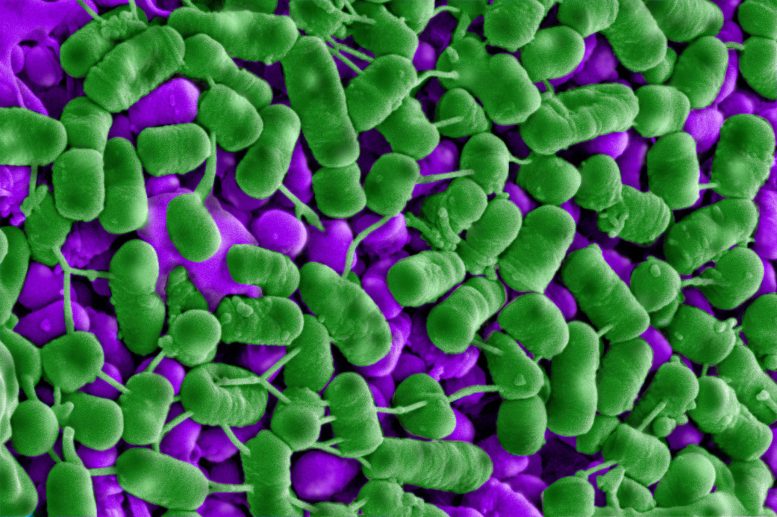
Listeria bacteria (green) dying after exposure to Plantacyclin B21AG. The bumps visible on many of the cells are the cell contents beginning to leak out. Credit: Dr. Elvina Parlindungan
==================================================================================
Co-lead researcher Professor Oliver Jones said changes in consumer habits have led to a greater demand for natural alternatives to artificial food preservatives.
“Scientists have known about these bacteria-killing compounds for many years but the challenge is to produce them in large enough quantities to be used by the food industry,” said Jones, Associate Dean of Biosciences and Food Technology at RMIT.
“The Nem Chua compound is colorless, odorless, tasteless, and very resilient.
“Through this new research, we’ve identified the right growth conditions that would enable us to make it in large amounts, potentially at industrial scales.
“With further development, we hope this could be an effective, safe, and all-natural solution for both food waste and food-borne disease.”
Bacteria-killing weapon
A team of RMIT researchers was inspired to investigate Nem Chua for its potential antibacterial properties after traveling to Vietnam and observing people eating the raw meat snack without getting sick, despite the hot and humid climate.
The team, led by Professor Andrew Smith (now at Griffith University) and Dr. Bee May, discovered a new type of bacteria-killing compound in Nem Chua.
Plantacyclin B21AG is one of a group of compounds known as bacteriocins, which are produced by bacteria to destroy rival bacterial strains.
Listeria Plantacyclin B21AG
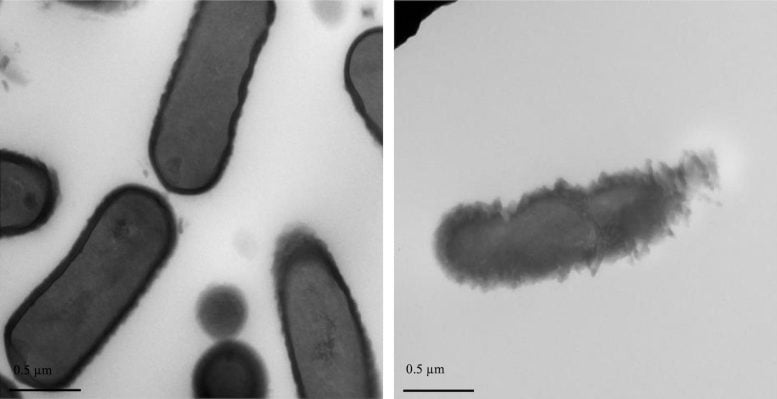
Left: Listeria bacteria, alive and with intact cell membranes. Right: The same bacteria after exposure to Plantacyclin B21AG, dead and with the cell membranes destroyed. Credit: Dr. Elvina Parlindungan
==================================================================================
Bacteriocins form holes in the membranes of target bacteria. This causes the contents of the cell to leak out — effectively killing the bacteria.
The problem is most bacteriocins only work against one or two types of bacteria and they are not very stable in different environmental conditions.
Only one — Nisin, which came to market in the 1960s — is currently licensed for use as a food preservative, in a market estimated to be worth more than $US513 million in 2020, but this compound is temperature and pH sensitive limiting its use.
Tough and effective
The Nem Chua-derived compound is more robust than Nisin and is effective against a wide range of bacteria even after exposure to a range of environments typical in food processing.
It can survive being heated to 90C for 20 minutes and remains stable across high and low pH levels.
The compound can also destroy a range of disease-causing organisms commonly found in food including potentially life-threatening Listeria, which can survive refrigeration and even freezing.
Co-lead researcher Dr. Elvina Parlindungan, who completed the new study as part of her PhD research at RMIT, is now a postdoctoral fellow at APC Microbiome, part of University College Cork in Ireland.
“Using bacteriocins as food preservatives effectively means we are turning bacteria’s own toxic weapons against them — harnessing nature’s smart solutions to tackle our big challenges,” Parlindungan said.
“In the future, these compounds might also be useful as an antibiotic in human medicine.”
Researchers at RMIT’s School of Science have begun experimenting with methods to further purify the compound and are planning to incorporate it into test food products.
Reference:
“Factors that influence growth and bacteriocin production in Lactiplantibacillus plantarum B21″ by Elvina Parlindungan, Chaitali Dekiwadi and Oliver A. H. Jones, 18 May 2021, Process Biochemistry.
DOI: 10.1016/j.procbio.2021.05.009
The team is keen to collaborate with potential industry partners to further develop the technology.
This work was supported by a PhD scholarship from the Indonesian Endowment Fund for Education (LPDP), part of the Ministry of Finance of the Republic of Indonesia, awarded to Parlindungan.
FOODIE PINGY!....................
Reason #377 why I’m glad I don’t live in Vietnam.
All of the sudden there are scores of articles on the newest fad problem — “food waste.” Let’s hope all the kooks switch tracks and put all their energy into that instead of pronouns.
With plenty of Nuoc Mam, chased with lots of Nuoc Tra.
Dried Salami when cured right is similar. Fermented with good bacteria over bad bacteria.
I’m not sure, but I read awhile back that trich8nosis has been practically wiped out (because of,ranching rehulations thatnchanged years ago), except in countries where raw pork. Or bear, or undercooked wild pork is consumed
Just think of it as “Pork Sushi”......................
And a big bowl of Pho......................
Interewting tidbits
Supposedly,in Australia there is no trichinosis-
Experts hsed to recommend coo,ing pork to 165 minimum because of trichinosis, now they say 145 is safe because of the bear eradication of trichinosis in america
Eating raw pork = intestinal worms.
That’s not kosher.
5.56mm
Nem Chua is eaten raw, not dry cured.
It’s fermented .....................
Neither is a cheeseburger.....................
Full research paper “Factors that influence growth and bacteriocin production in Lactiplantibacillus plantarum B21”:
https://sci-hub.se/10.1016/j.procbio.2021.05.009
Nope, likely the articles on food waste are the retread topic for SJWs to save the planet. Thousands of years of humanity and we will continue to waste food for many reasons with the most likely issue being transportation. I guess in their utopia we have to ration food
to save a short-hair beaver berating event from them.
they can’t get their kombucha and caviar from the truckers on time
It’s like clockwork the next generation of know nothings will flog older ideas without doing the research to find out what happened before.
Fermented meat = rotten meat, right?
Fermented grains = Really good stuff.......................
Disclaimer: Opinions posted on Free Republic are those of the individual posters and do not necessarily represent the opinion of Free Republic or its management. All materials posted herein are protected by copyright law and the exemption for fair use of copyrighted works.