Posted on 11/02/2021 7:51:48 AM PDT by Red Badger
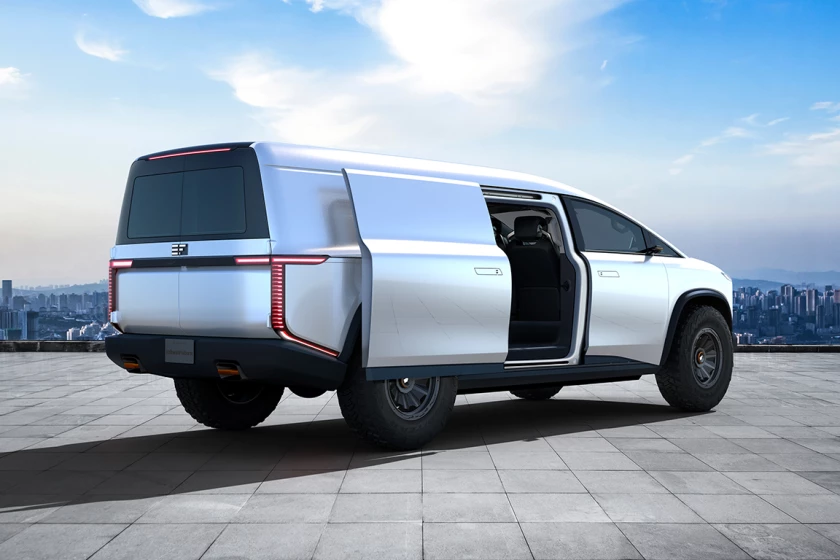
With its sliding side door(s), the EF1-V promises to be a versatile cargo van and, potentially, family MPVEdisonFuture VIEW 14 IMAGES
The convention of naming electric vehicle startups after iconic innovators of electricity past continues. EdisonFuture was founded in 2020 as a subsidiary of SPI Energy and it's about to introduce itself to the world in a big way at this month's LA Auto Show. It will host the premiere of both an all-electric SUV-like van and an electric pickup. It calls its EF1-V a last-mile delivery van, but its high ride height, large all-terrain tires and body form give it the look of a rugged, old-school SUV updated with a cutting-edge solarized transparent roof and potent electric powertrain.
When we first saw the name EdisonFuture, we thought it might be a revamped, rebranded Faraday Future, but EF is actually the latest automotive endeavor from SPI, a Hong Kong/California-headquartered solar energy and mobility company that also offers electric vehicles through its Phoenix Motorcars subsidiary. EdisonFuture will leverage SPI's expertise in solar charging and storage in a lineup of vehicles designed with utility and commercial customers top of mind.
The EF1-T joins a long list of upcoming potential Rivian e-pickup competitors

The EF1-T joins a long list of upcoming potential Rivian e-pickup competitors - EdisonFuture
The American electric pickup market officially made it to reality in September when Rivian began production of the R1T, and we expect to see many players, old and new, launching e-pickups in the coming years. EdisonFuture makes the EF1-T pickup the cornerstone of its brand, promising a rugged multipurpose truck good for work, travel and everyday driving, on-road and off.
The EF1-T will come standard with a single-motor 470-hp electric powertrain, competing with electric supertrucks like the GMC Hummer via an optional range-topping 816-hp triple-motor "Super" trim. The lineup will come with traditional 6.5- and 8-foot bed options, along with an available retractable solar panel roof that drops back over the bed.
In place of the mosaic roof, the EF1-T gets a retractable armadillo-inspired solar cover
In place of the mosaic roof, the EF1-T gets a retractable armadillo-inspired solar cover - EdisonFuture
Anyone can tease another electric pickup truck, but EdisonFuture distinguishes itself from others with its second vehicle, the EF1-V. Built atop the EF1-T truck platform, the EF1-V is a sort of utility vehicle/van mashup that pushes the imagination to immediately brainstorm work, play and everyday use cases. From the outside, it's shaped more like an SUV or single-cab EF1-T with a neatly integrated utility canopy over the pickup bed. However, its sliding side doors give it van-like loading, working with the dual swing-out rear doors to provide flexible access into the cavernous cabin. EdisonFuture plans variants with between 260 and 400 cubic feet (7.4 to 11.3 cu m) of cargo space, enough to rival all but the largest configurations of the full-size Ford Transit.
While EdisonFuture is showing it as a commercial van, the EF1-V would also make a very cool on/off-road MPV and camper van

While EdisonFuture is showing it as a commercial van, the EF1-V would also make a very cool on/off-road MPV and camper van EdisonFuture The EF1-T platform and large all-terrain tires below its segment-bending body give the V more off-road presence than you'd get from even the most heavily modified 4x4 van, pushing it closer to a Land Rover Defender Hard Top. Other EV startups, such as XBus and Neuron, have shown similar van cabins atop electric pickup platforms, but the EF1-V is the most SUV-looking of the lot, regardless of its sliding van doors.
We imagine a passenger-ready SU-MPV variant will be in the cards if and when the EF1-V commercial cargo van proves itself on the market, and, of course, an overland camper could make a cozy home inside that big, empty body.
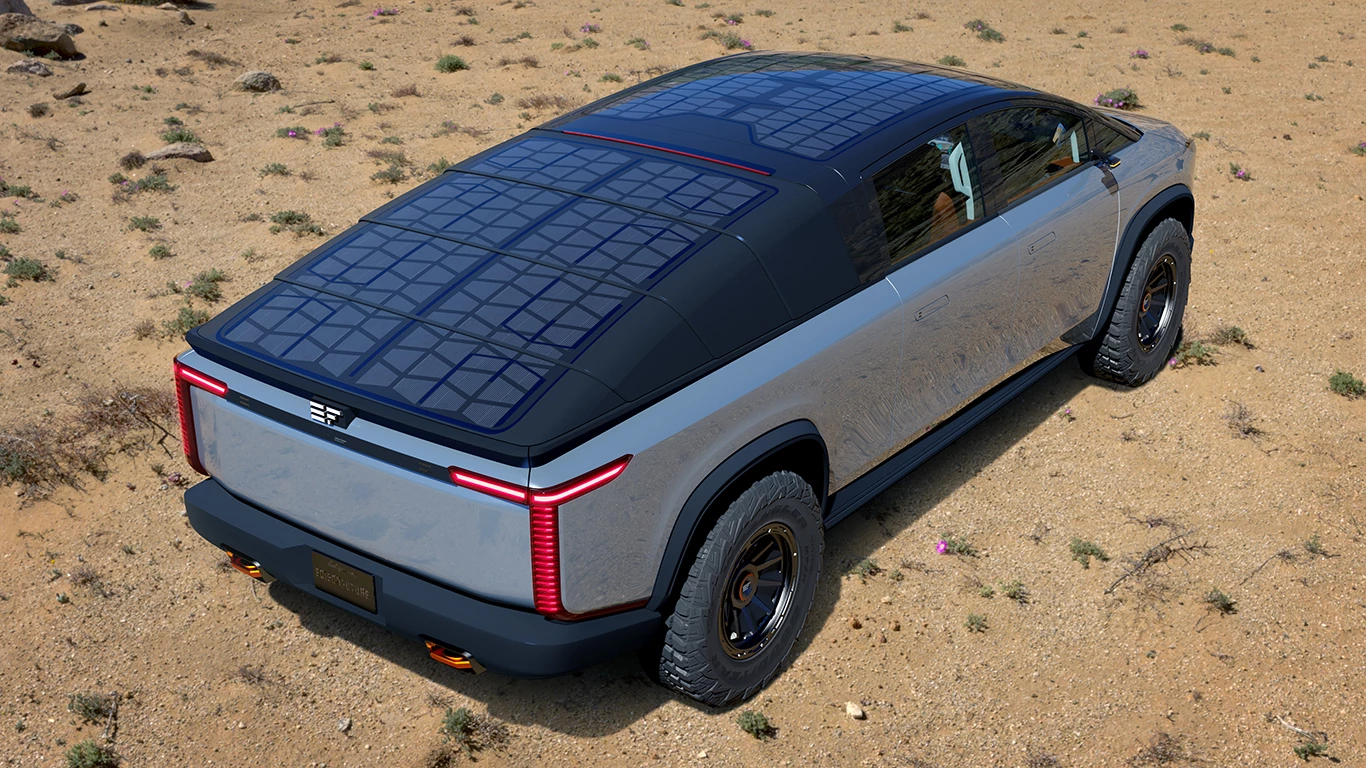
EdisonFuture doesn't yet plan a "Super" triple-motor EF1-V spec, but the high-riding utility van will come in both 400-hp single-motor and 689-hp dual-motor variants. An optional "solar mosaic" roof will take the place of the EF1-T's armadillo retractor cover in providing integrated solar charging.
An available solar mosaic roof offers integrated battery charging for the EF1-V

An available solar mosaic roof offers integrated battery charging for the EF1-VEdisonFuture EdisonFuture doesn't give any indication of the battery size or range of its single-, double- or triple-motor trucks, let alone how all that rooftop solar might impact range, but it expects 0-60-mph (96.5-km/h) times to come in around 6.5 seconds for the EF1-V and between 3.9 and 6.5 seconds for the various EF1-T models. Towing will range between 7,500 and 8,500 lb (3,400 and 3,855 kg).
We'll get a closer look and more details about EdisonFuture's launch vehicles and market plans once the LA Auto Show opens to the media on November 17. The company plans to start taking reservations at the show.
Source: EdisonFuture

Pingy!....................
Looks real expensive. Time to recharge batteries with solar panels. About 3 weeks I’d say..
Everything I’ve seen with on board vehicle solar says it might run the radio, but not much more.
Back in the day when they had the “Sunrayce” those cars had about the same amount of solar and weighed 400 pounds.
I removed those races. At some time in the future these electric cars will be practical, but now, only the rich can afford them.
No thanks! I’ll stick with my 50mpg road warrior diesel.
but now, only the rich can afford them
These are cool looking, but as depicted in the pictures the only real use case is “going camping in the desert.”
Hey, I have one too. A 2015 golf diesel standard 6 speed. Great car. 50 mpg all day with the AC on!
Other EV news....
I bet no one caught the memorandum to work together between SK Innovations and Solid Power to produce Solid Power's Solid State batteries using SK Innovations manufacturing technology.
Solid Power is Ford's Solid-State battery partner and new plants they will build include 3 battery plants with SK.
Can you see where this is going? Hmmm....
1 kilowatt per square meter. That is how much solar power hits the earth. That's 1.3 horsepower for every square meter. Let's be generous and say 4. So you have 5.2 hp max. Now reduce that for panel efficiency, clouds, night, and not having the sun perfectly overhead. You'll have to leave the van outside for hundreds of hours to be able to drive for one hour.
Physics is a b*tch, isn’t it....
You are using the wrong numbers. No one drives around at peak horsepower for extended distances. The Tesla model S uses 250 watt hours to travel a mile distance at highway speeds, less in stop and go city traffic due to regenerative braking. Put another way one kWh will move a Tesla model S down the highway one mile.
Modern thin film multiband gap solar panels can achieve 40% photonic efficiency. The roof of a Tesla is just over 2 meters square. 800 watts is doable off a Tesla roof. Given that it takes 1000 thousand watt hours to move that Tesla a mile. That means for every hour that Tesla sits in the sun it will go 8/10 of a mile from that sunlight. Texas has 14 hour days in the summer and the shortest day of the year is 10.1 hours of daylight at this latitude. Given the breakdown of trips from .gov a Tesla with a solar roof in an average Texas day would charge enough in the parking lot to not be plugged in but for less than 20% of all trips.
Look at this data from .gov the VAST majority of trips are under 6 miles total with only 5% being more than 30 miles.
https://afdc.energy.gov/data/mobile/10318
” the distribution of trip lengths among all vehicle trips in the United States. A substantial majority of U.S. vehicle trips are less than 6 miles long, and only about 5% are longer than 30 miles.”
I think the article misses the whole point of the solar panels. The solar panels can be used to run the HVAC system to keep the interior and batteries of a parked vehicle cool on hot, sunny Summer days without eating into battery range.
For that use, bright sunny days work best to provide power for the air conditioner and battery chiller, and on overcast cloudy days (and at night) the need for the air conditioner is reduced.
Disclaimer: Opinions posted on Free Republic are those of the individual posters and do not necessarily represent the opinion of Free Republic or its management. All materials posted herein are protected by copyright law and the exemption for fair use of copyrighted works.