Posted on 07/15/2021 7:12:15 AM PDT by Red Badger
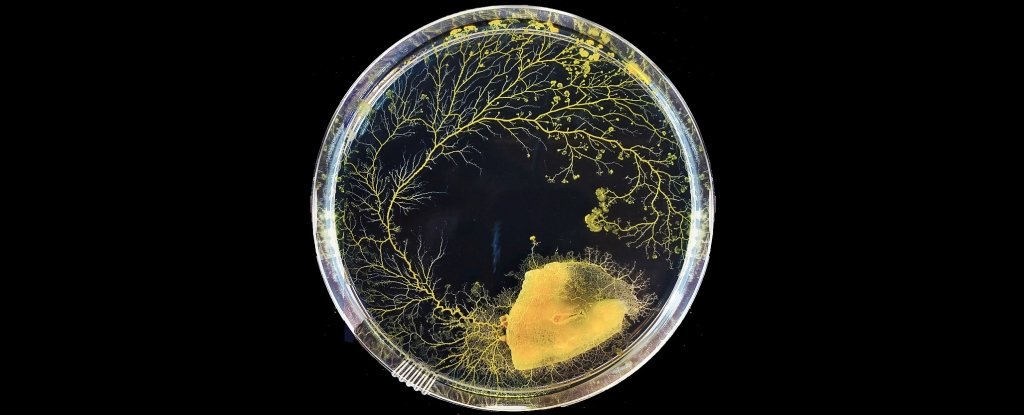
(Nirosha Murugan, Levin lab, Tufts University and Wyss Institute at Harvard University)
A slippery yellow slime that lives in the damp undergrowth is continuing to test our understanding of what it means to make decisions.
Physarum polycephalum, AKA the many-headed slime mold, uses its body to physically sense its environment before making a decision about where it wants to go, new research has found. It's the latest in an impressive list of ways the single-celled organism has blown our minds lately.
"People are becoming more interested in Physarum because it doesn't have a brain but it can still perform a lot of the behaviors that we associate with thinking," said neuroscientist Nirosha Murugan of Algoma University in Canada.
"Figuring out how proto-intelligent life manages to do this type of computation gives us more insight into the underpinnings of animal cognition and behavior, including our own."
P. polycephalum is a curious little organism. It's not actually a fungus at all; nor is it an animal or a plant. It belongs to the protist kingdom - basically anything that doesn't belong in the other three kingdoms. It lives in dark, humid environments like forest floors, aiding in the decomposition of organic matter and recycling it back into the food web.
Physarum starts its life as many individual cells, each with its own nucleus. These cells merge to form the plasmodium, a large, single cell containing millions or even billions of nuclei swimming in a cytoplasmic fluid. This is the vegetative stage of life, in which the protist moves about, feeds, and grows.
It's also the stage in which P. polycephalum exhibits some curious behaviors. Scientists have observed it solving mazes, and remembering new substances for months. It can also remember places in which it previously found food, and share memories with other blobs of slime mold. That's pretty incredible for something that doesn't have a brain or a nervous system.
Most of the previous research has involved some sort of incentive, such as a chemical the protist didn't like, light, or a food reward. Muruga and her team wanted to know how P. polycephalum makes decisions in the absence of these cues, based solely on its physical environment, so they designed an experiment to find out.
(Nirosha Murugan, Levin lab, Tufts University and Wyss Institute at Harvard University)
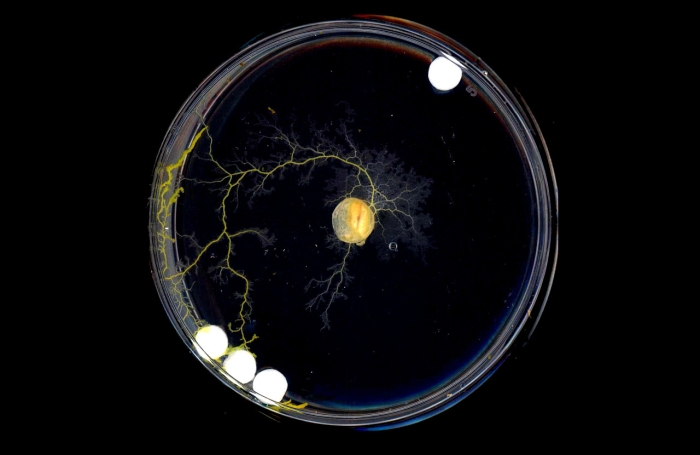
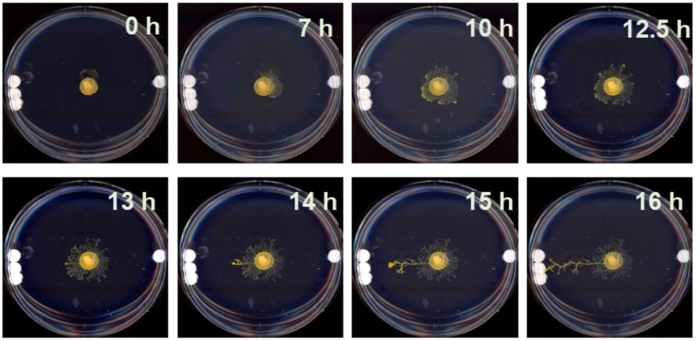
They placed samples of P. polycephalum in petri dishes, on a gel of plain agar. On one side of the dish, a single small glass disc was placed. On the other, three glass discs were placed together, side-by-side. The dishes were placed in a dark room - the slime mold's preferred light setting - and left to their own devices.
For the first 12 hours or so, P. polycephalum grew out evenly in all directions. Then, by the 24-hour mark, 70 percent of the samples had all grown towards the three discs instead of the one.
Further experimentation revealed even more oddities. When the three discs were stacked on top of each other, rather than side by side, the slime mold lost its preference, growing towards one side or the other at roughly the same rates. This seemed to suggest that it wasn't mass alone causing the slime mold's preference for the three side-by-side discs.
The additional factor was revealed by computer modelling. When placed side-by-side on the springy agar gel, the three discs deformed the gel differently than when placed in a stack, much like three weights placed next to each other on a trampoline will cause a different strain pattern than a stacked weight would.
This strain pattern in the agar gel, the team determined, is what P. polycephalum moves towards.
"Imagine that you are driving on the highway at night and looking for a town to stop at. You see two different arrangements of light on the horizon: a single bright point, and a cluster of less-bright points. While the single point is brighter, the cluster of points lights up a wider area that is more likely to indicate a town," said engineer Richard Novak of the Wyss Institute.
"The patterns of light in this example are analogous to the patterns of mechanical strain produced by different arrangements of mass in our model."
(Nirosha Murugan, Levin lab, Tufts University and Wyss Institute at Harvard University)
Given that P. polycephalum doesn't have a nervous system, the next question was, naturally, how is the slime mold able to sense this strain pattern. As it turns out, it's to do with the organism's movement and internal communication.
The cytoplasm inside P. polycephalum isn't static, but moves around in pulses. The walls of its veins contract to act as a peristaltic pump, pushing the fluid from one region to another. Other animals, such as mammals, have molecules called TRP proteins in their cell membranes that can detect stretching.
So, the researchers decided to give P. polycephalum a TRP blocker to see what would happen.
Sure enough, the protist lost its ability to discern between one glass disc and three glass discs side-by-side. In a new trial, 71 percent of the samples moved towards both sides of the petri dish. This suggests that something like TRP proteins are at play within P. polycephalum.
"Our discovery of this slime mold's use of biomechanics to probe and react to its surrounding environment underscores how early this ability evolved in living organisms, and how closely related intelligence, behavior, and morphogenesis are," said biologist Mike Levin of the Wyss Institute.
"This work in Physarum offers a new model ... to explore the ways in which evolution uses physics to implement primitive cognition that drives form and function."
The research has been published in Advanced Materials.
lol. In before the Biden jokes.
Same thing in the movie Life.
“I Am The Slime”
https://www.youtube.com/watch?v=tdtGo2Ib9oI
DNC Travel Agency?
>lol. In before the Biden jokes.
I know right, that’s what I came here for. Am disappoint
It’s just like Michael Moore with a built-in GPS to every local Whataburger.
Read the headline and thought it was talking about BLM.
This Brainless Slime Mold Can Decide Where to Go Without Having Already Been ThereHarris to the border.
Has it asked for a ballot so it can vote a straight Rat ticket?
Morphic Fields, kidz.
They write themselves.
I was just getting ready to post a Biden joke!
Mama Biden just called him “Joey!”
Looks like Biden’s brain CT scan. Physarum polycephalum invades empty spaces.
I’m not in before the Frank Zappa jokes
One of the greatest moments in SNL history, getting Don Pardo to join in was a masterstroke.
You must not have a life.
I’m familiar with slime mold, but not THAT one! It has tendrils. Like the pods that have apparently consumed Al Sharpton — see previous rant-like speculation.
I remember SM from my youth in the midwest and have seen it here in my back yard in CaCaLand. Totally weird stuff.
Campers! Try not to think of this next time you bed down inna woods! Be sure and tell your kids, “It makes acne worse!”. Make it a family experience sure to be remembered. And commented on when they deposit your sorry Arse inna senior center.
Disclaimer: Opinions posted on Free Republic are those of the individual posters and do not necessarily represent the opinion of Free Republic or its management. All materials posted herein are protected by copyright law and the exemption for fair use of copyrighted works.