
Posted on 07/07/2021 9:40:39 AM PDT by Red Badger
Scientists from Trinity College Dublin are homing in on a recipe that would enable the future production of entirely renewable, clean energy from which water would be the only waste product.
Using their expertise in chemistry, theoretical physics and artificial intelligence, the team is now fine-tuning the recipe with the genuine belief that the seemingly impossible will one day be reality.
Initial work in this area, reported just under two years ago, yielded promise. That promise has now been amplified significantly in the exciting work just published in leading journal, Cell Reports Physical Science.
Energy for a song—the theory, and the problem
Reducing humanity's carbon dioxide (CO2) emissions is arguably the greatest challenge facing 21st century civilization—especially given the increasing global population and the heightened energy demands that come with it.
One beacon of hope is the idea that we could use renewable electricity to split water (H2O) to produce green, energy-rich hydrogen (H2), which could then be stored and used in fuel cells. This is an especially interesting prospect in a situation where wind and solar energy sources produce electricity to split water, as this would allow us to store energy for use when those renewable sources are not available.
The essential problem, however, is that water is very stable and requires a great deal of energy to break up; there is no point using much more energy than you get back from such an effort. A particularly major hurdle to clear is this "overpotential" associated with the production of oxygen, which is the bottleneck reaction in splitting water to produce H2.
Although certain elements are effective at splitting water, such as Ruthenium or Iridium, these are prohibitively expensive and scarce for global commercialization. Other, cheaper options tend to suffer in terms of their efficiency and/or their robustness. In fact, at present, nobody has discovered catalysts that are cost-effective and robust for significant periods of time.
So, how do you solve such a riddle? Stop before you imagine lab coats, glasses, beakers and funny smells; this work was done entirely through a computer.
By bringing together chemists and theoretical physicists, the Trinity team behind the latest breakthrough combined chemistry smarts with very powerful computers to find one of the "holy grails" of catalysis.
What did the team find?
Then: Two years ago, the team discovered that science had been underestimating the activity of some of the more reactive catalysts and, as a result, the dreaded "overpotential" hurdle seemed easier to clear. Furthermore, in refining a long-accepted theoretical model used to predict the efficiency of water splitting catalysts, they made it far easier to search for the elusive "green bullet" catalyst.
Now: Their subsequent searches, made using an automated combinatorial approach and advanced quantum chemical modeling, have pinpointed nine earth-abundant combinations of metals and ligands (which glue them together to generate the catalysts) as highly promising leads for experimental investigation.
Three metals stand out (chromium, manganese, iron) for the team as being especially promising. Thousands of catalysts based around these key components can now be placed in a melting pot and assessed for their abilities as the hunt for the magic combination continues.
Max García-Melchor, Ussher Assistant Professor in Chemistry at Trinity, is the senior author on the landmark research. He said:
"Two years ago, our work had made the hunt for the holy grail of catalysts seem a little more manageable. Now, we have taken another major leap forward by narrowing the search area significantly and speeding up the way we search.
"Until recently we were looking for a tiny needle in a huge haystack. After reducing the size of the haystack, we have now hoovered up plenty of the remaining hay. To put a sense of scale on this, two years ago we had screened 17 catalysts. Now we have screened 444 and believe it won't be long before we have a database with 80,000 'screenable' catalysts in it.
"'How can we live sustainably?' That is arguably the biggest and most pressing question facing 21st century society. I believe researchers from all disciplines can help to answer that, and we feel a particular strength of our pursuit is the multi-disciplinary approach we are taking."
Michael Craig, Ph.D. Candidate at Trinity, is the first author of the journal article. He added:
"It seems hopeful that science could provide the world with entirely renewable energy, and this latest work provides a theoretical basis to optimize sustainable ways to store this energy and goes beyond that by pinpointing specific metals that offer the greatest promise.
"A lot of research has focused on the effective yet prohibitively expensive metals as possible candidates, even though these are far too rare to do the heavy lifting required to store enough hydrogen for society. We are focused on finding a long-term, viable option. And we hope we will."
Explore further
Scientists take strides towards entirely renewable energy
More information: Cell Reports Physical Science (2021). DOI: 10.1016/j.xcrp.2021.100492
Journal information: Cell Reports Physical Science
Provided by Trinity College Dublin
All they have to do is invent a Perpetual Motion Machine.
Where is my Government Grant?
Short summary: nothing yet but computer models are working on it.
Is it “home in on” or “hone in on?”
“the Trinity team behind the latest breakthrough “
Lots of computer crunching but no breakthrough.
I already have one, but it's connected to my alchemist's engine for turning lead into gold.
“home in on” as in homing pigeons and RADAR targets.............
All we need to do is call the conservation of energy law a racist, and it will go away.

I am all for investigating any and all energy solutions, but when ignoramuses like this one are advocates of anything, I am inclined to not take it seriously.
It’s so surprising nowadays to read a well written article.

That is, I think, the bottom line. If you want that grant, you had better be doing something to address “climate change”. I’d like to say more, but I’ve got work to do. I am applying for a grant to turn discarded shoestrings into 100% clean energy.
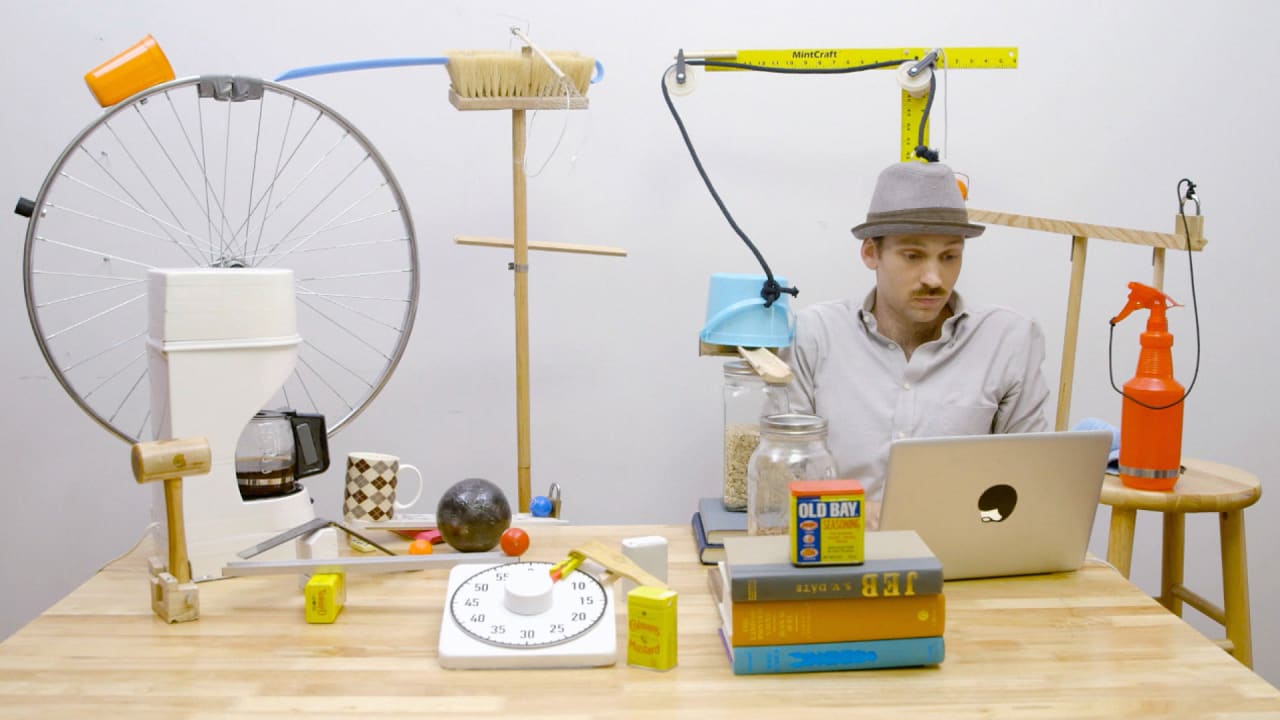
He’s on the right track with that can of Old Bay.
I thought this would be about Fusion Energy. I’ve been hearing about it’s remarkable properties for many years.
Some think Big Energy corporations are finding ways to stop Fusion Energy from becoming widely accepted, as this would ‘steal away’ most of their consumer market.
Science is real!
Bet ya a dollar it’ll be available when graphene is available.
Yeah, I scanned down, saw the same “reducing humanity’s lalala ...”
Brain said, “STOP READING.”
If they are successful they will find out water is actually a pollutant and is directly contributing to climate change and the technology will be cancelled.
Disclaimer: Opinions posted on Free Republic are those of the individual posters and do not necessarily represent the opinion of Free Republic or its management. All materials posted herein are protected by copyright law and the exemption for fair use of copyrighted works.