Posted on 07/02/2021 11:11:39 AM PDT by Red Badger
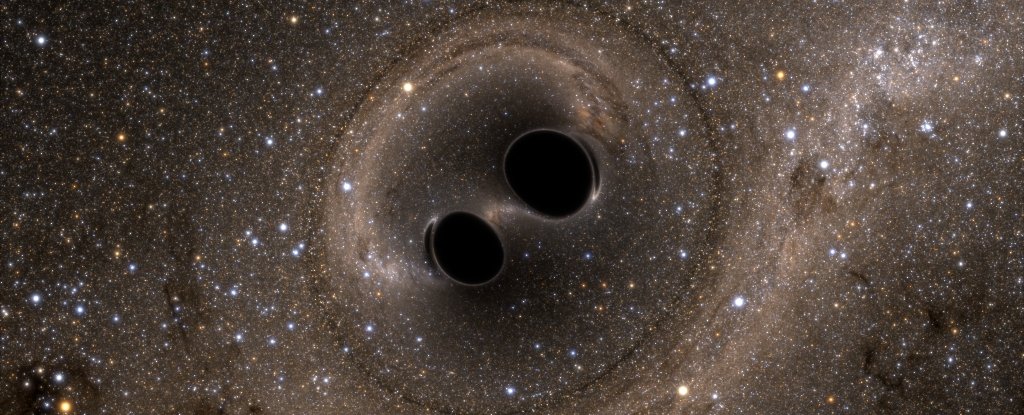
Gravitational wave astronomy has just given us another amazing gift: the first observational confirmation of one of Stephen Hawking's predictions about black holes.
An analysis of the very first gravitational wave detection made back in 2015, GW150914, has confirmed Hawking's area theorem. It states that, under classical physics, the area of the event horizon of a black hole can only grow larger - never smaller.
The work gives us a new tool for probing these mysterious objects, and testing the limits of our understanding of the Universe.
"It is possible that there's a zoo of different compact objects, and while some of them are the black holes that follow Einstein and Hawking's laws, others may be slightly different beasts," said astrophysicist Maximiliano Isi of MIT's Kavli Institute for Astrophysics and Space Research.
"So, it's not like you do this test once and it's over. You do this once, and it's the beginning."
Hawking first proposed his theorem back in 1971. It predicted that the surface area of the event horizon of a black hole should never decrease, but only increase.
The event horizon is not the black hole itself, but the radius at which even light speed in a vacuum is insufficient to achieve escape velocity from the gravitational field generated by the black hole singularity. It's proportional to the mass of the black hole; since black holes can only gain mass, under general relativity, the event horizon should only be able to grow.
(This increase-only model is also curiously similar to another theory, the second law of thermodynamics. It states that entropy - the progression from order to disorder in the Universe - can only increase. Black holes also have entropy ascribed to them, and it's directly proportional to their event horizon surface area.)
Mathematically, the area theorem checks out, but it's been observationally difficult to confirm - mainly because black holes are extremely difficult to observe directly, since they emit no detectable radiation. But then, we detected the gravitational ripples propagating through space-time of a collision between two of these enigmatic objects.
This was GW150914, and the brief bloop of the collision recorded by the LIGO interferometer changed everything. It was the first direct detection of not one black hole, but two. They came together and formed one larger black hole.
This black hole then faintly rung, like a struck bell. In 2019, Isi and his colleagues worked out how to detect the signal of this ringdown. Now they've decoded it, breaking it down to calculate the mass and spin of the final black hole.
They also performed a new analysis of the merger signal to calculate the mass and spin of the two pre-merger black holes. Since mass and spin are related to the area of the event horizon, this allowed them to calculate the event horizons of all three objects.
If the event horizon could shrink in size, then the event horizon of the final merged black hole should be smaller than those of the two black holes that created it. According to their calculations, the two smaller black holes had a total event horizon area of 235,000 square kilometers (91,000 square miles). The final black hole had an area of 367,000 square kilometers.
"The data show with overwhelming confidence that the horizon area increased after the merger, and that the area law is satisfied with very high probability," Isi said.
"It was a relief that our result does agree with the paradigm that we expect, and does confirm our understanding of these complicated black hole mergers."
At least in the short term. Under quantum mechanics - which does not play nicely with classical physics - Hawking later predicted that, over very long timescales, black holes should lose mass in the form of a type of black-body radiation we now call Hawking radiation. So it's still possible that the event horizon of a black hole could decrease in area, eventually.
That will obviously need to be examined more closely in the future. In the meantime, the work of Isi and his team have given us a new toolset for probing other gravitational wave observations, in the hope of gaining even more insights into black holes and the physics of the Universe.
"It's encouraging that we can think in new, creative ways about gravitational-wave data, and reach questions we thought we couldn't before," Isi said.
"We can keep teasing out pieces of information that speak directly to the pillars of what we think we understand. One day, this data may reveal something we didn't expect."
The research has been published in Physical Review Letters.
Sounds as though - for some reason - you are positing that positively-charged particles in a Black Hole would somehow have a different effect upon the area of that Black Hole's Event Horizon than would negatively-charged particles.
You speak of the "repulsive" force of a positively-charged Black Hole - but it would only repel other positively-charged bodies. It is not "inherently" repulsive. In fact, it would actually attract some other bodies - namely neg.-charged ones.
I assert that a Black Hole of mass "x" would have an Event Horizon of the same area, regardless as to whether it is positively or negatively charged.
After all: Otherwise, two Black Holes - one positive, one negative - could merge, and...
Regards,
I wasn’t thinking about bending space with charge, just about balancing of forces. A related question is whether a charged particle can bend light, by virtue of its charge. I think the answer is “no”. But it certainly can change the trajectory of another charged particle.
Exactly. It is well known that a solar system-sized Black Hole (with a mass a billion times that of our own Sun) could be easily entered into by a human space traveler, without being torn apart - very moderate tidal forces.
Or a small, automated space probe - only 10 cm in diameter...
Regards,
The electrostatic force is, what, 10^38 times as powerful as the gravitational force, right? After all, a charged plastic comb can wrest a fragment of paper from the Earth's surface, in spite of the Earth's gravity. Shouldn't the corresponding "warping of space" due to charge be likewise many of orders of magnitude greater than the warping due to "mere" mass?
But it ain't!
Regards,
Of course! That is where ufos come from and go back to. And where Bagster will send you if you do not wear your mask. Like a good boy or girl.
Excellent...
No, I was just trying to envision the event horizon for a particle of the *same* charge as the black hole, positive or negative. The electrical repulsion would tend to frustrate the gravitational attraction.
Yeah, thought so.
A charged-particle would be repulsed by a like-charged Black Hole. Conceivably, one could "float" just outside the Event Horizon.
A few hundred pounds of electrons on the Moon and a few hundred pounds of electrons on the Earth would suffice to totally compensate for the gravitational attraction between the Earth and Moon - that's how powerful the electrostatic charge is.
If a spinning Black Hole can be oblate (flattened at the poles), could a charged Black Hole be polar (i.e. have measurable differences, from place to place over its "surface," in charge)?
Regards,
The big mass at the center of the Milky Way might fit the bill. Not terribly far away, either. You go first; I’ll watch from here.
“If a spinning Black Hole can be oblate (flattened at the poles), could a charged Black Hole be polar (i.e. have measurable differences, from place to place over its “surface,” in charge)?”
Makes sense, but I’m not the right one to ask.
That was Awesome!
She ran as a Democrat Presidential candidate in the last election. The debates wouldn’t give her much time and the MSM censured her.
She’s a weird new age type.
When SNL mocked the debates, they had her arrive through astral projection. It was funny.
From Wikipedia: Williamson’s beliefs on forgiveness and God influence her belief that sin is impossible: “A sin would mean we did something so bad that God is angry with us. But since we cannot do anything that changes our essential nature, God has nothing to be angry at. Only love is real. Nothing else exists. The Son of God cannot sin.”
Disclaimer: Opinions posted on Free Republic are those of the individual posters and do not necessarily represent the opinion of Free Republic or its management. All materials posted herein are protected by copyright law and the exemption for fair use of copyrighted works.