Posted on 06/12/2021 9:01:32 PM PDT by SeekAndFind
It’s the programming equivalent of the circle of life: programming languages are created, gain popularity, hit their peak, and slowly degrade until nobody uses them anymore. With some languages, this process is fairly rapid, especially if the language in question never sees much adoption; others are decades old and still going strong.
For developers, knowing which languages will fade is a crucial issue: It’s hard to earn money off programming in a language that nobody really uses anymore. Here are five languages that won’t disappear tomorrow, but the long-term trends definitely don’t look good.
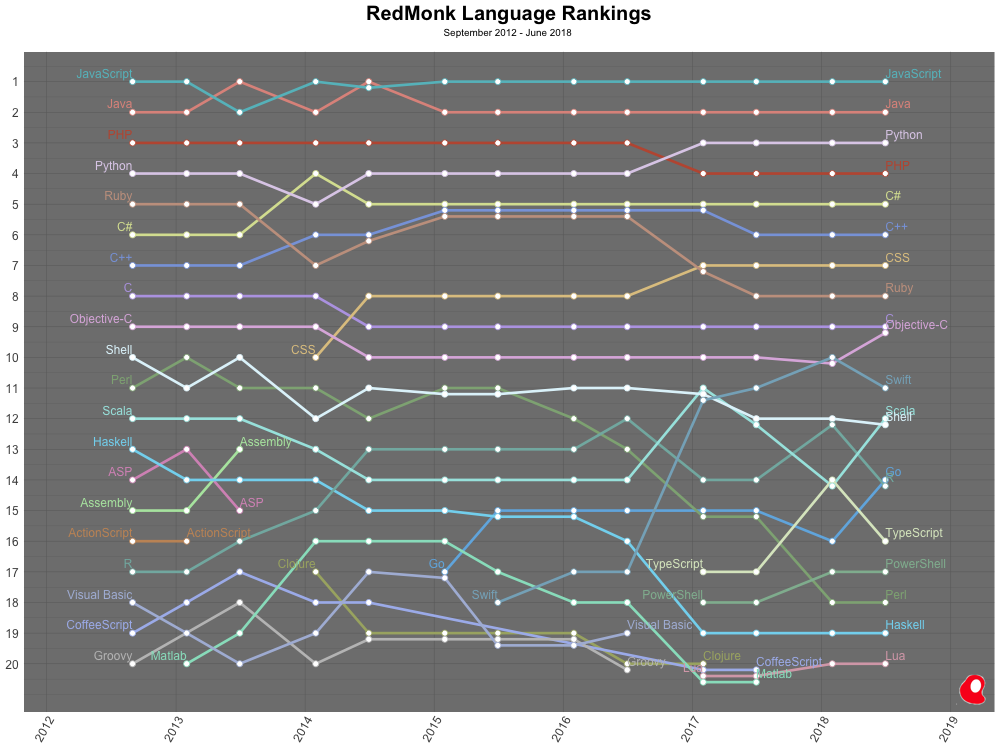
In the TIOBE Index, R has tumbled from 15th to 18th place over the past year. There’s a solid reason behind this: although it emerged as a strong language for data analytics (itself a burgeoning field), R has lost ground to Python, which has proven as useful for data analysis as it has for other kinds of programming work.
R faces the same situation as many highly specialized languages: a steady rise thanks to a relatively small group of loyal specialists and subject-matter experts—many of whom begin to drift away once they realize that they can use another programming language that works roughly as well. In addition, workers entering the field for the first time may choose to go with the more general-purpose language over the specialized one, figuring they can use the former for other functions, besides.
Like other, highly specialized languages, R probably won’t disappear completely. But if Python becomes data analysts’ language of choice, it could end up reduced to relatively few users.
In 2014, Apple launched Swift, its general-purpose language for building iOS, macOS, and watchOS apps. It was meant to work with Apple’s existing frameworks and programming infrastructure; more to the point, the company wanted its developer ecosystem to use it in place of Objective-C, which is over three decades old.
But a funny thing happened on the way to Objective-C’s predicted obsolescence: the language refused to die. Maybe that’s due to the enormous number of apps written in it, or maybe because developers who learned Objective-C aren’t quite ready to commit to learning Swift yet; maybe it’s a combination of both. Whatever the case, Objective-C has maintained a (slowly declining) presence on various popular-languages lists.
All that being said, Apple is determined to replace Objective-C with Swift. It’s going to happen. It might just take longer than the company expects.
R might have tumbled quite a bit in the TIOBE Index over the past 12 months, but it has nothing on Visual Basic, which fell from 13th place to 19th over the same period. It’s also dipped in RedMonk’s long-term language rankings, although not quite as much.
In many ways, this decline isn’t surprising: Visual Basic is a really old language, having first appeared on the scene in 1991, and if there’s any truism in the technology world, it’s that older technologies are inevitably eclipsed by the new. Plus, Microsoft stopped supporting Visual Basic quite some time ago. And yet, according to the sites that monitor the relative popularity of programming languages, this platform continues to hold on—there must be a substantial number of hobbyists out there, or else tech pros tasked with maintaining legacy code.
Rather than learn Visual Basic, which will completely fade from view at some point, it’s worth your time to educate yourself in the particulars of its successor, Visual Basic .NET, an object-oriented programming language that launched in 2002 and continues to power the building of Windows apps. It’s safe to say that Microsoft isn’t going to stop supporting Visual basic .NET anytime soon, given its importance to the contemporary Windows ecosystem. (If you’re unfamiliar with Visual Basic .NET, note that Microsoft doesn’t use ‘.NET’ in its documentation, which can lead to some confusion between the contemporary .NET and “classic” Visual Basic.)
At one point, Perl seemed ubiquitous, and developers used it to build some of the biggest websites of yesteryear, including Craigslist and Slashdot. It was also useful for prototyping new, smaller programs, or creating wrapper functions.
Perl was doing so well for so long—it even broke into the top 10 of the TIOBE Index (peaking in ninth place) before tumbling to 16th. But it’s also a language in serious decline. In 2000, Perl creator (and the language’s “benevolent dictator for life”) Larry Wall announced that work had begun on Perl 6, the language’s next big iteration; it’s now 2018, and while the Rakudo Perl 6 compiler is in active development (targeting MoarVM and the Java Virtual Machine), momentum for the project seems to have frittered away. Smaller updates, meanwhile, continue on Perl 5 (which is up to 5.28).
What drove Perl’s decline? Some experts think that Python, which occupies much of the same programming “niche,” had something to do with it. “Perl’s eventual problem is that if the Perl community cannot attract beginner users like Python successfully has, it runs the risk of become like Children of Men, dwindling away to a standstill; vast repositories of hieroglyphic code looming in sections of the Internet and in data center partitions like the halls of the Mines of Moria,” Conor Myhrvold wrote for Fast Company in 2014. Not much has changed since.
If you’re a COBOL programmer, chances are good you can land a job at a major institution that’s maintained a COBOL codebase since before you were born. Indeed, an industry-wide shortage of COBOL programmers means that such positions can provide quite a comfortable salary (the Dice Salary Calculator suggests $79,000 per year isn’t out of the question in California).
But sooner or later, COBOL is going to fade away as companies replace their tech stacks, especially if they opt for cloud-based solutions over on-premises. If you plan on having a decades-long career as a programmer, COBOL probably won’t be a factor in your mid- to late career.
LOL!
L:ove that!
I also use DosBox to run Turbo Pascal 5 (5.5?) on my laptops. This version of TP is in the public domain and free to dowmload.
In 1968 I was using Fortran with punch cards on an IBM 1130 which was the size of a car.
I learned Fortran using punch cards in graduate school and BASIC on my Commodore Amiga. Yes, I’m very old too.
FORTRAN in HS
BASIC in college
Then
ALGOL
Turbo Paschal ( bought my own and brought to work since IT department did not allow us to use the main frames)
APL ( I really hated that one)
SAS
R
Python
[This was posted to Usenet by its author, Ed Nather (), on May 21, 1983.]
The Story of Mel
A recent article devoted to the macho side of programming made the bald and unvarnished statement:
Real Programmers write in FORTRAN.
Maybe they do now, in this decadent era of Lite beer, hand calculators, and “user-friendly” software but back in the Good Old Days, when the term “software” sounded funny and Real Computers were made out of drums and vacuum tubes, Real Programmers wrote in machine code. Not FORTRAN. Not RATFOR. Not, even, assembly language. Machine Code. Raw, unadorned, inscrutable hexadecimal numbers. Directly.
Lest a whole new generation of programmers grow up in ignorance of this glorious past, I feel duty-bound to describe, as best I can through the generation gap, how a Real Programmer wrote code. I'll call him Mel, because that was his name.
I first met Mel when I went to work for Royal McBee Computer Corp., a now-defunct subsidiary of the typewriter company. The firm manufactured the LGP-30, a small, cheap (by the standards of the day) drum-memory computer, and had just started to manufacture the RPC-4000, a much-improved, bigger, better, faster — drum-memory computer. Cores cost too much, and weren't here to stay, anyway. (That's why you haven't heard of the company, or the computer.)
I had been hired to write a FORTRAN compiler for this new marvel and Mel was my guide to its wonders. Mel didn't approve of compilers.
“If a program can't rewrite its own code”, he asked, “what good is it?”
Mel had written, in hexadecimal, the most popular computer program the company owned. It ran on the LGP-30 and played blackjack with potential customers at computer shows. Its effect was always dramatic. The LGP-30 booth was packed at every show, and the IBM salesmen stood around talking to each other. Whether or not this actually sold computers was a question we never discussed.
Mel's job was to re-write the blackjack program for the RPC-4000. (Port? What does that mean?) The new computer had a one-plus-one addressing scheme, in which each machine instruction, in addition to the operation code and the address of the needed operand, had a second address that indicated where, on the revolving drum, the next instruction was located.
In modern parlance, every single instruction was followed by a GO TO! Put that in Pascal's pipe and smoke it.
Mel loved the RPC-4000 because he could optimize his code: that is, locate instructions on the drum so that just as one finished its job, the next would be just arriving at the “read head” and available for immediate execution. There was a program to do that job, an “optimizing assembler”, but Mel refused to use it.
“You never know where it's going to put things”, he explained, “so you'd have to use separate constants”.
It was a long time before I understood that remark. Since Mel knew the numerical value of every operation code, and assigned his own drum addresses, every instruction he wrote could also be considered a numerical constant. He could pick up an earlier “add” instruction, say, and multiply by it, if it had the right numeric value. His code was not easy for someone else to modify.
I compared Mel's hand-optimized programs with the same code massaged by the optimizing assembler program, and Mel's always ran faster. That was because the “top-down” method of program design hadn't been invented yet, and Mel wouldn't have used it anyway. He wrote the innermost parts of his program loops first, so they would get first choice of the optimum address locations on the drum. The optimizing assembler wasn't smart enough to do it that way.
Mel never wrote time-delay loops, either, even when the balky Flexowriter required a delay between output characters to work right. He just located instructions on the drum so each successive one was just past the read head when it was needed; the drum had to execute another complete revolution to find the next instruction. He coined an unforgettable term for this procedure. Although “optimum” is an absolute term, like “unique”, it became common verbal practice to make it relative: “not quite optimum” or “less optimum” or “not very optimum”. Mel called the maximum time-delay locations the “most pessimum”.
After he finished the blackjack program and got it to run (“Even the initializer is optimized”, he said proudly), he got a Change Request from the sales department. The program used an elegant (optimized) random number generator to shuffle the “cards” and deal from the “deck”, and some of the salesmen felt it was too fair, since sometimes the customers lost. They wanted Mel to modify the program so, at the setting of a sense switch on the console, they could change the odds and let the customer win.
Mel balked. He felt this was patently dishonest, which it was, and that it impinged on his personal integrity as a programmer, which it did, so he refused to do it. The Head Salesman talked to Mel, as did the Big Boss and, at the boss's urging, a few Fellow Programmers. Mel finally gave in and wrote the code, but he got the test backwards, and, when the sense switch was turned on, the program would cheat, winning every time. Mel was delighted with this, claiming his subconscious was uncontrollably ethical, and adamantly refused to fix it.
After Mel had left the company for greener pa$ture$, the Big Boss asked me to look at the code and see if I could find the test and reverse it. Somewhat reluctantly, I agreed to look. Tracking Mel's code was a real adventure.
I have often felt that programming is an art form, whose real value can only be appreciated by another versed in the same arcane art; there are lovely gems and brilliant coups hidden from human view and admiration, sometimes forever, by the very nature of the process. You can learn a lot about an individual just by reading through his code, even in hexadecimal. Mel was, I think, an unsung genius.
Perhaps my greatest shock came when I found an innocent loop that had no test in it. No test. None. Common sense said it had to be a closed loop, where the program would circle, forever, endlessly. Program control passed right through it, however, and safely out the other side. It took me two weeks to figure it out.
The RPC-4000 computer had a really modern facility called an index register. It allowed the programmer to write a program loop that used an indexed instruction inside; each time through, the number in the index register was added to the address of that instruction, so it would refer to the next datum in a series. He had only to increment the index register each time through. Mel never used it.
Instead, he would pull the instruction into a machine register, add one to its address, and store it back. He would then execute the modified instruction right from the register. The loop was written so this additional execution time was taken into account — just as this instruction finished, the next one was right under the drum's read head, ready to go. But the loop had no test in it.
The vital clue came when I noticed the index register bit, the bit that lay between the address and the operation code in the instruction word, was turned on — yet Mel never used the index register, leaving it zero all the time. When the light went on it nearly blinded me.
He had located the data he was working on near the top of memory — the largest locations the instructions could address — so, after the last datum was handled, incrementing the instruction address would make it overflow. The carry would add one to the operation code, changing it to the next one in the instruction set: a jump instruction. Sure enough, the next program instruction was in address location zero, and the program went happily on its way.
I haven't kept in touch with Mel, so I don't know if he ever gave in to the flood of change that has washed over programming techniques since those long-gone days. I like to think he didn't. In any event, I was impressed enough that I quit looking for the offending test, telling the Big Boss I couldn't find it. He didn't seem surprised.
When I left the company, the blackjack program would still cheat if you turned on the right sense switch, and I think that's how it should be. I didn't feel comfortable hacking up the code of a Real Programmer.
[1999 update: Mel's last name is now known. The manual for the LGP-30 refers to “Mel Kaye of Royal McBee who did the bulk of the programming [...] of the ACT 1 system”.]
[2001: The Royal McBee LPG-30 turns out to have one other claim to fame. It turns out that meteorologist Edward Lorenz was doing weather simulations on an LGP-30 when, in 1961, he discovered the “Butterfly Effect” and computational chaos. This seems, somehow, appropriate.]
[2002: A copy of the programming manual for the LGP-30 lives at http://ed-thelen.org/comp-hist/lgp-30-man.html]
In 8,000 possibly 20,000 years from now people will mourn the loss of the indigenous programers from milliniums past.
And tell tales of how they obviously were assisted by ancient aliens.
Surprised RPG isn’t in that list.
Unless it’s dead already.
“Those Assembler decks of cards were huge.”
I was “stacking” Fortran cards in 1981 in Engineering School. I’m a dinosaur.
Great story!
In 1977-1978, using Fortran card decks.
“One” of the graduate students claimed that, in the bottom floor of the basement of the Engineering Center, “one” of the new computers had a keyboard and CRT display. He claimed you could type a line for the program, and immediately “see” what what had been typed!
APL? PL1? Pascal? Fortran? Dbase? Clipper?
I’m a bit long of tooth for current programming languages.
So the pay is the same as it was 20 years ago with no apparent adjustment for inflation!!!! Wow.
> I started out in BASIC and FORTRAN in the mid80s.
I started college in 1982. Same thing here, then PASCAL, then VAX Assembly language, C, Visual Basic, C# then Java and Groovy.
-SB
Contracting companies are getting $75 an hour for their workers. You have to cut out the middle man.
While my story pales in comparison to Mel’s, when I first started learning 6502 assembly, I was a kid, and didn’t have money for an assembler. So, I wrote the code out on paper, and then using the opcode reference in the back of the programming book, converted those instructions into their opcodes, and poked them into memory. A quick “sys xxxxx” command would run my code. So, not QUITE as awesome, but I *DO* understand what he was saying.
ping
“By The Lords of COBOL, I canâÂÂt believe that language is still around. I donâÂÂt remember a single switch or command, but I can still see the textual formatting in my mind. *Brrrr* “
LOL!
The “lords of COBOL” live forever.
Disclaimer: Opinions posted on Free Republic are those of the individual posters and do not necessarily represent the opinion of Free Republic or its management. All materials posted herein are protected by copyright law and the exemption for fair use of copyrighted works.