Posted on 06/11/2021 8:30:28 AM PDT by Red Badger
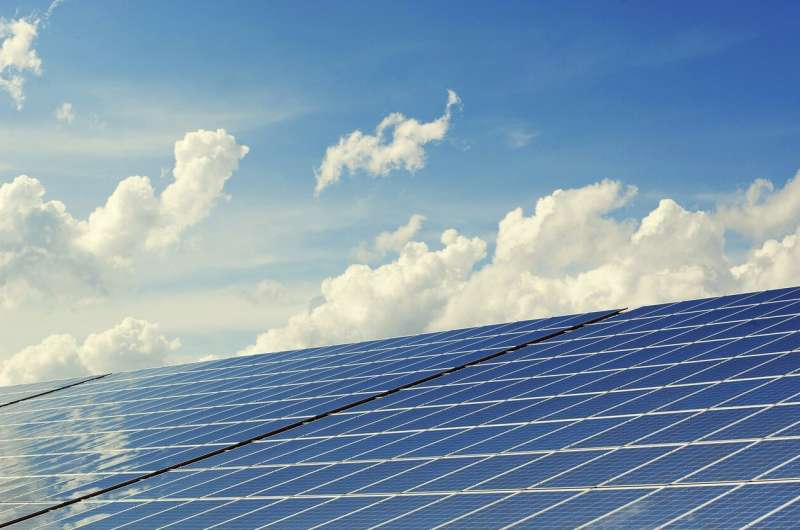
An electrode coating just one molecule thick can significantly enhance the performance of an organic photovoltaic cell, KAUST researchers have found. The coating outperforms the leading material currently used for this task and may pave the way for improvements in other devices that rely on organic molecules, such as light-emitting diodes and photodetectors.
Unlike the most common photovoltaic cells that use crystalline silicon to harvest light, organic photovoltaic cells (OPVs) rely on a light-absorbing layer of carbon-based molecules. Although OPVs cannot yet rival the performance of silicon cells, they could be easier and cheaper to manufacture at a very large scale using printing techniques.
When light enters a photovoltaic cell, its energy frees a negative electron and leaves behind a positive gap, known as a hole. Different materials then gather the electrons and holes and guide them to different electrodes to generate an electrical current. In OPVs, a material called PEDOT:PSS is widely used to ease the transfer of generated holes into an electrode; however, PEDOT:PSS is expensive, acidic and can degrade the cell's performance over time.
The KAUST team has now developed a better alternative to PEDOT:PSS. They use a much thinner coating of a hole-transporting molecule called Br-2PACz, which binds to an indium tin oxide (ITO) electrode to form a single-molecule layer. The organic cell using Br-2PACz achieved a power conversion efficiency of 18.4 percent, whereas an equivalent cell using PEDOT:PSS reached only 17.5 percent.
"We were very surprised indeed by the performance enhancement," says Yuanbao Lin, Ph.D. student and member of the team. "We believe Br-2PACz has the potential to replace PEDOT:PSS due to its low cost and high performance."
Br-2PACz increased the cell's efficiency in several ways. Compared with its rival, it caused less electrical resistance, improved hole transport and allowed more light to shine through to the absorbing layer. Br-2PACz also improved the structure of the light-absorbing layer itself, an effect that may be related to the coating process.
The coating could even improve the recyclability of the solar cell. The researchers found that the ITO electrode could be removed from the cell, stripped of its coating and then reused as if it was new. In contrast, PEDOT:PSS roughens the surface of the ITO so that it performs poorly if reused in another cell. "We anticipate this will have a dramatic impact on both the economics of OPVs and the environment," says Thomas Anthopoulos, who led the research.
Explore further
A flaky option boosts organic solar cells
More information: Yuanbao Lin et al, 18.4 % Organic Solar Cells Using a High Ionization Energy Self‐Assembled Monolayer as Hole‐Extraction Interlayer, ChemSusChem (2021). DOI: 10.1002/cssc.202100707
Provided by King Abdullah University of Science and Technology
Pingy!.................
I wonder what the cost is? So you have a 5% increase in efficiency, but if the cost is a lot higher it may worth it. I am not super educated on solar. It doesn’t work well around here - too much rain, too much cloud cover. Does efficiency help on cloudy/winter days? Or does it just a measure of power output on clear sunny days?
Just under ideal conditions, like in Death Valley..................
I am not opposed to technology, but when it comes to "green" energy solutions the cost is always obfuscated by tax credits, subsidies in production and distribution, rebates from electric companies, and grants from government. That makes it nearly impossible to compare to other forms of energy. Global warming and carbon footprint bull crap are not important to me. Cheap power on the other hand would be great.
Here in Florida, back in the 80’s and 90’s, new homes were built with solar water heaters on roofs all over the place.
Now they are all gone.
But now they are being built with SOLAR PANELS..................
Ooh, let’s squeeze another piddly bit of efficiency out of a non-baseline unreliable power source. EcoNuts must be salivating at their cut when another corrupt politico sets up a taxpayer sponsored project like Solyndra.
It’s carbon based rather than silicon based and can be printed. So significantly cheaper and cleaner than silicon solar panels, but just not as much output as silicon yet.
I think this is the solar film stuff they use on solar LED yard lights.
Our 650 watts of Solar gives us plenty of power on the boat. We run a fridge fans, a tv, 3 laptops and our LED lighting. Wouldn’t mind having a bit more, but, we’d have to add another 100ah battery to the system to do it.
When it is time, hoping the new panels will work even better for us.
Disclaimer: Opinions posted on Free Republic are those of the individual posters and do not necessarily represent the opinion of Free Republic or its management. All materials posted herein are protected by copyright law and the exemption for fair use of copyrighted works.