Posted on 04/28/2021 7:55:38 AM PDT by ConservativeInPA
Calling FReeper historians. Please chime-in with your thoughts.
I have studying some history lately relating to the Spanish-American war, particularly in regards to Cuba, and to a lesser degree to Puerto Rico and the Philippines; Guam not so much.
One line of thought that I have been pursuing is with Cuba. The military success of the Spanish-American War is unquestionable. This is not unlike all wars the US has engaged. My curiosity comes from from the standpoint of success in the freedom of the Cuban people and to a lesser degree in success of US foreign policy.
I contend that Cubanos are a people that have long wanted freedom. That was initially freedom from Spain, and beginning shortly after the Spanish-American war, they also wanted freedom from America. Today, some Cubanos want freedom from communists, but at least that freedom has been from their own commies.
To be transparent, I am looking for arguments for and against US foreign intervention that leads to nation building and under the guise of bringing freedom to foreign peoples that never knew freedom. This part of an analysis that can be applied to Vietnam, Iraq, Afghanistan and others. Please focus comments from the standpoint of successfully providing Cubanos freedom and whether our military or foreign policy should be directed to that end elsewhere.
This is the bible of the war of 1898, IMO.
https://www.amazon.com/War-Spain-1898-David-Trask/dp/0803294298
I live in Puerto Rico and can give you our perspective since we study that war extensively here, and still live with its aftermath. If you’re interested.
Thanks. I’ll put that on my reading list.
Definitely interested. It is a perspective I am interested.
Imagine if we had made The Philippines a State, now with over 100 million people.
The Spanish-American War turned America into an imperialist power (not a good thing). And it gave the country an appetite for intervening when our interests weren’t directly threatened (again, not a good thing).
Just my opinion.
The problem with the type of analyisis that you are looking for is that they typically reflect the belief system of the “historian” more than the actual events.
How many historians does it take to change a lightbulb?
Only one, but to tell anyone else about it you need an entire department: the historian of science to describe the development of electricity; the economic historian to describe the rise of power companies and disposable lightbulbs; the environmental historian to talk about the relationship between replacement bulbs and landfill issues; the political historian to describe the decision-making process in lightbulb replacement; and the social historian to argue about whether more lightbulbs are replaced by women or by men. Graduate students are working on the incandescant-fluorescent issue, but no publications yet.
from Jonathan Dresner
It was a success. It moved the US from a regional power to a global power in a single step.
It also damn near got us into a war with Germany, who wanted the Philippines.
German Plans to invade the US, 1897-1903:
https://en.wikipedia.org/wiki/Imperial_German_plans_for_the_invasion_of_the_United_States
You might justify the expulsion of the Spaniards from their remaining Western Hemisphere outposts, as the Caribbean is in America’s back yard, and Spain’s terminal decline in the 19th Century might have tempted another, more aggressive power, i.e., Germany, to gain a foothold. However. the capture of the Philippines thrust this country into the Pacific Rim, an area in which we had no previous interest. The seizure of Hawaii was another imperial adventure, although you could argue that France, Germany or Britain might have taken those islands had the U.S. not done so.
The U.S. gave the Cuban people the freedom they wanted after the Spanish-American War. Any economic dependency felt by them was internal. Castro and his communist backers wanted to control the country and thus began their “revolt.” Since then we have heard nothing but Communist propaganda about the economic “blight” of the pre-Communist Cuban population.
It will be up to the Cuban people to throw out their Communist rulers. Economics will be the reason but there should be NO U.S. military action. Unfortunately Putin is returning to provide economic support and possibly the Chicoms.
It was “physics.” ie) it was probably unavoidable
Spain was rapidly declining, leaving a vacuum, and some power was automatically going to fill the void.
It was the age of global imperialism, so no doubt those colonies would have fallen into the hands of another European power.
Don’t forget the Monroe Doctrine. It was only 60 years old
manifest destiny “demanded” the US control of the Pacific.
USA culture was unified, strong and proud (IMHO unlike today). People felt it the USA was doing God’s work by taking these places.
A famous poet here wrote that Cuba and Puerto Rico were, of a bird, its two wings. But our histories started diverging at the end of the 19th century. While Cuba had a strong independence movement by the time of the war with the U.S., Puerto Rico did not.
Puerto Rico had a large Spanish-loyalist population yet. In the 1897 Carta Autonómica (Autonomy Charter), Puerto Ricans had achieved full Spanish citizenship and the island had become a full fledged Spanish Overseas Province. Most Puerto Ricans were okay with that.
But what did ‘Puerto Ricans’ consist of, needs to be clarified. There was a large native or creole segment of the population, but there was also a significantly large population of South American Spanish loyalists displaced by the wars of independence in that continent.
There was also a large population lured to the island during the mid to late 1800s by the ‘Real Cédula de Gracias’ or Royal Decree of Graces, where Spain encouraged Spaniards and non-Spaniard Europeans to settle here. My great grandfather came with this group.
So, when the war of 1898 happened, you can imagine that a very large section of the population resented the change. To this day, many Spanish families still do and keep their ties to Spain, including citizenship.
You will read in Trask’s book that it was the intent of the U.S. all along to annex Puerto Rico, as opposed to granting its independence. So, in our sense it was not a war of ‘liberation’ but a full on grab.
From there on it has been a struggle by the US to manage Puerto Rico, until 1952 when it was granted “Commonwealth” status, a quasi statehood arrangement. If you read my profile here, you will see what that constitutional struggle was about.
I won’t go further into the current US-Puerto Rico issues, as your focus is the war itself. I’ll just say that today most Puerto Ricans feel very much a part of the US. In fact, most Puerto Ricans now live on the mainland.
Very interesting question. In the long run both the Philippines and Puerto Rico csot us far more then we ever got in return.
The effect on Spain also has to be considered. The defeat destabilized their government and without it there may have been no civil war in the 30s.
It was a success in that we won, but we probably should have given the Philippines and Puerto Rico their independence (while holding on to naval and military bases) as we did Cuba.
The Spanish American War was a failure.
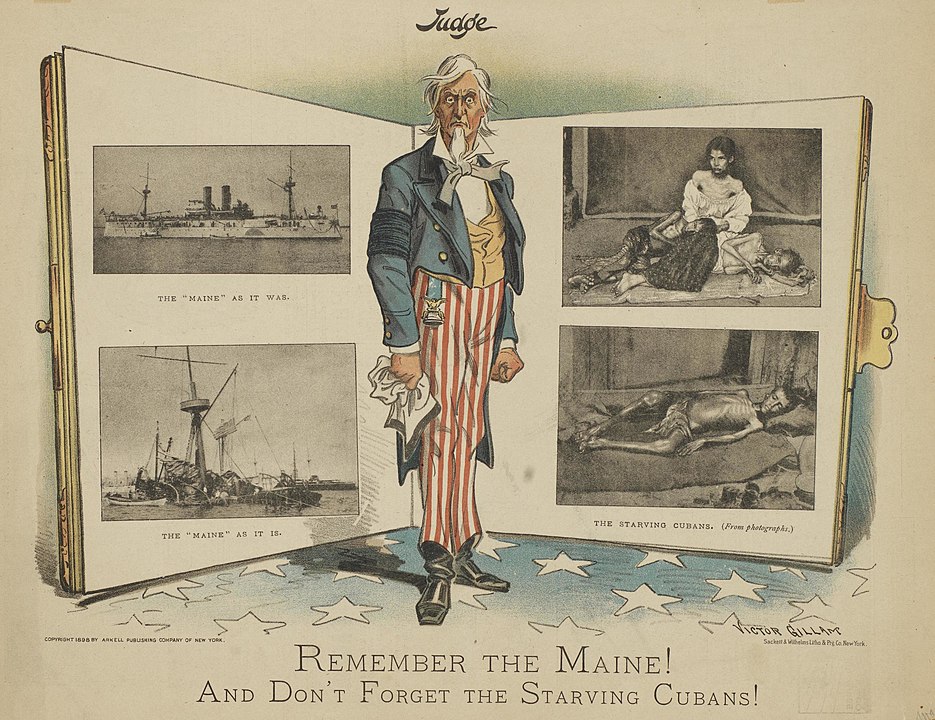
It goes down in history as the first war started by the MSM.
Yellow Journalism as it was known back then was primarily responsible for ginning up lies and distortions that provoked America into that war.
Cuba, Vietnam, Iraq and Afghanistan had American interventions for different reasons
Cuba - people were in two minds about independence or not. The US got involved really due to Hearst stirring up the US in his newspapers. The USA shouldn't have gotten involved
Vietnam - this was denying the commies. The mistake was allying with the colonial power. That made it from US vs commies to US+colonials vs freedom fighters
Iraq I and II were mistakes in my mistake
Afghanistan was hitting back at Al Qaeda. Not about nation building
Did we do some of the same in Cuba? Let's forget all of the yellow journalism leading up to 1898. Forget about the USS Maine. Once we defeated Spain, did we attempt nation building? Did we try to win the hearts and minds of Cubanos? I am fine with an answer in the affirmative, negative or somewhere in between. What interest me is the period of time after the war of 1898 until the Castros taking power.
Disclaimer: Opinions posted on Free Republic are those of the individual posters and do not necessarily represent the opinion of Free Republic or its management. All materials posted herein are protected by copyright law and the exemption for fair use of copyrighted works.