Posted on 04/04/2021 4:27:51 PM PDT by MtnClimber
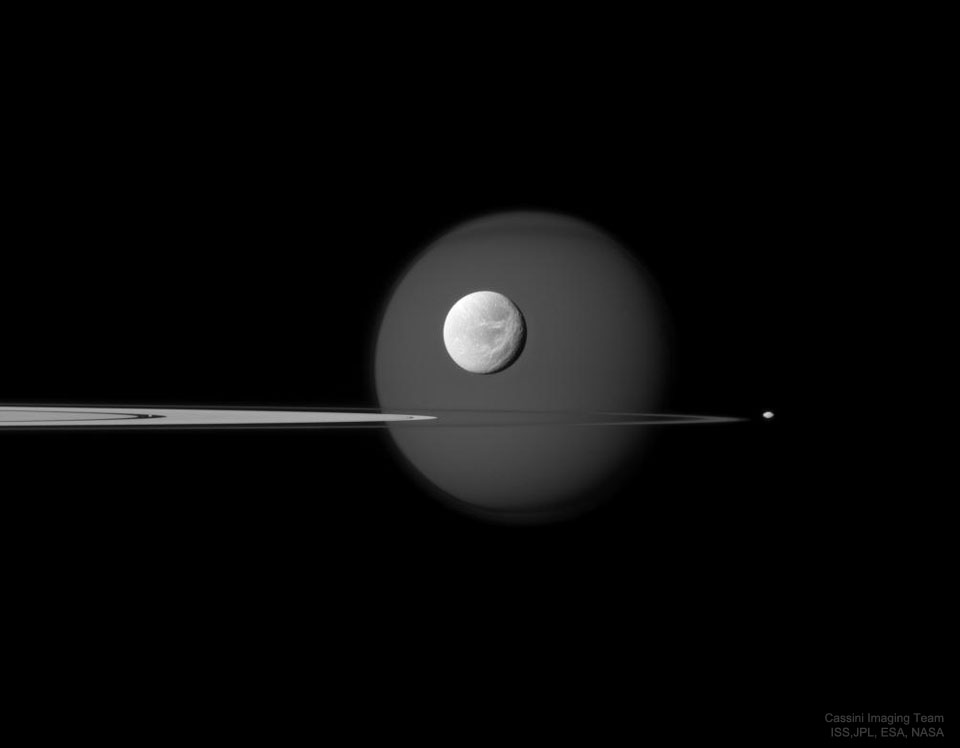
Explanation: Four moons are visible on the featured image -- can you find them all? First -- and farthest in the background -- is Titan, the largest moon of Saturn and one of the larger moons in the Solar System. The dark feature across the top of this perpetually cloudy world is the north polar hood. The next most obvious moon is bright Dione, visible in the foreground, complete with craters and long ice cliffs. Jutting in from the left are several of Saturn's expansive rings, including Saturn's A ring featuring the dark Encke Gap. On the far right, just outside the rings, is Pandora, a moon only 80-kilometers across that helps shepherd Saturn's F ring. The fourth moon? If you look closely inside Saturn's rings, in the Encke Gap, you will find a speck that is actually Pan. Although one of Saturn's smallest moons at 35-kilometers across, Pan is massive enough to help keep the Encke gap relatively free of ring particles. After more than a decade of exploration and discovery, the Cassini spacecraft ran low on fuel in 2017 and was directed to enter Saturn's atmosphere, where it surely melted.
For more detail go to the link and click on the image for a high definition image. You can then move the magnifying glass cursor then click to zoom in and click again to zoom out. When zoomed in you can scan by moving the side bars on the bottom and right side of the image.
bttt
@MC....
Love the pictures and I enjoy debunking these so-called scientists.
Unfortunately, they never seem to respond to my emails questioning the findings or allow any comments.
Thanks again though...
“The dark Encke Gap”
A place where time, space and the heartbreak of psoriasis all meet to form something new.....something unexpected.....something that scares cats.
“Saturns F’ing ring”
Seems kind of harsh.
Wow. Very cool.
What about the rings around Ouranos?
I wish NASA would post good photos of the rings around Uranus.
That’s what I said!
😁
Thanks! I guess I would have thought all of the moons would have been on the same axis as the rings.
https://hubblesite.org/video/27-science-visualization-of-moons-crossing-the-face/science
Here is a visualization of their orbits. They all follow and stay on their own latitudes - I never knew that. I wonder how that happened? I would have thought they would have orbited the center of the mass of Saturn.
Disclaimer: Opinions posted on Free Republic are those of the individual posters and do not necessarily represent the opinion of Free Republic or its management. All materials posted herein are protected by copyright law and the exemption for fair use of copyrighted works.