
Posted on 03/23/2021 6:13:54 AM PDT by Homer_J_Simpson


Free Republic University, Department of History presents U.S. History, 1855-1860: Seminar and Discussion Forum
Bleeding Kansas, Dred Scott, Lincoln-Douglas, Harper’s Ferry, the election of 1860, secession – all the events leading up to the Civil War, as seen through news reports of the time and later historical accounts
First session: November 21, 2015. Last date to add: Sometime in the future.
Reading: Self-assigned. Recommendations made and welcomed.
Posting history, in reverse order
https://www.freerepublic.com/tag/by:homerjsimpson/index?tab=articles
To add this class to or drop it from your schedule notify Admissions and Records (Attn: Homer_J_Simpson) by reply or freepmail.
Link to previous Harper’s Weekly thread
https://freerepublic.com/focus/f-chat/3942611/posts
Heh. Same as it ever was.
It is announced positively that the authorities in Pensacola and Charleston have refused to allow any further supplies to be sent to Fort Pickens, the United States fleet in the Gulf, and to Fort Sumter. Everywhere the Southern leaders are forcing on a solution with decision and energy, whilst the Government appears to be helplessly drifting with the current of events, having neither bow nor stern, neither keel nor deck, neither rudder, compass, sails, or steam. Mr. Seward has declined to receive or hold any intercourse with the three gentlemen called Southern Commissioners, who repaired to Washington accredited by the Government and Congress of the Seceding States now sitting at Montgomery, so that there is no channel of mediation or means of adjustment left open. I hear, indeed, that Government is secretly preparing what force it can to strengthen the garrison at Pickens, and to reinforce Sumter at any hazard; but that its want of men, ships, and money compels it to temporize, lest the Southern authorities should forestall their designs by a vigorous attack on the enfeebled forts.
There is, in reality, very little done by New York to support or encourage the Government in any decided policy, and the journals are more engaged now in abusing each other, and in small party aggressive warfare, than in the performance of the duties of a patriotic press, whose mission at such a time is beyond all question the resignation of little differences for the sake of the whole country, and an entire devotion to its safety, honor, and integrity. But the New York people must have their intellectual drams every morning, and it matters little what the course of Government may be, so long as the aristocratic democrat can be amused by ridicule of the Great Rail Splitter, or a vivid portraiture of Mr. Horace Greeley's old coat, hat, breeches, and umbrella. The coarsest personalities are read with gusto, and attacks of a kind which would not have been admitted into the “Age” or “Satirist” in their worst days, form the staple leading articles of one or two of the most largely circulated journals in the city. “Slang” in its worst Americanized form is freely used in sensation headings and leaders, and a class of advertisements which are not allowed to appear in respectable English papers, have possession of columns of the principal newspapers, few, indeed, excluding them. It is strange, too, to see in journals which profess to represent the civilization and intelligence of the most enlightened and highly educated people on the face of the earth, advertisements of sorcerers, wizards, and fortunetellers by the score — “wonderful clairvoyants,” “the seventh child of a seventh child,” “mesmeristic necromancers,” and the like, who can tell your thoughts as soon as you enter the room, can secure the affections you prize, give lucky numbers in lotteries, and make everybody's fortunes but their own. Then there are the most impudent quack programmes — very doubtful “personals” addressed to “the young lady with black hair and blue eyes, who got out of the omnibus at the corner of 7th Street” — appeals by “a lady about to be confined” to “any respectable person who is desirous of adopting a child:” all rather curious reading for a stranger, or for a family.
It is not to be expected, of course, that New York is a very pure city, for more than London or Paris it is the sewer of nations. It is a city of luxury also — French and Italian cooks and milliners, German and Italian musicians, high prices, extravagant tastes and dressing, money readily made, a life in, hotels, bar-rooms, heavy gambling, sporting, and prize-fighting flourish here, and combine to lower the standard of the bourgeoisie at all events. Where wealth is the sole aristocracy, there is great danger of mistaking excess and profusion for elegance and good taste. To-day as I was going down Broadway, some dozen or more of the most over-dressed men I ever saw were pointed out to me as “sports;” that is, men who lived by gambling-houses and betting on races; and the class is so numerous that it has its own influence, particularly at elections, when the power of a hard-hitting prize-fighter with a following makes itself unmistakably felt. Young America essays to look like martial France in mufti, but the hat and the coat suited to the Colonel of Carabiniers en retraite do not at all become the thin, tall, rather long-faced gentlemen one sees lounging about Broadway. It is true, indeed, the type, though not French, is not English. The characteristics of the American are straight hair, keen, bright, penetrating eyes, and want of color in the cheeks.
SOURCE: William Howard Russell, My Diary North and South, p. 26-8
https://civilwarnotebook.blogspot.com/2015/02/diary-of-william-howard-russell-march.html
Good afternoon Professor.
April 12, 1861 is fast approaching.
If I were Maj. Anderson, (I know he made it to Appomattox), I would be shitin’ bricks.
On a side note, there has been mucho activity at MacDill AFB this past week. (I posted this a few days ago on FR)
Interesting.
5.56mm
https://freerepublic.com/focus/f-chat/3942611/posts#37

Bruce Catton, The Coming Fury
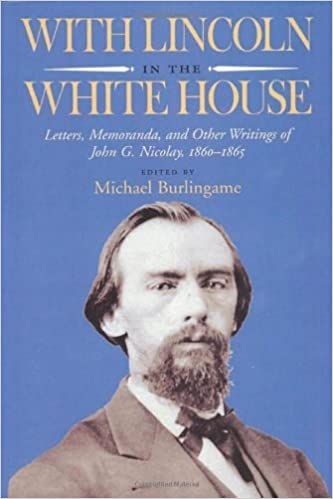

With Lincoln in the White House: Letters, Memoranda, and Other Writings of John G. Nicolay, 1860-1865, edited by Michael Burlingame
It nice to see that government emissaries were not any more useful in 1861 than they are today.
So, contrary to what DiogenesLamp has been telling us, it had nothing to do with the question of "resupply" versus "reinforcement", but rather any effort to support Fort Sumter was casus belli in Confederate eyes.
Of course, such threats by Confederates were, in themselves, acts of war against the United States.
LOWELL, March 25, '61
MY GOOD LITTLE BLANCHE: I was glad that your visit to Washington on the occasion of the Inauguration gave you so much pleasure. The apples too were very carefully put up that you might feel that father had not forgotten you. Your letters, neatly written, generally well composed, and correct in language please me much. The only drawback I have is your persistent quarrel with the Latin. You say that it will do you no good hereafter. You will allow, I know, that I am the better judge upon that point; and I assure you if I did not believe that in after life you would thank me for insisting upon your further pursuit of the language I would yield to your wish. Not to enter into a labored argument to prove its usefulness, will you remember that the Latin is the foundation of at least five of the modern languages most in use, as a part of our own language and a most powerful auxilliary to our own – that you may see how much we are in debt to it I have checked the words (thus) derived in whole or part from it. You will find your path so strewn with Latin flowers while you acquire the Spanish or the Italian that you will remember with pleasure the pain of Sister Augustine's teachings. I am much obliged to you for your “cards.” If you could fully appreciate a father's pride in the well doing of a darling child a new incentive would be added to the conscientious discharge of your duty which you now I believe most fully do.
Do not permit idle gossip of idle people to annoy you. While you do as well as you now do you can have no cause to fear anything however malicious. You see, I have written you precisely as if you were a “big girl” instead of a very little one, but you know I have always treated you more like a woman than a child, and have appealed to your good sense and judgment rather than to the childish motives of hope of reward or fear of chiding. I look forward with almost as much pleasure as you can do to our excursion which we shall have together in our vacation.
FATHER
SOURCE: Jessie Ames Marshall, Editor, Private and Official Correspondence of Gen. Benjamin F. Butler During the Period of the Civil War, Volume 1: April 1860 – June 1862, p. 14
https://civilwarnotebook.blogspot.com/2015/10/brigadier-general-benjamin-f-butler-to.html
I had an invitation to meet several members of the New York press association at breakfast. Among the company were — Mr. Bayard Taylor, with whose extensive notes of travel his countrymen are familiar — a kind of enlarged Inglis, full of the genial spirit which makes travelling in company so agreeable, but he has come back as travellers generally do, satisfied there is no country like his own — Prince Leeboo loved his own isle the best after all — Mr. Raymond, of the “New York Times” (formerly Lieutenant-Governor of the State); Mr. Olmsted, the indefatigable, able, and earnest writer, whom to describe simply as an Abolitionist would be to confound with ignorant if zealous, unphilosophical, and impracticable men; Mr. Dana, of the “Tribune;” Mr. Hurlbut, of the “Times;” the Editor of the “Courier des Etats Unis;” Mr. Young, of the “Albion,” which is the only English journal published in the States; and others. There was a good deal of pleasant conversation, though every one differed with his neighbor, as a matter of course, as soon as he touched on politics. There was talk de omnibus rebus et quibusdam aliis, such as Heenan and Sayers, Secession and Sumter, the press, politicians, New York life, and so on. The first topic occupied a larger place than it was entitled to, because in all likelihood the sporting editor of one of the papers who was present expressed, perhaps, some justifiable feeling in reference to the refusal of the belt to the American. All admitted the courage and great endurance of his antagonist, but seemed convinced that Heenan, if not the better man, was at least the victor in that particular contest. It would be strange to see the great tendency of Americans to institute comparisons with ancient and recognized standards, if it were not that they are adopting the natural mode of judging of their own capabilities. The nation is like a growing lad who is constantly testing his powers in competition with his elders. He is in his youth and nonage, and he is calling down the lanes and alleys to all comers to look at his muscle, to run against or to fight him. It is a sign of youth, not a proof of weakness, though it does offend the old hands and vex the veterans.
Then one finds that Great Britain is often treated very much as an old Peninsula man may be by a set of young soldiers at a club. He is no doubt a very gallant fellow, and has done very fine things in his day, and he is listened to with respectful endurance, but there is a secret belief that he will never do anything very great again.
One of the gentlemen present said that England might dispute the right of the United States Government to blockade the ports of her own States, to which she was entitled to access under treaty, and might urge that such a blockade was not justifiable; but then, it was argued, that the President could open and shut ports as he pleased; and that he might close the Southern ports by a proclamation in the nature of an Order of Council. It was taken for granted that Great Britain would only act on sordid motives, but that the well known affection of France for the United States is to check the selfishness of her rival, and prevent a speedy recognition.
SOURCE: William Howard Russell, My Diary North and South, p. 28-9
https://civilwarnotebook.blogspot.com/2015/02/diary-of-william-howard-russell-march_8.html
As a boy I learned some German & French, a poor student at both can today remember only a few words and almost never need those.
Latin, on the other hand, would be very useful to know -- everything from E Pluribus Unum to casus belli comes up frequently in daily news reports.
Especially the news from 1861!
So I agree with "the Beast's" recommendation to learn Latin.


Mary Chesnut’s Diary, Edited by Isabella D. Martin and Myrta Lockett Avary
Entry from the “Diary of William Howard Russell: March 26, 1861.” It’s pretty long so I’m only posting the link. It’s well worth the click. Russell journeys from NY City to D.C. via Philadelphia and describes the trip in amusing detail. After getting settled at the Willard Hotel he gets introduced to Secretary of State Seward and is granted an interview. Here we can get a first-person description of that talk. Later we will get if filtered through the NY Times and maybe Harper’s.
https://civilwarnotebook.blogspot.com/2015/02/diary-of-william-howard-russell-march_14.html
I was talking to Edmund Ruffin the other day. He said if it were up to him he’d blast those Damn Yankees out of Fort Sumter.

Continued from March 16 (reply #3).
https://freerepublic.com/focus/f-chat/3942611/posts#3
[I believe Goodwin errs in saying that Lincoln’s first state dinner was that same day. We learn from William Russell’s diary it will be tomorrow evening. See Russell’s diary entry for today in a following reply. – HJS]


Doris Kearns Goodwin, Team of Rivals
“Soon afterwards there entered, with a shambling, loose, irregular, almost unsteady gait, a tall, lank, lean man, considerably over six feet in height, with stooping shoulders, long pendulous arms, terminating in hands of extraordinary dimensions, which, however, were far exceeded in proportion by his feet. He was dressed in an ill-fitting, wrinkled suit of black, which put one in mind of an undertaker's uniform at a funeral; round his neck a rope of black silk was knotted in a large bulb, with flying ends projecting beyond the collar of his coat; his turned-down shirt-collar disclosed a sinewy muscular yellow neck, and above that, nestling in a great black mass of hair, bristling and compact like a ruff of mourning pins, rose the strange quaint face and head, covered with its thatch of wild republican hair, of President Lincoln. The impression produced by the size of his extremities, and by his flapping and wide projecting ears, may be removed by the appearance of kindliness, sagacity, and the awkward bonhommie of his face; the mouth is absolutely prodigious; the lips, straggling and extending almost from one line of black beard to the other, are only kept in order by two deep furrows from the nostril to the chin; the nose itself—a prominent organ — stands out from the face, with an inquiring, anxious air, as though it were sniffing for some good thing in the wind; the eyes dark, full, and deeply set, are penetrating, but full of an expression which almost amounts to tenderness; and above them projects the shaggy brow, running into the small hard frontal space, the development of which can scarcely be estimated accurately, owing to the irregular flocks of thick hair carelessly brushed across it. One would say that, although the mouth was made to enjoy a joke, it could also utter the severest sentence which the head could dictate, but that Mr. Lincoln would be ever more willing to temper justice with mercy, and to enjoy what he considers the amenities of life, than to take a harsh view of men's nature and of the world, and to estimate things in an ascetic or puritan spirit. A person who met Mr. Lincoln in the street would not take him to be what — according to the usages of European society — is called a “gentleman;” and, indeed, since I came to the United States, I have heard more disparaging allusions made by Americans to him on that account than I could have expected among simple republicans, where all should be equals; but, at the same time, it would not be possible for the most indifferent observer to pass him in the street without notice.”
https://civilwarnotebook.blogspot.com/2015/02/diary-of-william-howard-russell-march_16.html
Washington D.C.
Mch. 27 ’61
D. V
“Circumlocution” and delay prevents me going today so I write and will not telegraph. There being a Dr Fox in the navy I am not supposed to be the visitor by any of my friends here, though as I told you Nell smoked me out. The Tribune of yesterday has my name in full but in an out of the way place, whilst Dr. Fox of the navy is conspicuous. I hope your Ma got all our things which were lying about every where, slippers under the bureau &c. &c. In the stand of your bureau were bills, receipts &c which ought to be secured. I asked Lowery to give you money to settle up with. Blair is nearly run to death with office seekers. They left him at 2 this morning and commenced at 8 this morning. The Prest is equally beset. I have seen Abe often, also Mrs. L. She is Lady Like, converses easily, dresses well and has the Kentucky pronunciation like old Mrs. Blair. Higbee is appointed a marine officer. Morse is to have the P.O. at Portsh and Tallock, Gov. Goodwin's Secy, is to be Collector. Nell is mighty indignant that Spalding and Laighton are out. Probably something else will be offered them, though I don't know.
SOURCES: Robert Means Thompson & Richard Wainwright, Editors, Publications of the Naval Historical Society, Volume 9: Confidential Correspondence of Gustavus Vasa Fox, Assistant Secretary of the Navy, 1861-1865, Volume 1, p. 11
https://civilwarnotebook.blogspot.com/2018/03/gustavus-v-fox-to-virginia-woodbury-fox_21.html


Mary Chesnut’s Diary, Edited by Isabella D. Martin and Myrta Lockett Avary

Bruce Catton, The Coming Fury

Continued from January 22 (reply #22).
https://freerepublic.com/focus/f-chat/3926715/posts#22


Douglas Southall Freeman, Lee, an abridgement by Richard Harwell
Mr. Trumbull submitted the following resolution; which was ordered to be printed:
Resolved, That, in the opinion of the Senate, the true way to preserve the Union is to enforce the laws of the Union; that resistance to their enforcement, whether under the name of anti-coercion or any other name, is encouragement to disunion, and that it is the duty of the President to use all the means in his power to hold and protect the public property of the United States, and enforce the laws thereof, as well in the States of South Carolina, Georgia, Florida, Mississippi, Alabama, Louisiana, and Texas, as within the other States of the Union.
The Senate proceeded by unanimous consent to consider the said resolution; and,
On the question to agree to the resolution,
On motion by Mr. Sumner, that the Senate proceed to the consideration of executive business,
It was determined in the affirmative,
Yeas 25
Nays 11
On motion by Mr. Bright, The yeas and nays being desired by one fifth of the senators present,
Those who voted in the affirmative are,
Messrs. Anthony, Baker, Chandler, Clark, Collamer, Cowan, Dixon, Doolittle, Fessenden, Foot, Foster, Grimes, Hale, Harris, Howe, Johnson, King, Lane, Morrill, Sherman, Simmons, Sumner, Ten Eyck, Wilmot, Wilson.
Those who voted in the negative are,
Messrs. Breckinridge, Bright, Clingman, Douglas, Kenuedy, Mitchel, Nesmith, Nicholson, Powell, Trumbull, Wade.
So the motion was agreed to; and,
After the consideration of executive business,
The doors were opened.
SOURCE: Journal of the Senate of the United States of America, Being the Second Session of the Thirty-Sixth Congress; Begun and Held at the City of Washington, December 3, 1860, p. 431
https://civilwarnotebook.blogspot.com/2016/09/resolution-of-senator-lyman-trumbull.html
I’m adding a second reply for the Civil War Notebook to ensure a live link to W.H. Russell’s diary entry. He describes a state dinner at the White House in such a way that it allows the reader to feel like he was there. Don’t miss it. Incidentally, the starving artist that Russell meets at the Willard is named T.R. Davis, as we will be told in the pages of the NY Times on April 5.
I’ve posted letters form Charles Russell Lowell before. He is a young New England industrialist who will die at Cedar Creek in 1861.
Diary of William Howard Russell: March 28, 1861
https://civilwarnotebook.blogspot.com/2015/03/diary-of-william-howard-russell-march.html
Charles Russell Lowell to Anna Cabot Jackson Lowell, March 28, 1861
https://civilwarnotebook.blogspot.com/2014/10/charles-russell-lowell-to-anna-cabot.html
Disclaimer: Opinions posted on Free Republic are those of the individual posters and do not necessarily represent the opinion of Free Republic or its management. All materials posted herein are protected by copyright law and the exemption for fair use of copyrighted works.