
Posted on 02/10/2021 9:02:28 AM PST by Red Badger
Now that the bin-fire that was 2020 is in our rear view mirror, social media is making a return to serious discussions that truly matter. Like how many colors a thing has. Again.
Earlier this month, a classic optical illusion was posted on Twitter with the question "How many colors do you see?" The poster saw three.
How many colors do you see???? i see 3 pic.twitter.com/IgEHtyzebZ
— jade⁷🍓(slow ♡) (@0UTR0EG0) February 4, 2021 Others replied with numbers as high as 17. And tens of thousands of comments followed in heated debate on what the 'true' figure must be.
We here at ScienceAlert don't have a strong opinion on how many distinct bands are in the image (it's 11, right?). But we can help provide some insight into what's likely going on.
While it's hard to say for sure, the phenomenon at work is most probably due to an effect first described around a century and half ago by the Austrian physicist Ernst Mach, the same scientist who lent his name to the unit comparing an object's speed with the speed of sound.
Only in this instance, Mach's interest had less to do with speed, and more with sight. While working as a professor of mathematics and physics at the University of Graz in the 1860s, he developed a deep interest in optics and acoustics.
In 1865 he took interest in an illusion similar to the one we're all marvelling at now – similar colors of slightly contrasting shades becoming easily distinguishable when they touch, but harder to tell apart when separated.
Mach's understanding was that something weird was going on inside the eyeball, specifically within the photosensitive tissue making up the retina. Later these shaded stripes would become known as Mach Bands in his honour.
Remarkably, his speculations were pretty bang-on. Research using better technology than Mach ever hoped to have access to has since confirmed the mechanics behind this weird trick-of-the-eye as a retinal behavior called lateral inhibition.
Here's the 101: your retina is a bit like the screen at the cinema, capturing light projected through the pupil. This screen is covered in receptors, some of which will react more vigorously under brighter light and send a barrage of signals to the brain.
If we imagine two cells sending two very similar signals to the brain, we might simply assume they're the same shade. Our brain loves shortcuts, and in a busy world it really doesn't have time for splitting hairs.
But nature has evolved a clever trick to help our brain distinguish patterns more easily among similar shades. Whenever an individual light-sensitive cell sends a signal, it tells its immediate neighbours to shush.
This competition makes little difference among groups of cells all shouting and shushing as loudly as one another.
But when a quieter group of cells, reacting to a darker shade, sits right next to loud cells, this inhibitory influence over cells right on the boundary forces them to respond in a unique way, effectively enhancing the difference between the shades.
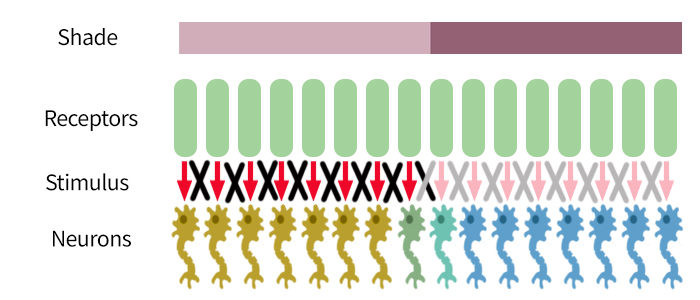
The diagram above might help understand what's happening. Brighter light causes receptors to trigger its corresponding nerve cell more intensely. At the same time, each light-sensitive cell dampens the nerves of its neighbours.
The result are nerves on the border between different shades sending signals that enhance the difference, providing a clear boundary signal for your brain to pick up.
This ability plays a part in a variety of optical illusions, including a maddening 'scintillating grid' of dots you can never quite set your focus on.
While lateral inhibition explains why our eyes can tell similar shades apart better when they're side-by-side, it doesn't quite explain why some of us can't tell the difference between colors of barely contrasting brightness, such as in this illusion.
Inhibitory influences in our cells might be something we all experience to a various extent, but it's also unlikely to be the only factor telling our brain how to interpret an image. Many of which will be unique to our eyes, brains, computer screens, and surrounding environments.
Surrounding light sources, differences in the brightness of our screens and monitors, and even the precise cellular make-up of our retina will all vary. Our brains will also add a level of correction in their own unique way depending on their experience and hard wiring.
Given so many variables, it's to be expected we won't all agree on exactly where one shade of pink stops and the next starts.
This is all fun and games on Twitter, but understanding more about how our retinas enhance differences in the shades that fall on them can help us find ways to improve our vision.
Now, keep in mind, we don't lay claim to being experts in optics here at ScienceAlert. This is all speculation from one science writer who happens to have a deep love for the psychology of illusions.
But we do know that beyond questions of how many colors (or, more accurately, hues, tones, tints, and shades) are in the rectangle, there is some fascinating biology going on that can tell us a great deal about what we have in common.
I see 10?...
Do the thin lines count as colors?
I see 8.
I see 8.
Women will see more than men.....................
“Women will see more than men...”
Yup.
The less “information” you have to process, the better you’ll be able to determine this.
2 adjacent colors can ghost a third color and as your eye moves across the digital image, your reception of the less focused areas will change.
Make a matte with a cut out box to view only a small area at a time. Process from one color to the next and tally that.
I see 7.
Well, we only have three color receptors in our eyes, so....
I see 11, and possibly 12 if you count that thin slice between the dark purple and gray hue.
I see 11, but many are varying shades of the same color.
That’s what I was questioning.
I see at least eleven, but I think this also has to do with your monitor. This is a bit like comparing the sound quality of different record phono cartridges by listening to a youtube video. It’s not difinitive.
One interesting thing I noticed was that after examining the narrower bars on the left, when I looked back at the two “fat” bars on the right, they suddently were obviously a lot more colors. i.e. I could see the subtle differences I couldn’t see at first.
I’ve heard that no culture had a word for the color “blue” until just a few hundred years ago. And this video about “brown” is truly fascinating. It turns out that language actually filters how we see the world.
https://www.youtube.com/watch?v=wh4aWZRtTwU
What about males that identify as women?
Are they in between?...
14 or more? It’s a bit harder to distinguish shades on the right than on the left, perhaps because the right is darker.
I think 22 - maybe more but the glare on my screen makes it tricky!
You’re exactly correct about the monitor. The color depth of your display driver will have a big effect as well. The comparison to phono carts heard through YouTube is dead on the money.
I initially counted 11, but brought the image into a graphics program and hit “count colors”, and it says “the number of unique colors in this layer is 132”. Since the image is a .jpg, I’m guessing that the compression used accounts for the large number, and most of these “unique colors” are probably found in the areas where the colors we can actually see meet one another.
I saw 15
Disclaimer: Opinions posted on Free Republic are those of the individual posters and do not necessarily represent the opinion of Free Republic or its management. All materials posted herein are protected by copyright law and the exemption for fair use of copyrighted works.