Posted on 01/15/2021 8:54:38 AM PST by Red Badger
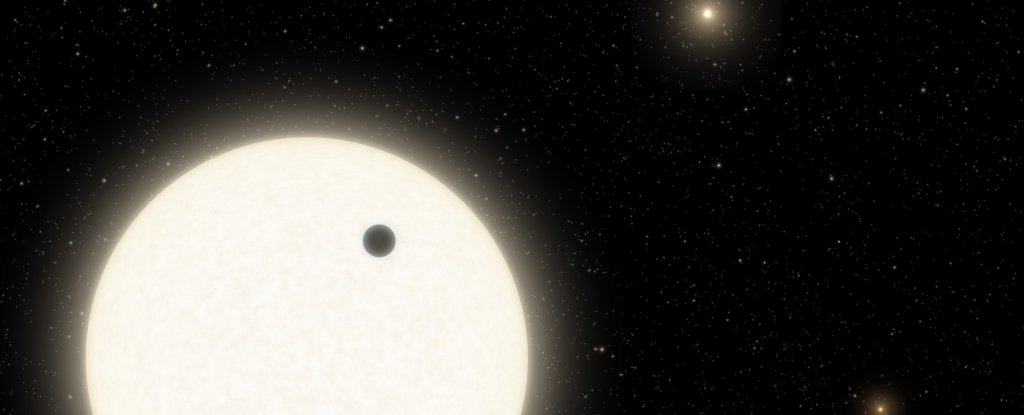
Artist's impression of the KOI-5 system. (Caltech/R. Hurt (IPAC))
------------------------------------------------------------------------------------------
To us humans, a single Sun feels completely normal, but our Solar System is actually a weird outlier. Most stars in the Milky Way galaxy have at least one companion star. Now, in a system 1,800 light-years away, astronomers have finally confirmed a gas giant planet orbiting a star in a triple star system.
This system, called KOI-5, is located in the constellation of Cygnus, and the exoplanet therein has been confirmed more than a decade after it was first detected by the Kepler planet-hunting space telescope.
In fact, the planet - now known as KOI-5Ab - was the second candidate exoplanet detection made by Kepler when it commenced operations back in 2009. But it fell by the wayside.
"KOI-5Ab got abandoned because it was complicated, and we had thousands of candidates," said astronomer David Ciardi of NASA's Exoplanet Science Institute.
"There were easier pickings than KOI-5Ab, and we were learning something new from Kepler every day, so that KOI-5 was mostly forgotten."
Exoplanet hunters tend to avoid the complexities of multi-star systems; of the over 4,300 exoplanets confirmed to date, fewer than 10 percent belong to multi-star systems, even though such systems dominate the galaxy. As a result, very little is known about the properties of exoplanets in multi-star systems, compared to those that orbit a lone star.
Following Kepler's detection, Ciardi and other astronomers had used ground-based telescopes such as the Palomar Observatory, the WM Keck Observatory and the Gemini North telescope to study the system. By 2014, they had identified two companion stars, KOI-5B and KOI-5C.
This made it extremely difficult to figure out if the dip in starlight observed by Kepler was caused by an exoplanet or something else. The project was popped into the too-hard basket.
In 2018, Kepler's successor TESS picked up the job. And when TESS looked at Cygnus, it, too, pinged a candidate exoplanet orbiting KOI-5A.
"I thought to myself, 'I remember this target'," Ciardi said. "But we still couldn't determine definitively if the planet was real or if the blip in the data came from another star in the system - it could have been a fourth star."
He and his team got to work, reanalysing all previous data. In an excellent testament to the abilities of our planet-hunting telescopes, the researchers found that yes, there is indeed an exoplanet in orbit around KOI-5A, at a skewed angle to at least one of the stars in the triple system.
"We don't know of many planets that exist in triple-star systems, and this one is extra special because its orbit is skewed," Ciardi said.
What the scientists were able to ascertain is that the planet, KOI-5Ab, is probably a gas giant about half the mass of Saturn and 7 times the size of Earth, on a very close five-day orbit around KOI-5A. KOI-5A and KOI-5B, both around the same mass as the Sun, form a relatively close binary, with an orbital period of about 30 years.
The third star, KOI-5C, orbits the binary at a much larger distance, with a period of about 400 years - a bit larger than Pluto's 248-year orbit.
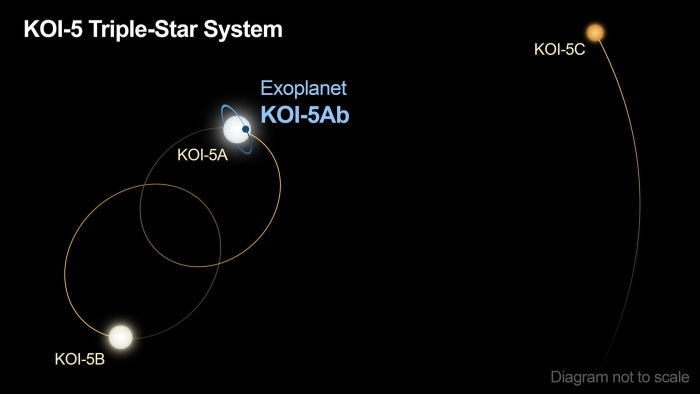
So, if you were able to stand on KOI-5Ab, KOI-5A would dominate the sky. KOI-5B would look a lot like the Sun would look from Saturn (Saturn's on a 29-year solar orbit). And KOI-5C would look like a very bright star.
And the orbit of KOI-5Ab is misaligned with KOI-5B, which is interesting. If all objects had formed from the same swirling disc of material, they should be aligned more or less on the same plane, like the planets of the Solar System around the Sun's equator. The researchers think that KOI-5B could have gravitationally perturbed the exoplanet's orbit, kicking it out of alignment while the planet was forming.
We've seen other evidence that suggests this can happen. A triple star system was revealed last year with a majorly wonky protoplanetary disc. Any planets that form therein will likely end up on pretty weird orbits.
So, while we haven't confirmed many exoplanets in triple star systems, finding more will help astronomers model these processes and figure out the wild dynamics involved.
"We still have a lot of questions about how and when planets can form in multiple-star systems and how their properties compare to planets in single-star systems," Ciardi said.
"By studying this system in greater detail, perhaps we can gain insight into how the Universe makes planets."
The discovery was announced at the 237th meeting of the American Astronomical Society.
no daughters?
Naaaa...we’ve know about that place for years.
That’s where the Clintonians a likely from. /s
Really wonder who reviews and validates this data and these “observations”. The humans who do it and the computers they program have their own imaginations, flaws and bias.


I just KNEW somebody would do that and I guessed it was you!......................
Non-binary genetic descendants. :-)
dfwgator beat you to it!.............................
Uncle Charlie was a ray of sunshine.
:-)
The math is the answer.....................

Maybe a tranny............................
If we're mostly looking for planets that can harbor life then I think it is a great thing that astronomers have been focusing their efforts on single star systems.

...also, the more stars in the system the more “solar wind” that can strip off whatever atmosphere is generated.
It’s a safe guess, isn’t it?
Although I’m still miffed about somebody beating me out on that Matthew McConaughey thread yesterday.
I wonder why none of the cast ‘sons’ ever became movie stars?...................
Disclaimer: Opinions posted on Free Republic are those of the individual posters and do not necessarily represent the opinion of Free Republic or its management. All materials posted herein are protected by copyright law and the exemption for fair use of copyrighted works.