Posted on 01/07/2021 8:03:34 AM PST by Red Badger
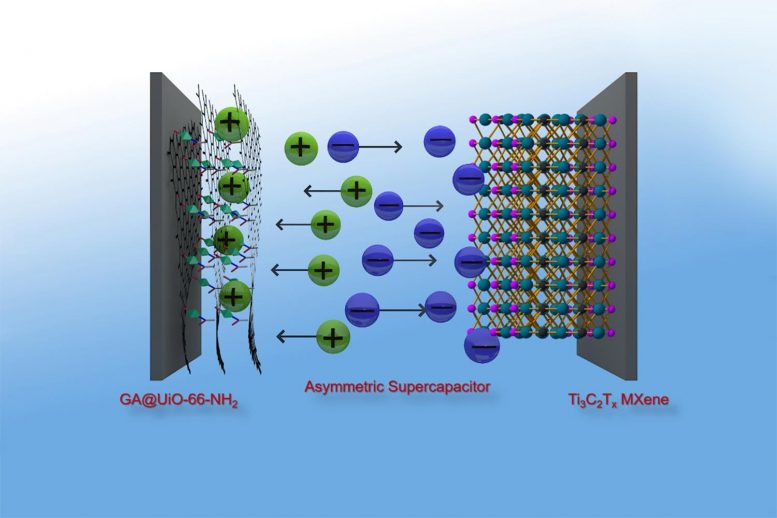
Graphene hybrid made from metal organic frameworks (MOF) and graphenic acid make an excellent positive electrode for supercapacitors, which thus achieve an energy density similar to that of nickel-metal hydride batteries. Credit: Prof. Dr. J. Kolleboyina / IITJ
====================================================================
A team working with Roland Fischer, Professor of Inorganic and Metal-Organic Chemistry at the Technical University Munich (TUM) has developed a highly efficient supercapacitor. The basis of the energy storage device is a novel, powerful and also sustainable graphene hybrid material that has comparable performance data to currently utilized batteries.
Usually, energy storage is associated with batteries and accumulators that provide energy for electronic devices. However, in laptops, cameras, cellphones or vehicles, so-called supercapacitors are increasingly installed these days.
Unlike batteries they can quickly store large amounts of energy and put it out just as fast. If, for instance, a train brakes when entering the station, supercapacitors are storing the energy and provide it again when the train needs a lot of energy very quickly while starting up.
However, one problem with supercapacitors to date was their lack of energy density. While lithium accumulators reach an energy density of up to 265 Kilowatt hours (KW/h), supercapacitors thus far have only been delivering a tenth thereof. Sustainable material provides high performance
The team working with TUM chemist Roland Fischer has now developed a novel, powerful as well as sustainable graphene hybrid material for supercapacitors. It serves as the positive electrode in the energy storage device. The researchers are combining it with a proven negative electrode based on titan and carbon.
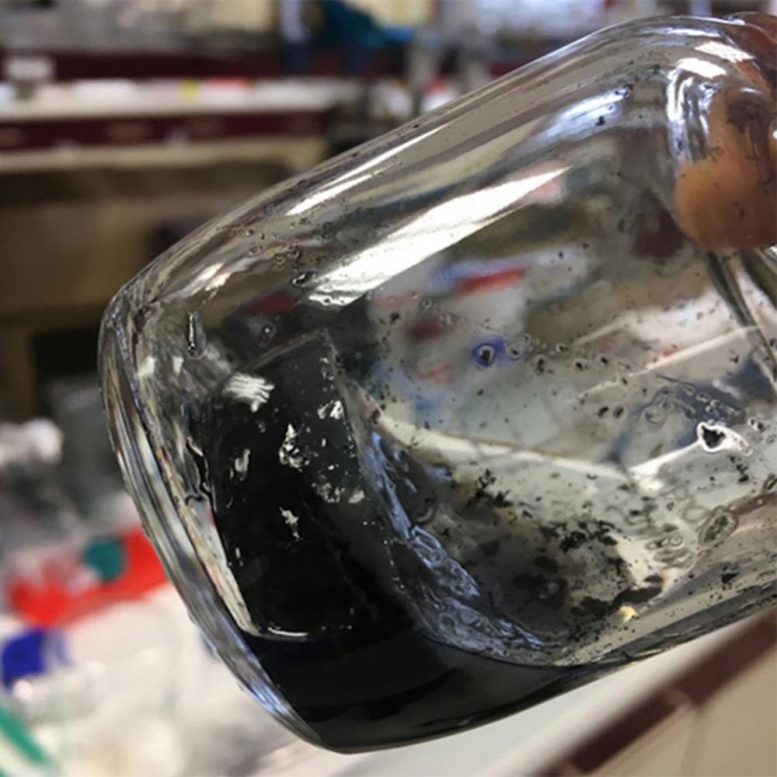
Graphene hybrids made from metal organic frameworks (MOF) and graphenic acid make an excellent positive electrode for supercapacitors, which thus achieve an energy density similar to that of nickel-metal hydride batteries. The black color indicates high electron mobility within the material. Credit: Prof. Dr. J. Kolleboyina / IITJ
===============================================================
The new energy storage device does not only attain an energy density of up to 73 Wh/kg, which is roughly equivalent to the energy density of a nickel metal hydride battery, but also performs much better than most other supercapacitors at a power density of 16 kW/kg. The secret of the new supercapacitor is the combination of different materials – hence, chemists refer to the supercapacitor as “asymmetrical.” Hybrid materials: Nature is the role model
The researchers are betting on a new strategy to overcome the performance limits of standard materials – they utilize hybrid materials. “Nature is full of highly complex, evolutionarily optimized hybrid materials – bones and teeth are examples. Their mechanical properties, such as hardness and elasticity were optimized through the combination of various materials by nature,” says Roland Fischer.
The abstract idea of combining basic materials was transferred to supercapacitors by the research team. As a basis, they used the novel positive electrode of the storage unit with chemically modified graphene and combined it with a nano-structured metal organic framework, a so-called MOF. Powerful and stable
Decisive for the performance of graphene hybrids are on the one hand a large specific surface and controllable pore sizes and on the other hand a high electrical conductivity. “The high performance capabilities of the material is based on the combination of the microporous MOFs with the conductive graphene acid,” explains first author Jayaramulu Kolleboyina, a former guest scientist working with Roland Fischer.
A large surface is important for good supercapacitors. It allows for the collection of a respectively large number of charge carriers within the material – this is the basic principle for the storage of electrical energy.
Through skillful material design, the researchers achieved the feat of linking the graphene acid with the MOFs. The resulting hybrid MOFs have a very large inner surface of up to 900 square meters per gram and are highly performant as positive electrodes in a supercapacitor. Long stability
However, that is not the only advantage of the new material. To achieve a chemically stable hybrid, one needs strong chemical bonds between the components. The bonds are apparently the same as those between amino acids in proteins, according to Fischer: “In fact, we have connected the graphene acid with a MOF-amino acid, which creates a type of peptide bond.”
The stable connection between the nano-structured components has huge advantages in terms of long term stability: The more stable the bonds, the more charging and discharging cycles are possible without significant performance impairment.
For comparison: A classic lithium accumulator has a useful life of around 5,000 cycles. The new cell developed by the TUM researchers retains close to 90 percent capacity even after 10,000 cycles. International network of experts
Fischer emphasizes how important the unfettered international cooperation the researchers controlled themselves was when it came to the development of the new supercapacitor. Accordingly, Jayaramulu Kolleboyina built the team. He was a guest scientist from India invited by the Alexander von Humboldt Foundation and who by now is the head of the chemistry department at the newly established Indian Institute of Technology in Jammu.
“Our team also networked with electro-chemistry and battery research experts in Barcelona as well as graphene derivate experts from the Czech Republic,” reports Fischer. “Furthermore, we have integrated partners from the USA and Australia. This wonderful, international co-operation promises much for the future.”
Reference: “Covalent Graphene‐MOF Hybrids for High‐Performance Asymmetric Supercapacitors” by Kolleboyina Jayaramulu, Michael Horn, Andreas Schneemann, Haneesh Saini, Aristides Bakandritsos, Vaclav Ranc, Martin Petr, Vitalie Stavila, Chandrabhas Narayana, Błażej Scheibe, Štěpán Kment, Michal Otyepka, Nunzio Motta, Deepak Dubal, Radek Zbořil and Roland A. Fischer, 4 December 2020, Advanced Materials. DOI: 10.1002/adma.202004560
#6 What is that in Jiggawatts?................
Look up pictures of Lynda Carter as Wonder Women.
#15 So McClane in Die Hard 2 using his lighter to light the leaking jet fuel from the airplane as it is taking off was not possible?... : )
Jet fuel is basically kerosene................
The expansion factor of a copper bussbar’s transition to vapor within an arc blast is exceptional. Twenty-thousand Kelvin exposure and the shock wave generated aren’t forgiving.
Flip-side...this kind of energy density/release might enable options to transition from chemical propellants. Something close to a light gas gun burning hydrogen, and scaled for personal carry?
A 155mm Gun was built and delivered exceptional range. The small demonstrator fired a 15mm projectile. So, not fiction—just needed self guiding ammo, which the rail gun project finally delivered a decade or so later. Company contracted was ULTRON.
https://apps.dtic.mil/dtic/tr/fulltext/u2/a462130.pdf
Air France knows a fuel aerosol burns quite nicely. Too bad the two port engines of that Concorde were drowning in the ingested fuel. Never gained sufficient velocity to outrun the flame front propagating through the trailing fog of fuel.
The energy density achieved in experiments with these latest type of capacitors is said in the article to have acheived an energy density in the raw cells of 73 Wh/kg, very impressive but still much less than lithium ion batteries which in their raw form achieve up to 265 Wh/kg. A gallon of gas contains 33,700 Wh and weighs 2.72 kg which is an energy density of 12,390 Wh/kg. Tesla now has a 100 kwh battery available for the model S which is the equivalent of 3 gallons of gasoline. It is the most advanced and powerful battery that they have produced. The P100D battery weighs 625 kg or 1378 pounds for an energy density of 160 Wh/kg in the completed battery.
I probably should not have even commented on the new capacitor development. I think that they are quite impressive and an exciting... I feel that their use as an energy source for vehicles is a long way in the future because of both energy density and safety considerations that will have to be worked out.
The ability to take a 20+C charge is what matters not raw energy density. There are already buses that run on electricity that charge via pantograph off overhead poles at the ends of their runs while they have the mandatory 15+ minute safety break times for the drivers. Rapid charging of LI based cells rapidly diminishes their lifespan. These cells would allow not only rapid charges but at least double the lifespan which is nothing to sneeze at. A full sized motor coach only needs 40 or 50 kWh to do a full route run of 40 to 50 km. Easily achieved in reasonable weight at 70+wh / kg . Look up pantograph opportunity charging it’s game changing technology as it allows the safe charging at 1000+v and 1000 amps that’s a megawatt it’s proven technology for electrified trains which use it every day world wide at 25,000v AC and 3000V DC from overhead wires the secret sauce is reversing the arrangement and putting the expansive pantograph at a central location or at the route ends and cheap copper bus bars on the tops of the vehicles that only weight 10kg. With that arrangement many vehicles share a pantograph using time sharing having super rapid 1MW rates means a 40kWh charge only takes 2.5 minute much shorter than the required end of line rest time, and short enough for midline opportunity charging at selected stops busses typically have time phasing stop times to keep them on schedule that last from 5 to ten minutes. Anyone who has taken the metro on the regular has experienced this as when a bus just sits at a stop and waits for apparently no reason they are stopped to avoid getting ahead of their time schedule.
Obviously your knowledge of the types of devices that you mention is far greater than mine. And I thank you for sharing your insight. I am merely a tinkerer who has been interested in human powered devices and energy storage devices since childhood. I have installed both electric motors and gasoline engines on bicycles and had a lot of fun with them. You would not believe the number of hand cranked devices that I have collected over the years.
Busses and trains are a completely different catregory from consumer sized cars and trucks just as powered bicycles are. Although they mention laptops and other small electrical device along with trains, the article’s focus was more on advances being made than the actual applications.
I have been waiting for the prices to drop on so called “super-capacitors” to do some experimenting with them just for fun as always. It is interesting to me that one could spend a few minutes hand cranking a a small generator to charge a bank of capacitors and then use the energy to start a car.
Your interest seems to be in larger devices such as trains and busses where banks of capacitors are already being used. Before I became involved in firefighting my interest in banks of capacitors on a professional basis was their use to correct power factor problems in large idling 3 phase motors. Along with starting single phase motors for pumps, compressors and other equipment this along with diesel trains was probably the primary purpose for larger sized capacitors for the past 70 years or so.
Because of my experience with these capacitors and line powered industrial equipment along with 25 years as a professional firefighter... I am more aware of the awesome power controlled and delivered by electrical distribution equipment and also electrical storage devices used in industrial applications than most people.
Disclaimer: Opinions posted on Free Republic are those of the individual posters and do not necessarily represent the opinion of Free Republic or its management. All materials posted herein are protected by copyright law and the exemption for fair use of copyrighted works.