Posted on 12/31/2020 7:14:23 AM PST by Red Badger
The best present this holiday season came in a small package, parachuted into the Australian desert from far within our Solar System on 5 December 2020.
Inside, astronomers were delighted to unwrap the first significant samples of a rocky asteroid which is currently 9 million kilometres (5.6 million miles) away, and returned to Earth in "perfect" shape.
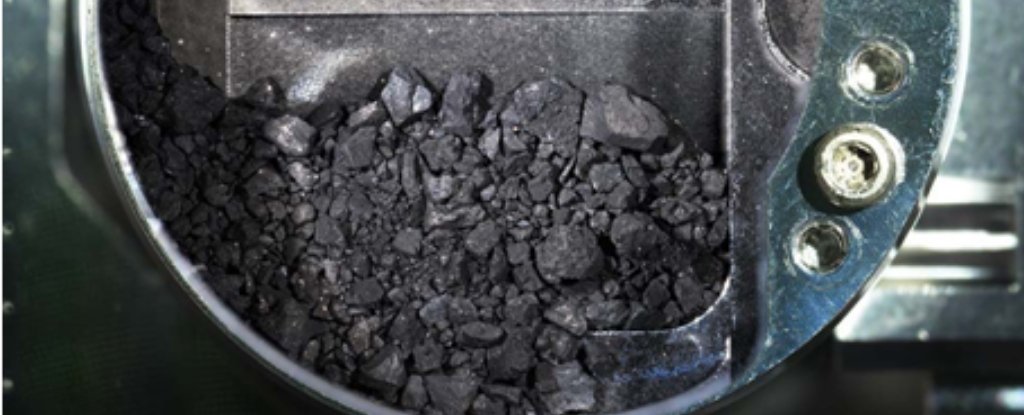
Photographs of the pristine pebbles have finally been released, and while the tiny, black-coloured grains inside may resemble nothing more than dirty coal, this galactic gift is hardly a rebuke. It's the culmination of a five-year-long journey, requiring careful planning and execution.
The samples were originally collected by Japan's Hayabusa2 mission, which was sent to circle and sample the diamond-shaped asteroid called Ryugu, following the success of its first mission.
The initial Hayabusa spacecraft returned from the asteroid Itokawa in 2010 with the first direct sample of a near-Earth object. Altogether, the surface material weighed less than a milligram, and yet that was still enough to yield crucial information about the asteroid's age and geologic history.
The new samples from Ryugu - scooped up last year - date back even further and contain more material than astronomers dared hope for, amounting to roughly 5.4 grams.
The name Ryugu refers to a magical underwater "dragon palace" in Japanese folklore, in which a fisherman finds himself being presented with a mysterious box to return home with - rather like Hayabusa's sealed capsules.
The treasure in this case is thought to be over 4.5 billion years old - a relic of our early Solar System, containing potentially ancient material that once formed our Sun and its orbiting planets.
Opening the carefully sealed chambers, astronomers have found many particles larger than a millimetre. Those in chamber C were slightly bigger than the rest and were collected from the mission's second touchdown.
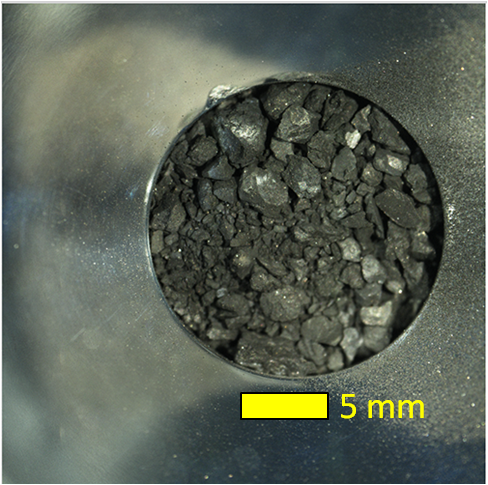 Sample catcher chamber A, captured by an optical microscope. (JAXA)
Because this landing took place a little to the north of a crater intentionally created earlier in the mission, researchers expected the sample to contain chunks of subsurface material. That would be quite the achievement, since all other asteroid samples collected in space merely come from the surface.
Before these direct samples, most of our knowledge on the topic of asteroids came from meteorites, which are asteroids or comets that find themselves smashing into Earth's surface.
Unfortunately, without the protection of a human-made capsule, much of that material is destroyed or contaminated by our planet's atmosphere upon entry, not to mention all the weathering that occurs once these rocks come to rest on the ground.
Ryugu is a C-type asteroid which means its rock is highly porous and contains a lot of carbon and water. Astronomers suspect this particular pile of dark rubble was formed billions of years ago, when it broke off another large body of rock somewhere in the asteroid belt between Mars and Jupiter.
Because Ryugu's surface appears unusually dry and shows red colouration, some experts think it once flew closer to the Sun.
Still, not all the material collected in these containers is quite so primordial. One of the capsules does contain an obvious anachronism (pictured below).
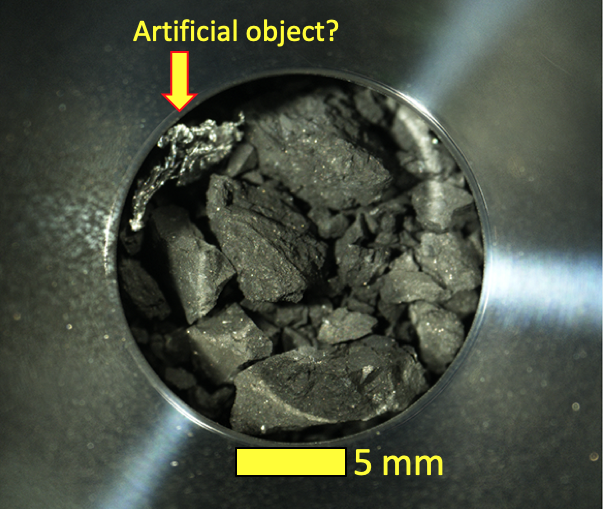
"Artificial material seems to be present in chamber C," reads a press release from the Hayabusa2 project.
"The origin is under investigation, but a probable source is aluminium scraped off the spacecraft sampler horn as the projectile was fired to stir up material during touchdown."
Later, an update from Twitter said the object was still unconfirmed, but that it might have separated from the sampler horn used during collection.
Scientists are already starting to analyse these new samples, including some gas trapped inside the capsules, which is thought to have been collected on the surface of Ryugu as well.
If researchers are correct, it will be the world's first gas sample returned from deep space.
Quite the present indeed.
Private enterprise will. Not the government.........................
ET can’t phone home......................
Too many redundancy requirements and manned flight will still require NASA approval.
I am actually disappointed that they couldn’t preclude contamination. The Apollo samples didn’t have that problem. I actually touched the sample that visitors are invited to touch at the KSC on Cape Canaveral.
What are rocks other than atoms of elements combined in different ways? Carbon, oxygen, iron and everything heavier than hydrogen are byproducts of solar fusion and supernova as I understand it.
NASA will become irrelevant................
“Mind blowing” = looks like the crap you dump out of your BBQ at the end of the night.
Well, rocks are distinguished from simple elements because they have been shaped by geologic processes: sedimentation by wind or water, volcanic action, or metamorphic action (compressed and heated by the weight of a planet’s crust).

Carbonaceous chondrites...
*laughs in Space X*
Gum wrapper from the aliens’ secretarial pool.
Maybe you can cite some area where government has relinquished oversight?
NASA will be relegated to Muslim outreach and diversity programs. The real scientists will leave for retirement or commercial endeavors like Elon Musk’s. The future of the human race is in space, but it will not be a government entity that does it. Private industry will conquer space at a faster rate than government workers...............
1-Payload lift capability
2-Adequate construction in space
3-Medical limits on radiation exposure
4-Nutritional requirements
True, at 66 in the nxt couple of weeks, I won’t live long enough to see much more tha I have already.
But Musk’s enterprises gave me hope when it was waning that men will be in space for a long time and living on the Moon and then Mars will be within this century.....................
Wouldn’t America need to survive for free enterprise to succeed?
Hahahaha! We have a geologist!!!!
LOL, that made me laugh...
I fully admit to being one who was skeptical that this could be accomplished by a private company (like SpaceX) even with subsidies, but by God, they did it, and so far, have done a damned good job.
I am completely impressed.
I fully admit it has taken me time to adjust to the millenial population and the cheering and all, but...I am the first to admit it is me being an old fuddy-duddy.
After all, what did I expect...them all sitting there with white shirts, horn-rimmed glasses, and striped ties?
They have a lot to cheer about...:)
Disclaimer: Opinions posted on Free Republic are those of the individual posters and do not necessarily represent the opinion of Free Republic or its management. All materials posted herein are protected by copyright law and the exemption for fair use of copyrighted works.