Posted on 11/23/2020 9:24:03 AM PST by Red Badger
A survey found only 36 percent of people could find the right answer to a seemingly simple logic problem, according to economics and math pro Presh Talwalkar of the YouTube channel Mind Your Decisions.
Here's the problem:
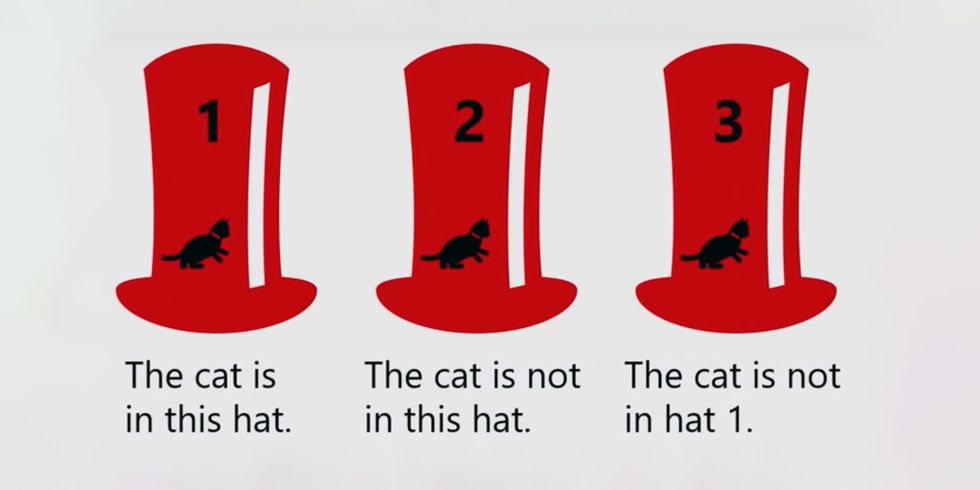
"There are three hats, each with an accompanying statement.
Hat One: The cat is in this hat.
Hat Two: The cat is not in this hat.
Hat Three: The cat is not in Hat One.
Exactly one of the statements is true. Exactly one hat contains a cat. Which hat contains the cat?"
The answer options are:
1) Hat One;
2) Hat Two;
3) Hat Three;
4) None of the hats; or
5) Not enough information.
Okay, so maybe this problem isn't as simple as it seems. But thankfully, Talwalkar broke down how to solve the logic problem in a new YouTube video.
Did you solve the problem without cheating?
VIDEO AT LINK.................
So, what is the correct answer?
Well, first, you have to logically consider each case, assuming the cat is in each hat, then seeing if each statement applies to that case. If you end up with one true statement and two false statements, you have the correct cat-in-hat placement.
Let's assume the cat is in Hat One.
Hat One's statement is obviously true in this scenario. But if the cat is in Hat One, the cat would not be in Hat Two, making the second statement also true. This means the cat is not in Hat One because if it was, two statements would be true—and that clearly doesn't satisfy the conditions of the problem.
Well, what if we assume the cat is in Hat Three?
Hat Three’s statement would then be true, while Hat One’s statement would be false. So far, so good for only one true statement in the bunch. But the issue comes when considering Hat Two’s statement: The cat is not in Hat Two. That would also be true, assuming the cat were in Hat Three. With two true statements, this isn’t the right answer.
Spoiler Alert:
The cat is in Hat Two—and here’s why. Assuming the cat is in Hat Two, the statement corresponding with that hat is false. In addition, the first statement is also false, as the cat is in Hat Two, not Hat One. The true statement then is Hat Three’s statement. The cat is not in Hat One. This answer satisfies the confusion conditions of the problem, putting the cat in Hat Two with the correct statement being that of Hat Three.
Trust us: Watching the problem play out in Talwalkar’s video is helpful in understanding this complex logic test. The math pro says most people run into trouble assuming the cat must be in a hat where the statement is true. But that's obviously not the case. The two need to be thought as independent conditions to solve the problem correctly.
That said, we'd just pick up each hat until we found the damn cat, but that’s probably not as impressive.
After re-reading (time honored - you know) I have decided only ONE going to St. Ives.
It’s the old “What’s the name of the bus driver?” puzzle.
Took me 40 seconds. Didn’t Spock and Kirk melt an evil computer with this sort of problem?
Exactly. Everything after “You’re a bus driver” is extraneous.
I like to jazz it up a bit and go thru a tale about memory and math and efficiency and paying attention to details that a good driver should be capable of; then just slip in the suggestion that they might be a good driver; too: “Just list to this small sample of...”
Disclaimer: Opinions posted on Free Republic are those of the individual posters and do not necessarily represent the opinion of Free Republic or its management. All materials posted herein are protected by copyright law and the exemption for fair use of copyrighted works.