Posted on 11/06/2020 6:43:26 AM PST by Red Badger
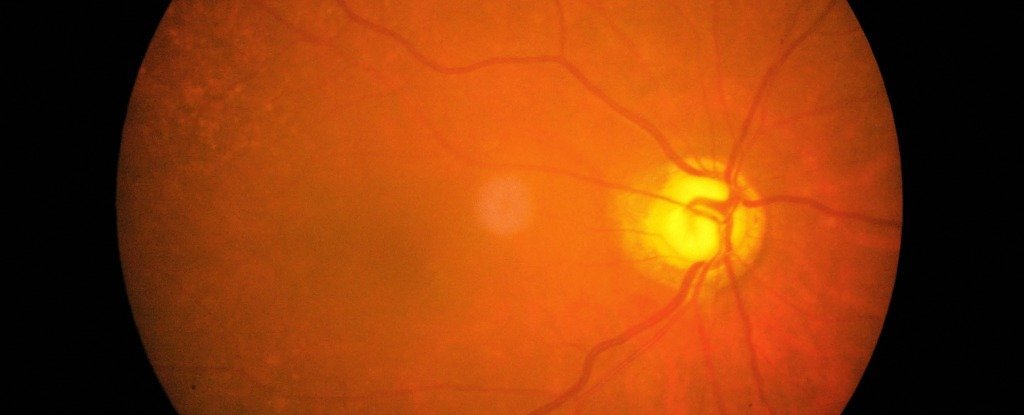
(Santibhavank P/Shutterstock)
==============================================================================
Scientists have found a new way to regenerate damaged optic nerve cells taken from mice and grown in a dish. This exciting development could lead to potential eye disease treatments in the future.
Damage to full-grown nerve cells causes irreversible and life-altering consequences, because once nerve fibres mature, they lose their ability to regenerate after injury or disease. The new experiments show how activating part of a nerve cell's regenerative machinery, a protein known as protrudin, could stimulate nerves in the eye to regrow after injury.
With more research, the achievement is a step towards future treatments for glaucoma, a group of eye diseases which cause vision loss by damaging the optic nerve (that links the eye to the brain).
"What we've seen is the strongest regeneration of any technique we've used before,'' said ophthalmologist Keith Martin from the University of Melbourne in Australia.
"In the past it seemed impossible we would be able to regenerate the optic nerve but this research shows the potential of gene therapy to do this."
We have seen similar attempts to restore vision in mice and some promising results before.
In 2016, scientists were able to regrow a small fraction of retinal ganglion cells in adult mice by turning on a dormant growth switch, and showed these new nerve cells at the back of the eye reconnected to the right part of the brain as well.
And before that, a 2012 study also partially restored 'simple' vision to adult mice after regenerating nerves along the full length of the optic pathway.
This latest research is still in its early stages, and has focused on understanding precisely how protrudin, a scaffolding molecule present in sprouting neurons, works to support cell growth.
It's always good to have a few options because there's no guarantee that promising results in mouse studies translate to safe and effective treatments for people.
In this study, scientists stimulated nerve cells of the eye to produce more protrudin, to see if this would help protect the cells from damage and even repair after injury.
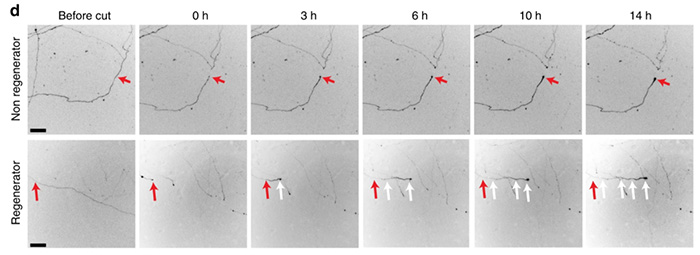
First, in optical nerve cells cultured in a dish, the researchers showed that ramping up protrudin production stimulated regeneration of nerve cells that had been cut by a laser. Their spindly axons regenerated over longer distances, and in less time, than untreated cells.
(Petrova et al., Nature Communications, 2020)
Above: A regenerating and a non-regenerating axon over 14 hours after laser axotomy. Red arrows at 0 h post injury show the point of injury; white arrows trace the path of a regenerating axon.
============================================================================
Next, adult mice were administered gene therapy - an injection straight into the eye - carrying instructions for nerve cells to bump up protrudin production. As painful as that sounds, this procedure can actually be done safely in people (the injection, that is, not yet the gene therapy).
A few weeks and one optic nerve injury later, these mice had more surviving nerve cells in their retinas than the control group did.
In one final experiment, the scientists used whole retinas from mice removed two weeks after giving them a protrudin boost, to see if this treatment could prevent nerve cells from dying in the first place.
The researchers found, three days later, that stimulating protrudin production had been almost "entirely neuroprotective, with these retinas exhibiting no loss of [retinal] neurons," the researchers wrote in their paper. Usually, about half of retinal neurons removed in this way die within a couple of days.
"Our strategy relies on using gene therapy – an approach already in clinical use – to deliver protrudin into the eye," said Veselina Petrova, a neuroscience student at the University of Cambridge.
"It's possible our treatment could be further developed as a way of protecting retinal neurons from death, as well as stimulating their axons to regrow."
It's important to note that we're a long way from restoring vision in a person: Regenerating cells in a dish is great, but we don't know from these experiments if giving a mouse more protrudin would restore its sight.
One of the next steps will be to look at whether protrudin has the same protective effect in cultured human retinal cells.
The scientists publishing this work also plan on studying whether the same technique could be used to repair damaged neurons after spinal cord injury.
"Treatments identified this way often show promise in the injured spinal cord," said Petrova. "It's possible that increased or activated protrudin might be used to boost regeneration in the injured spinal cord."
The research was published in Scientific Reports:
https://www.nature.com/articles/s41467-020-19436-y

They should have no problem creating nerves for people. Genetically, it’s a small jump.
I had an eye stroke about 2 months ago and lost considerable vision in my right eye. I was told that nothing can be done about it. I may get some of it back but unlikely to get it all back. For me this would be a miracle cure.
My nephew was born blind. Maybe one day.
It seems to me that this is the perfect cure!..............
Amen!..................
This is HUGE!
It could lead to many wonderful things, including recovery after spinal chord injury.
Pray for success!
The world must be reminded that it is FREE MARKET CAPITALISM--i.e. LIBERTY--that makes such miracles possible.
CAPITALISM is the goose that lays the golden eggs which finance all such miracles. Kill it, and there will be nothing, no more golden eggs, no more such miracles.
Those who flirt with the idea of Marxism are stupid. But it does no good to tell them that. They are too stupid to understand it.
The curse of high intelligence is having to watch the morons do everything you know won't work, some of which is dangerous and even destructive, but they're morons; they can't do any better.
Disclaimer: Opinions posted on Free Republic are those of the individual posters and do not necessarily represent the opinion of Free Republic or its management. All materials posted herein are protected by copyright law and the exemption for fair use of copyrighted works.