Skip to comments.
World first: Dutch brewery burns iron as a clean, recyclable fuel
New Atlas ^
| 4 Nov 2020
| Loz Blain
Posted on 11/04/2020 11:00:36 AM PST by DUMBGRUNT
Many industries use heat-intensive processes that generally require the burning of fossil fuels, but a surprising green fuel alternative is emerging in the form of metal powders. Ground very fine, cheap iron powder burns readily at high temperatures, releasing energy as it oxidises in a process that emits no carbon and produces easily collectable rust, or iron oxide, as its only emission.
If burning metal powder as fuel sounds strange, the next part of the process will be even more surprising. That rust can be regenerated straight back into iron powder with the application of electricity, and if you do this using solar, wind or other zero-carbon power generation systems, you end up with a totally carbon-free cycle. The iron acts as a kind of clean battery for combustion processes, charging up via one of a number of means including electrolysis, and discharging in flames and heat.
(Excerpt) Read more at newatlas.com ...
TOPICS: Business/Economy; Chit/Chat; Science
KEYWORDS: fe
Navigation: use the links below to view more comments.
first previous 1-20, 21-40, 41-60, 61-63 next last
To: ProtectOurFreedom
Everyone knows that a scaled-up drinking bird is superior to that energy hog.
And as soon as they come up with low drag vacuum seals, the large scale radiometer should easily outproduce solar cells.
41
posted on
11/04/2020 11:52:11 AM PST
by
DUMBGRUNT
("The enemy has overrun us. We are blowing up everything. Vive la France!"Dien Bien Phu last message.)
To: KarlInOhio
(pump water to the top of a dam during high production times to let it flow down through turbines during high use times), Sounds like you would end up with a huge net loss of energy doing that. The energy used to pump the water up would far exceed the energy you would recover from the down flow through a turban.
It just doesn't add up to me.
42
posted on
11/04/2020 11:55:14 AM PST
by
usurper
( version)
To: Bob434
The binding resin in fiberglass contains lots of carbon.
43
posted on
11/04/2020 11:55:15 AM PST
by
reg45
(Barack 0bama: Gone but not forgiven.)
To: chrisser; DUMBGRUNT
Of course, the devil is in the details... Such as; buying and operating a iron fired boiler and turbine-generator. I doubt that anyone makes one. And of course you need an industrial water treatment system for your feed water. And you will need a High Pressure Boiler Operator’s license to run your system.
Of course you also need the equipment to reduce your iron oxide back in to iron.
You probably also need a mill system that operates in a vacuum to turn your iron back in to a powder. It is very likely to clump up during the regeneration process.
Yes, the devil is in the details.
This entire idea is a solution looking for a problem.
CO2 is not a pollutant.
44
posted on
11/04/2020 11:55:59 AM PST
by
Pontiac
(The welfare state must fail because it is contrary to human nature and diminishes the human spirit)
To: DUMBGRUNT
How much energy does it take to grind that iron to powder?
45
posted on
11/04/2020 11:56:12 AM PST
by
Grimmy
(equivocation is but the first step along the road to capitulation)
To: Red Badger
Different kind of “burning”. And iron is the “waste product” of chromium + helium fusion.
46
posted on
11/04/2020 11:56:12 AM PST
by
calenel
(Mask up or lock down. Your choice.)
To: ClearCase_guy
No, they are counting wind and solar as “free” carbon-neutral energy sources for the reverse reaction, but neither is remotely so. It’s just all front-end loaded.
47
posted on
11/04/2020 11:58:14 AM PST
by
calenel
(Mask up or lock down. Your choice.)
To: ProtectOurFreedom
jeepers- what’s made of lithium in car parts? That’s quite a fire
48
posted on
11/04/2020 12:01:59 PM PST
by
Bob434
To: ProtectOurFreedom
[[Who needed a Second Law, anyway?]]
Runner ups
49
posted on
11/04/2020 12:02:50 PM PST
by
Bob434
To: usurper
"It just doesn't add up to me."
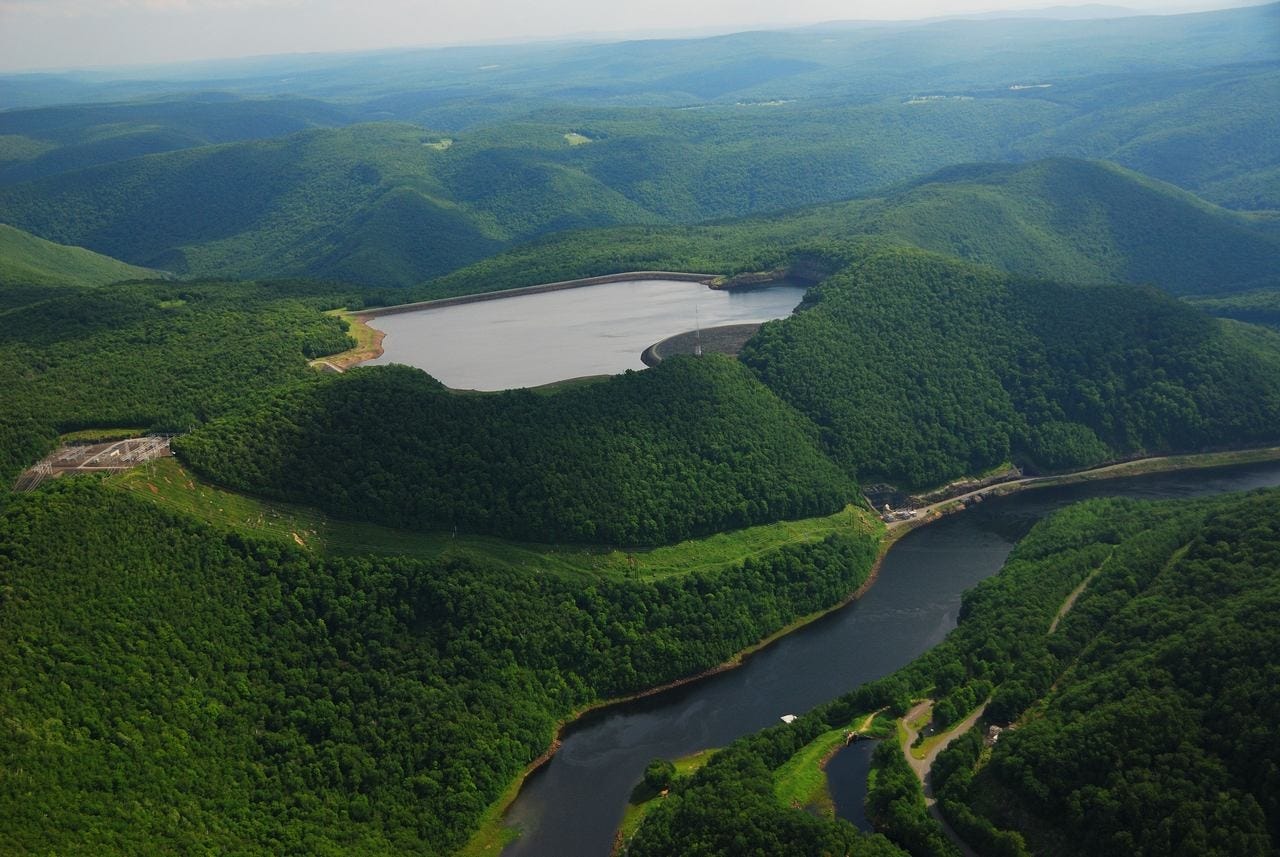
They are called "pumped storage facilities" and there are many of these around the world. See this Wiki List of Pumped Storage Hydroelectric Power Stations" for those 1,000 MW and larger.
They are used to store cheap power generated at night when demand is low and deliver it to the market during the day when demand is high. They've been used for decades and are quite cheap. An alternative is Compressed Air Energy Storage where you pump high pressure air into old salt mine caverns, but these didn't catch on much. 
50
posted on
11/04/2020 12:04:34 PM PST
by
ProtectOurFreedom
("Inside Every Progressive Is A Totalitarian Screaming To Get Out" -- David Horowitz)
To: reg45
watched a boat burn once- wow- the smoke was unreal-
51
posted on
11/04/2020 12:04:36 PM PST
by
Bob434
To: usurper
Sounds like you would end up with a huge net loss of energy doing that. The energy used to pump the water up would far exceed the energy you would recover from the down flow through a turban. Like I said, I want to see the efficiency. Some times and industrial user could get the energy practically for free, like with nuclear reactors or coal plants which have to be kept running even if the energy isn't being used like the middle of the night. The electric company is glad to get any money for it rather than just pumping out waste heat without spinning a turbine.
One example of this is air conditioning systems which produce ice (or a salt water slush) at night and use that for cooling during the day. It can be cheaper to do that than to pay prime rates at 3pm to keep your building cool.
If you could run a solar farm at a net cost of 1 cent per kilowatt-hour, you could afford some inefficiencies to get power from it and some batteries 24 hours per day.
52
posted on
11/04/2020 12:11:02 PM PST
by
KarlInOhio
(The greatest threat to world freedom is the Chinese Communist Party and Joe Biden is their puppet.)
To: gundog
“Rosie O’Donnell is skeptical.”
You mean the renowned metallurgist who explained to us why 9/11 was an inside job? I remember that.
53
posted on
11/04/2020 12:11:44 PM PST
by
beef
(Use a VPN, use Tor, and get a shortwave radio. Oh, and ACAB- All Commies Are Bastards)
To: Pontiac
54
posted on
11/04/2020 12:13:59 PM PST
by
Secret Agent Man
(Gone Galt; Not Averse to Going Bronson.)
To: reg45
Iron burning in stars is how you get Novas and Supernovas. Iron is the death of stars.
55
posted on
11/04/2020 12:46:31 PM PST
by
Outlaw76
(Free Men don't ask permission.)
To: Calvin Locke
56
posted on
11/04/2020 12:50:35 PM PST
by
gundog
( Hail to the Chief, bitches!)
To: cpdiii
“BUT,,,BUT,,,BUT,,, the Unicorn farts!!!!?!?!?!!! Nobody has ever tried them before and I just graduated from my community college with a masters in ancient Egyptian Lesbian studies and a second major in underwater basket weaving, so I am smart!!!!!”
SARCASM
I swear we should raise the voting age to 35 with 10 years of tax returns plus owning property to qualify.
57
posted on
11/04/2020 2:03:51 PM PST
by
Wildbill22
( They have us surrounded again, the poor bastards- Gen Creighton William Abrams)
To: ProtectOurFreedom
I live near the Ludington MI facility. At first they discovered it turned aquatic life, fish, into chum until they had to screen it all off.
There has to be a net loss in energy which can only be made up economically by the time of the day that it is used/stored. It is not an answer or a major source of energy. More like a science experiment.
58
posted on
11/04/2020 2:08:36 PM PST
by
Wildbill22
( They have us surrounded again, the poor bastards- Gen Creighton William Abrams)
To: Pontiac
59
posted on
11/04/2020 2:09:22 PM PST
by
DUMBGRUNT
("The enemy has overrun us. We are blowing up everything. Vive la France!"Dien Bien Phu last message.)
To: Grimmy
60
posted on
11/04/2020 2:13:00 PM PST
by
DUMBGRUNT
("The enemy has overrun us. We are blowing up everything. Vive la France!"Dien Bien Phu last message.)
Navigation: use the links below to view more comments.
first previous 1-20, 21-40, 41-60, 61-63 next last
Disclaimer:
Opinions posted on Free Republic are those of the individual
posters and do not necessarily represent the opinion of Free Republic or its
management. All materials posted herein are protected by copyright law and the
exemption for fair use of copyrighted works.
FreeRepublic.com is powered by software copyright 2000-2008 John Robinson