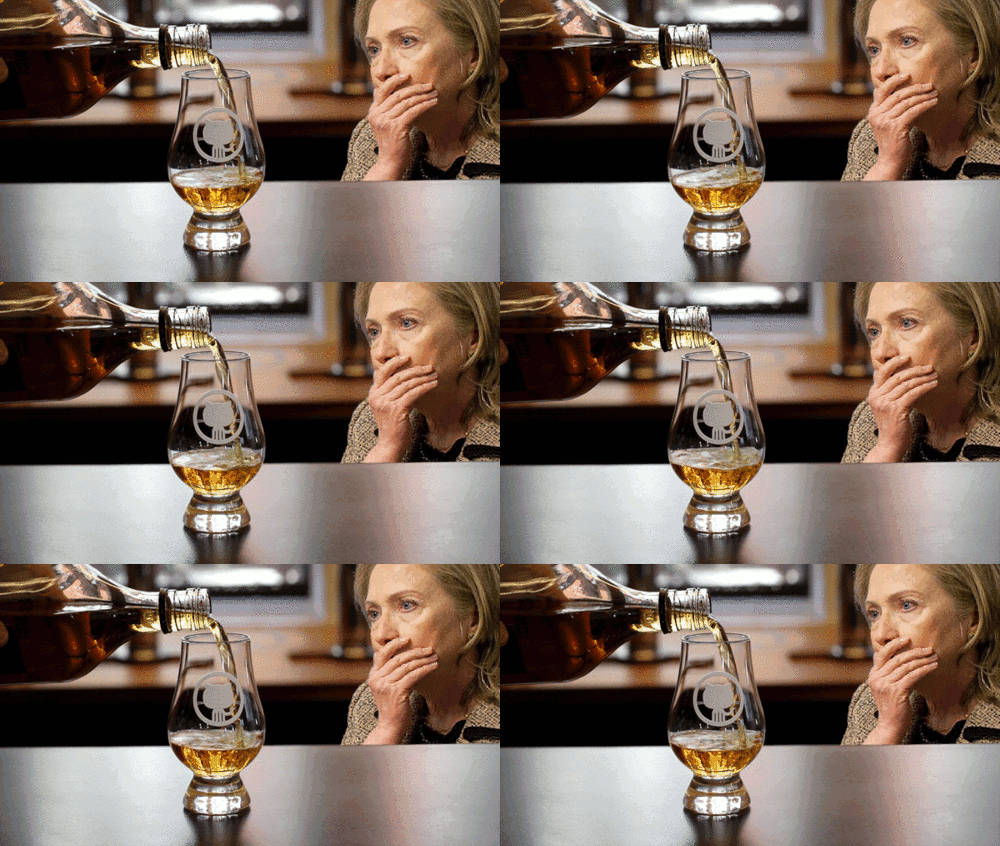
"I love scotch. Scotchy, scotch, scotch. Here it goes down, down into my belly..."
Posted on 09/09/2020 3:08:13 PM PDT by nickcarraway
Men who lose consciousness after drinking alcohol are up to three times as likely to develop dementia within the next 10 years, according to an analysis published Wednesday by JAMA Network Open.
Women who "passed out" after consuming alcohol were more than twice as likely to develop dementia over the next decade, the data showed.
Overall, the risk for early-onset dementia -- which develops in people age 65 and younger -- was twice as high among drinkers who "passed out," the researchers said.
"Our analysis ... suggests that binge drinking is a long-term dementia risk factor even if a person usually drinks moderately," study co-author Mika Kivimaki, a professor of epidemiology at University College London, told UPI.
Up to 6 million Americans have dementia, which may cause memory loss and communication problems, according to the Alzheimer's Association.
Research suggests that consumption of high quantities of alcohol in a short time can lead to "neurotoxic levels of alcohol," which can cause health complications, Kivimaki said.
One sign of alcohol neurotoxicity is losing consciousness or passing out, he said
It's possible that high alcohol consumption increases a person's risk for other diseases -- like diabetes, heart disease and high blood pressure -- which "contribute to dementia risk," according to Kivimaki.
More than one in four U.S. adults 18 years old and older acknowledge they "binge drink" -- or consume four or more drinks over a two-hour period -- the National Institute on Alcohol Abuse and Alcoholism estimates.
To maintain a healthy level of consumption, men should drink no more than two alcoholic beverages per day -- or 14 per week -- while women should limit their intake to one drink per day, or seven per week, according to the U.S. Centers for Disease Control and Prevention.
RELATED Getting dizzy when standing could be risk factor for dementia For this study, Kivimaki and his colleagues reviewed data on more than 130,000 adults in Britain, France, Sweden and Finland, more than 1,000 of whom -- or 0.8% -- developed dementia over the course of a 14-year period.
Those who consumed more than 14 drinks per week, on average, were 16% more likely to develop dementia, compared to those who consumed less than the CDC's threshold, the data showed.
Overall, 10% of the study participants admitted that they had lost consciousness -- or "passed out" -- due to alcohol consumption during the past year.
Even if they reported "moderate" drinking normally -- defined as 14 drinks or less per week -- those who lost consciousness due to alcohol consumption at least once were just over twice as likely to develop dementia, the data showed.
"We found that alcohol-induced loss of consciousness was linked to doubling of dementia risk among both moderate and heavy drinkers," Kivimaki said.
“Define passing out.”
It’s like when you wake in the morning and check eBay to see if you ordered anything last night...
Dementia is harmless. Certainly not a problem for job advancement. You can even be President of the United States. Woo hoo.
(Snicker, snicker)
"I love scotch. Scotchy, scotch, scotch. Here it goes down, down into my belly..."
You have that backwards... They read the article, but think they didn’t (don’t remember reading it ;^))
If you drink so much that you pass out, you don’t have much of a brain to begin with.
Wh at ma n?
The President is a teetotaler. How much of a drinker was Biden? It would be interesting to know.
https://ruqqus.com/post/1t1/....Go to this. It will answer your question,
Hmmm, within 10 years?
Lots of mid-30s college grads must be going senile.
So, if one chooses to go to sleep...er...now, does that count as passing out?
The one comment says it all.
Was Biden a heavy drinker?
Biden has had shit for brains his whole life.
What’s with this writing, “Dementia *may* cause memory loss.”
Um, isn’t that the whole deal?
Disclaimer: Opinions posted on Free Republic are those of the individual posters and do not necessarily represent the opinion of Free Republic or its management. All materials posted herein are protected by copyright law and the exemption for fair use of copyrighted works.