Posted on 06/01/2019 7:18:04 PM PDT by ETL
A transportation company is betting its sleek new hydrogen-powered electric flying vehicles will someday serve as taxis, cargo carriers and ambulances of the sky, but experts say they will have to clear a number of regulatory hurdles before being approved for takeoff years in the future.
With six rotors on the roof and seats inside for five people, a passenger model of the Skai (pronounced "sky") unveiled Wednesday near Los Angeles resembles an oversized drone crossed with a luxury SUV.
Like a drone, the vehicle from Alaka'i Technologies takes off and lands vertically.
It's one of many similar electric flying crafts in production, including prototypes from Boeing and Airbus that made successful test flights this year, according to Vertical Flight Society, an industry group.
Most are powered by batteries, which can add a lot of weight.
The Skai instead uses very light hydrogen fuel cells to run its rotors, giving it a range of 400 miles and the capacity to carry 1,000 pounds in people or freight, the company says.
"We just couldn't get to the point where we could have enough batteries to get to the payload that we knew we needed," CEO Stephan Hanvey said of the choice to switch to hydrogen power.
Alaka'i says it's planning a test flight near its Massachusetts headquarters.
It would be flown by an on-board pilot using a pair of joysticks, but the technology exists to eventually fly it remotely and even autonomously, Hanvey said.
It will be years before the Federal Aviation Administration allows the autonomous flight of passenger vehicles, said attorney Thaddeus Lightfoot, a partner with the firm Dorsey & Whitney who helps companies navigate FAA rules.
Regulators are still grappling with the proliferation of smaller drones—those under about 50 pounds flown by hobbyists and filmmakers.
The FAA just this year eased restrictions on flying small drones over crowds and at night.
Drone-like vehicles such as the Skai must first simply prove their airworthiness, like any common plane, Lightfoot said.
After that, getting commercial certification is another convoluted process, he said.
"The technology is interesting, but the regulatory road will be very long," said Lightfoot, adding that the idea of allowing people to fly in a large aircraft without a pilot is "well outside the current regulatory regime."
Hanvey conceded that it could take at least a decade before the company realizes his vision of a fleet of electric flying vehicles ferrying passengers over major cities at nearly 120 mph.
Before that, he hopes to see Skai aircraft used by first responders to send in food or water following disasters like hurricanes or wildfires that can destroy infrastructure.
It could be used as an ambulance and to evacuate people, Hanvey said.
Outfitted with a transmitter, one could serve as a mobile cell tower, hovering for up to 10 hours over a neighborhood to provide communication services, he said.
Lift = C x v^2 x S.
That is the crux. rest is nonsense.
FWIW, Wikipedia currently lists the best power/weight ratio at about 6 hp/lb; this for the Emrax 268 motor, which was designed for service in electric aircraft. Judging from that motor's published size, that may be what is shown in the passenger hexacopter shown above in this thread.
Each of these Emrax motors generates around 250 hp is a package that weighs around 44 pounds; that rating is not for continuous service.
The Emrax is rated at around 100 hp continuous, which would give the hexacopter shown about 600 hp continuous total mechanical power to the props. For comparison, the Bell 206 Jet Ranger uses a gas turbine engine of about 300 hp and has a lifting capacity of about 900 pounds including fuel. Assuming lifting capacity scales roughly linearly with power, that would give this notional hexacopter a lifting capacity of about 1800 lb, which is plausible for four passengers and some carry-on items.
Motor power per unit volume has really gone up in recent years, to some extent because of the availability of magnetic superalloys, most of which use rare earth elements.
I don't think the motor size is that implausible. I do wonder how they would provide 1500 hp (about 2MW) continuously from a hydrogen fuel cell of any reasonable size. Maybe they can do it, I don't know.
“A transportation company is betting its sleek new hydrogen-powered electric flying vehicles will someday serve as taxis, cargo carriers and ambulances of the sky”
hell, i’m still waiting for “conventional” flying cars we were promised back in the 1950’s ...
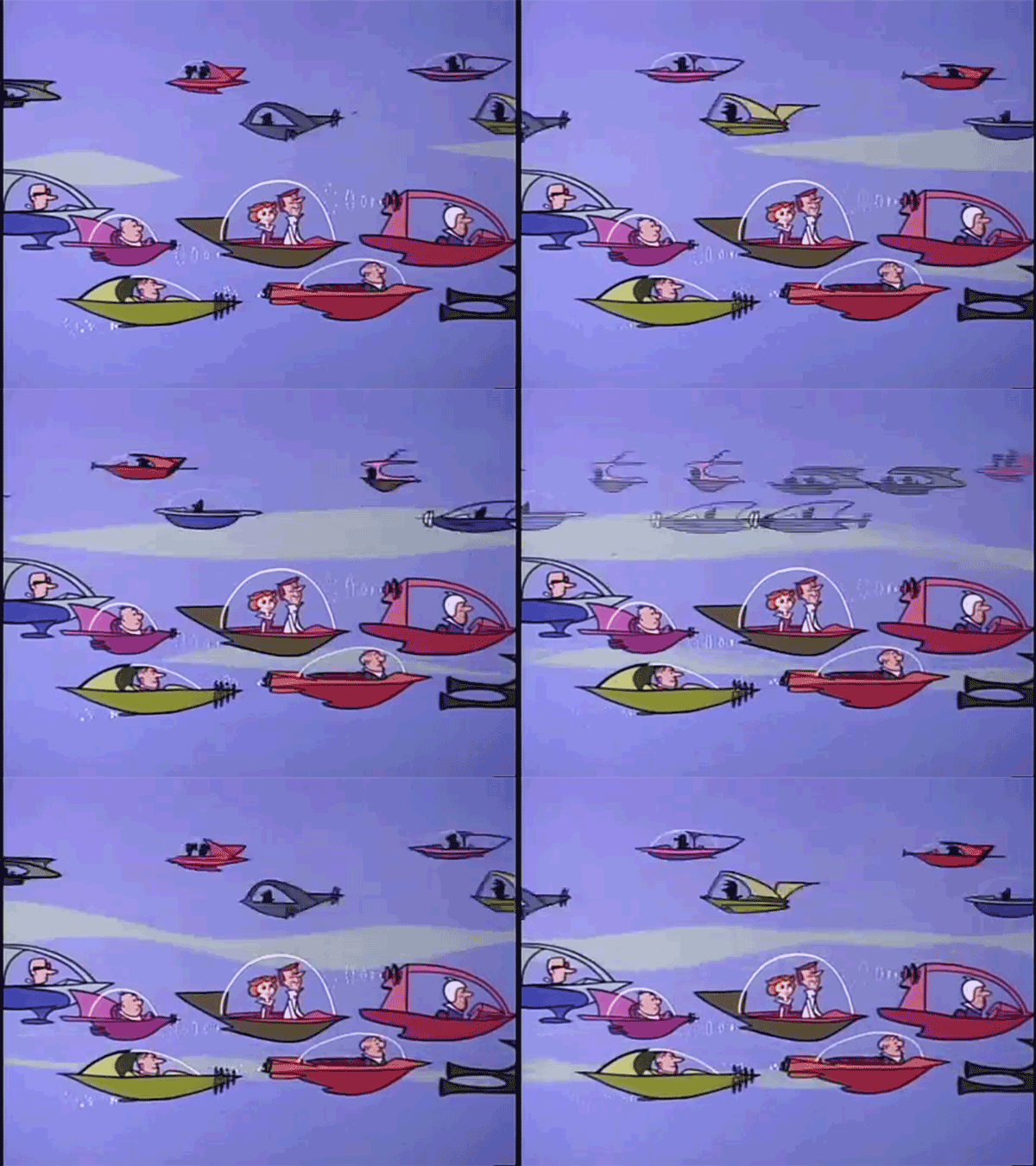
Call me a cynical curmudgeon. But the idea of “flying cars” scares the daylights out of me.
Ironically, if one simply called it a helicopter, I have no problems. I presume you have to be a licensed pilot, file flight plans, etc.
“Flying car” gives me images of dubiously qualified pilots doing what automobile drivers do routinely. In the air. Over other people and structures.
I wish people will be that cool and considerate in their flying cars!

Wrote my undergrad and grad theses on hydrogen
In the 1990 s
Hydrogen powered and no pilot.
To separate hydrogen from water takes a certain amount of energy. A fraction of that energy is recovered when the hydrogen is burned in the engine.
Hydrogen must be kept under pressure. It leaks out through the tiniest of holes.
Stupid idea. I’ll pass.
Right!! The fuel cells are light, and even the hydrogen is light. The only problem is where to store the hydrogen on the airplane. Even at 10,000 psi, four times higher than the 2,500 psi oxygen tanks you see with oxy-acetylene welding tanks that weigh a hundred pounds each, hydrogen still takes seven times the volume to produce an equivalent amount of energy as gasoline. And that doesn't include the volume of the tank material.
Small airplanes easily store a hundred gallons of gasoline in wing tanks that would burst at only 20 psi. So where do you put the 700 gallons of hydrogen and the round tanks that are needed to store it?
Disclaimer: Opinions posted on Free Republic are those of the individual posters and do not necessarily represent the opinion of Free Republic or its management. All materials posted herein are protected by copyright law and the exemption for fair use of copyrighted works.