
Posted on 07/30/2018 12:26:15 PM PDT by dayglored
[Dayglored's comment: As usual The Register has its sarcastic, barbed tongue deeply embedded in its cheek.]
Absurd hardware requirements and compatibility problems aplenty. Sound familiar?
Windows NT has hit an important milestone. Its launch is now closer to the first Moon landing than it is to today.
With its debut in July 1993, Windows NT ushered in a gloriously pure 32-bit future, free of the 16-bit shackles of the past. While the majority of PCs at the time were running MS-DOS, often with Microsoft's Windows 3.1 perched precariously atop, like a giant lemon balanced on a peanut, the kernel-based NT represented a stab at something entirely new.
Originally intended as a successor for IBM's OS/2, before the collaboration between the two companies foundered on the rocks of the success of Microsoft's Windows, NT required some tasty hardware. Nothing less than a 386-class processor (for the Intel iteration) would do, and running it in less that 16MB would make for a very sub-par experience – astonishingly excessive for the time.
Development was famously led by DEC's Dave Cutler, who joined Microsoft five years earlier, with the goal of making the operating system portable via a common code base and a Hardware Abstraction Layer to do all the grungy low-level stuff. Non-Intel architectures such as DEC's Alpha were initially supported but later dropped. Support for POSIX and OS/2 APIs was also present, but faded away as the Windows juggernaut rode into town.
The current Arm incarnation of Windows 10 owes some debt to the early work of the Windows NT 3.1 team.
While initially not as wildly successful as its Windows/MS-DOS stablemate, Windows NT 3.1 (Server and Workstation) provided a solid basis that would eventually eclipse its legacy sibling. Unfortunately, it took some time before application vendors ported their wares over to the new OS (many were likely hedging their bets and waiting to see what IBM would do with its OS/2) so Microsoft offered some modicum of backwards compatibility in the form of the slightly shonky NTVDM (NT Virtual DOS Machine.)
The NTVDM (also known as Windows on Windows, or WOW) allowed legacy applications to run as though on a DOS computer, except without access to protected areas of memory. The theory went that applications running in this subsystem could not take down the operating system if things went south, only the NTVDM itself. Alas, this protection also meant that a substantial number of applications (notably games) simply did not work because NT blocked access to the hardware.
Windows NT 3.1 initially matched its DOS-based sibling version number-wise, but stepped out of sync a year later with the launch of NT 3.5, and then 3.51. NT 4, in 1996, is peak Windows as far as this grizzled hack is concerned, before NT was retooled for consumers with the launch of Windows XP in 2001.
It was 25 years ago that Microsoft made a determined effort to break with the past, and ditch backwards compatibility in order to modernise its operating system offering. If the cruft that has built up in the OS in the intervening years is to be dealt with, Redmond will need to repeat the process. ®
NT stood for New Technology. Hahaha.
More coffee....
And let's not forget the marketing slogans:
"Windows, now with NT Technology!"That would be "New Technology Technology"....
OS2 Warp was a superior product.
Nice Try............................
heard it referred to as “Nice Try” also,
As I recall, originally Windows NT abstracted ALL of the video drivers to cut down on crashing the whole machine, but eventually allowed direct video writes to hardware for performance reasons. Typical Microsoft maneuver, but they got away with it.
We used Windows NT for quite a while in our business without problems.
Arguably so. But it suffered for the fact that IBM required it to remain runnable/compatible with 16-bit protected-mode CPU hardware (notably the 80286), long after that CPU and architecture had been abandoned by everyone else. A terrible marketing decision on IBM's part, and it gave WinNT a chance to move forward into 32-bit-land much faster without significant competition from OS/2.
My employer has a marking laser that still runs Windows NT. I think the machine was built in 2000, but it still runs fine.
Correct, and that was one of the stupidest technical decisions Microsoft ever made.
Their marketing/sales people demanded that NT be as responsive as Win95/DOS, where the applications could talk directly to the hardware. That's simply impossible given a HAL.
So instead of waiting for the hardware to catch up in speed so that the HAL could run as well, they demanded that a bunch of drivers be thrust right back into the kernel, where they could corrupt and/or crash the entire system.
And so, BSODs, malware, lousy drivers breaking things, etc.
Terrible decision -- it gave Windows NT a black eye that it didn't need, and that lasted for two decades.
I like Windows Nice Try better. More accurate anyway.
Genius! Monkey Boy Ballmer come up with that all by himself?
I used to carry some NT certs back when.
I’d probably be lost for a while in it.
And while soundcards and speakers to hear it were still considered optional by many, NT had the coolest start-up sound of all!
https://www.youtube.com/watch?v=6suWwnjGKgQ
I can’t take credit for it.
It came from an Apple guy!.....................
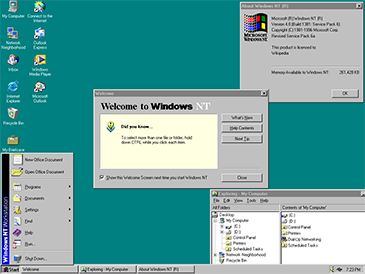
NT 4.0 was a good OS once it had some service packs under it...at least 4 anyway.
Let’s make a crapshow called a “Registry”. That’ll be awesome.
Thank God for Mac OS and my Unix loveliness built in. Windows is still 30 years behind on desktops, mobiles and servers, but pretends they don’t know. Microsoft’s future is web services. Windows is dead; thank goodness.
Disclaimer: Opinions posted on Free Republic are those of the individual posters and do not necessarily represent the opinion of Free Republic or its management. All materials posted herein are protected by copyright law and the exemption for fair use of copyrighted works.