Pickett's Charge

A lone cannon and the field of Pickett's Charge. The Copse of Trees (focal point of the charge) is the right-most cluster of trees on the ridge, "The Angle" is marked by the single tree to the left of the Copse of Trees.
Posted on 07/03/2007 8:51:36 AM PDT by yankeedame
A lone cannon and the field of Pickett's Charge. The Copse of Trees (focal point of the charge) is the right-most cluster of trees on the ridge, "The Angle" is marked by the single tree to the left of the Copse of Trees.
Pickett's Charge was a disastrous infantry assault ordered by Confederate General Robert E. Lee against Maj. Gen. George G. Meade's Union positions on Cemetery Ridge, on July 3, 1863, the last day of the Battle of Gettysburg. Its futility was predicted by the charge's commander, Lt. Gen. James Longstreet, and it was arguably an avoidable mistake from which the Southern war effort never fully recovered psychologically. The farthest point reached by the attack has been nicknamed the high-water mark of the Confederacy.
After Confederate attacks on both Union flanks had failed the day and night before, Lee determined to strike the Union center on the third day. On the night of July 2, General Hancock correctly predicted at a council of war that Lee would try an attack on his lines in the center the following morning.
The infantry assault was preceded by a massive artillery bombardment that was meant to soften up the Union defense and silence its artillery, but it was largely ineffective. Approximately 12,500 men in nine infantry brigades advanced over open fields for three quarters of a mile under heavy Union artillery and rifle fire. Although some Confederates were able to breach the stone wall that shielded many of the Union defenders, they could not maintain their hold and were repulsed with over 50% casualties, ending the battle and Lee's campaign into Pennsylvania.

Cemetery (sic) Ridge
Aftermath
Pickett's Charge was a bloodbath. While the Union lost about 1,500 killed and wounded, the Confederate casualty rate was over 50%....
Command losses were also horrendous. Pickett's three brigade commanders and all thirteen of his regimental commanders were casualties.... Kemper was wounded, and Garnett and Armistead did not survive....falling near "The Angle" at what is now considered the High Water Mark of the Confederacy.
As soldiers straggled back to the Confederate lines along Seminary Ridge, Lee... tried to rally his center, telling returning soldiers and Gen. Wilcox that the failure was "all my fault."
General Pickett was inconsolable...and never forgave Lee for ordering the charge. When Lee told Pickett to rally his division for the defense, Pickett allegedly replied, "General Lee, I have no division."
...When asked, years afterward, why his charge at Gettysburg failed, General Pickett said: "I've always thought the Yankees had something to do with it."

"Taking Battery A"
General Lewis A. Armistead
Pickett's Charge - July 3, 1863

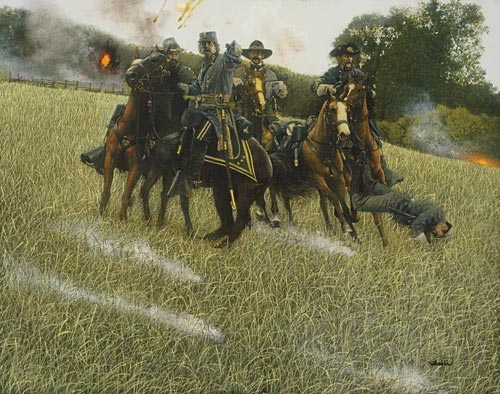
Pickett's Charge -- Into the Jaws of Hell
General Pickett at Gettysburg-- July 3, 1863
===================
Quotes from the 1993 movie
[Buford's cavalry has sighted the Rebel army]
Gen. Buford: Meade will come in slowly, cautiously, new to command... And then, after Lee's army is entrenched behind nice fat rocks, Meade will attack finally, if he can coordinate the army. He'll attack right up that rocky slope, and up that gorgeous field of fire. And we will charge valiantly, and be butchered valiantly. And afterwards men in tall hats and gold watch fobs will thump their chest and say what a brave charge it was. Devin, I've led a soldier's life, and I've never seen anything as brutally clear as this.
------------------
Lt. Gen. James Longstreet: You know what's gonna happen? I'll tell you what's gonna happen. Troops are now forming behind the line of trees. When they come out, they'll be under enemy long-range artillery fire. Solid shot. Percussion. Every gun they have. Troops will come out under fire with more than a mile to walk. And still, within the open field, among the range of aimed muskets. They'll be slowed by that fence out there, and the formation - what's left of it - will begin to come apart. When they cross that road, they'll be under short-range artillery. Canister fire. Thousands of little bits of shrapnel wiping the holes in the lines. If they get to the wall without breaking up, there won't be many left. A mathematical equation... But maybe, just maybe, our own artillery will break up their defenses. There's always that hope.
[sighs]
Quotes from the movie "Gettysburg"
Their descendants are among the most patriotic Americans you will ever find, including my father who was a World War II Naval officer and combat vet of the PTO, exec-officer on an LCI landing Marines on hostile beaches.
I also have three direct descendants (from those same lines) who fought in the Revolutionary War.
As history and God are my witnesses, and despite my love, understanding, and great respect for my progenitors, the Union had to hold.
Wow
Having played many wargames, both board and computer, I have done Pickett’s charge several times. I always ask myself, “What in the world was Lee thinking about”?
Despite his own record of bloodying the Union armies badly that made direct frontal assaults on his onw forces, he, nevertheless, made the same mistake.
He miscalculated terribly, and it cost him and the southern Army of Northern Virginia horribly. It is amazing, after that defeat, that he continued on, and was able to inflict serious, and very horrible damage on the Union armies for another two years after the defeat at Gettysburg.
I've read a lot of your posts over the years and you always came across as a real American.
Happy Independence Day.
this is something that I have long wondered about, and while I doubt it is true, it is interesting to ponder.
Rather, I am myself convinced that he ordered the charge because he truly thought he could win, that he could smash the Unon as they had failed to smash him, and thus hasten the end of the war and save more lives. He made a grave mistake in thinking this IMHO, but he was there on the ground and knew his troops as well as anyone.
But that is my opinion. Robert E. Lee and God know for sure...but given his life and his honorable character, I believe he certainly would have resigned before ordering a charge he knew would fail and that would hasten his own army's defeat.
Thank you. God bless and keep you and yours and may you also have a Happy Independence Day, and may God’s hand still stretch over, protect and preserve America.
Four score and seven years ago our fathers brought forth on this continent, a new nation, conceived in Liberty, and dedicated to the proposition that all men are created equal.
Now we are engaged in a great civil war, testing whether that nation, or any nation so conceived and so dedicated, can long endure. We are met on a great battle-field of that war. We have come to dedicate a portion of that field, as a final resting place for those who here gave their lives that that nation might live. It is altogether fitting and proper that we should do this.
But, in a larger sense, we can not dedicate — we can not consecrate — we can not hallow — this ground. The brave men, living and dead, who struggled here, have consecrated it, far above our poor power to add or detract. The world will little note, nor long remember what we say here, but it can never forget what they did here. It is for us the living, rather, to be dedicated here to the unfinished work which they who fought here have thus far so nobly advanced. It is rather for us to be here dedicated to the great task remaining before us — that from these honored dead we take increased devotion to that cause for which they gave the last full measure of devotion — that we here highly resolve that these dead shall not have died in vain — that this nation, under God, shall have a new birth of freedom — and that government of the people, by the people, for the people, shall not perish from the earth.
- A. Lincoln
November 19, 1863
I know he wanted the decisive battle, but when you watch Picket’s Charge unfold on an accurate computer simulation, you just wonder how in the world he could make such a mistake. In these computer games, if the South continues to press the attack on the first day and the North tries to hold, the South will win. If the South waits to the third day to press home the attack, it is hopeless.
OTH - When you stand at the top of Missionary Ridge in Chattanooga, you think there was no way Sheridan’s attack could succeed. Yet it did.
Patton’s Great uncle was wounded at Gettysburg during Pickett’s charge.
Not if the South had the firepower available the North had at Gettysburg.
I have two ancestors who were from North Carolina, but joined a Union regiment. They were Quaker abolitionists, but not pacifists.
I'm not sure if you are familiar with this story, but I recall reading it a biography of General Lee many years ago.
The war had ended, and the years had rolled on, but people -- as opposed to the politicians -- still remembered the aging general. A young woman sought him out and presented her tiny infant son for Lee to touch and, in his own way, to bless.
"Please, General," she asked, "what advise can you give me to raise him?"
Lee looked tenderly at the infant and stroked its head. "Only one," he said to the mother. He looked her in the eye. "Teach him to deny himself."
==========
I have never forgotten that story, or that advise. Advise that was puzzling at first, but the more I think up it the more I think, "By the love of God, there was a man."
They weren't paying attention in Mexico, where most of the leading generals on both sides fought. Scott did not assault Mexican strongpoints, except perhaps at Molino del Rey, where he had bad intelligence about Mexican strength.
Lee was Scott's best engineer and scout in Mexico.
Interesting factoid.
Grant is often called “a butcher” because of the high casualties his men suffered.
But guess which Civil War general had the highest casualty rate?
R. E. Lee.
Given the conditions, it is amazing that Lee got his army to perform as it did. Of course, when presented with such superior forces, and without the abaility to really rebuild, his percentages (or rate) would go up as opposed to an Army that was contantly resupplying and growing.
Troops Available for Duty
Year -- North --- South
1862 - 527,204 - 209,852
1863 - 698,808 - 253,208
1864 - 611,250 - 233,586
1865 - 620,924 - 154,910
Total Casualties -------- North --- South
Deaths from Wounds -- 110,070 - 094,000
Deaths from Disease --- 249,458 - 164,000
Total Deaths ----------- 360,158 - 258,000
Death Rate ----------- 23 percent - 24 percent
Wounded -------------- 275,175 - 100,000
Total Casualties -------- 635,333 - 358,000
Disclaimer: Opinions posted on Free Republic are those of the individual posters and do not necessarily represent the opinion of Free Republic or its management. All materials posted herein are protected by copyright law and the exemption for fair use of copyrighted works.