Skip to comments.
The Dendritic Ridges of Olympus Mons
Thunderbolts.info ^
| Nov 22, 2006
Posted on 11/30/2006 1:47:07 AM PST by Swordmaker
Recent European Space Agency images of the escarpment of Olympus Mons reveal branching ridge patterns that continue to baffle planetary scientists. But the “Lichtenberg” form of these ridges points directly to an electrical interpretation.
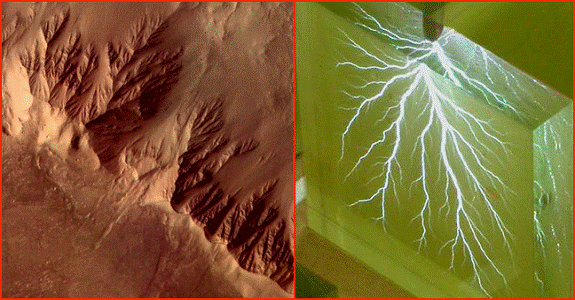
LEFT: Finely carved branching ridges on the western flank of the Martian mountain Olympus Mons
pose unsolved riddles for planetary scientists. (Note: to avoid seeing ridges as depressions, keep in
mind that the light is coming from the left. The tree-like branching of the ridges is running down
the escarpment.) Credit: ESA/DLR/FU Berlin (G. Neukum) RIGHT: A Lichtenberg figure created by
electric discharge in an acrylic block.
In a previous Picture of the Day, we noted the presence of hundreds of fascinating and bizarre formations called “spiders” at the south pole of Mars. We also noted that since the discovery of these formations a few years ago — and despite the best efforts of planetary scientists -— they have evaded scientific explanation.
We did, however, draw attention to an electrical formation called a "Lichtenberg figure." In 1777, the German scientist Christoph Lichtenberg discovered that dust settling on a cake of non-conducting resin, when subjected to an electric spark, recorded star-like patterns. Later, other experimentalists found that these Lichtenberg Figures could be recorded directly on film as a two dimensional photograph of discharge streamers. The positive and negative surfaces in a discharge produce quite different patterns.
We noted the striking similarity in form of the Martian spiders to a Lichtenberg figure. These same forms are found in the “novae” and "arachnoids" on Venus -- overlying "spidery" formations stretching around the planet's equator. Large-scale formations of this kind, if they are to be explained electrically, require something that is not permitted under standard theoretical assumptions -- electrical arcing on a cosmic scale in an earlier, unstable phase of solar system history.
Lichtenberg figures take the observed radial forms of the Martian spiders. In many instances, (as illustrated here) the "trunk" of the tree-like, “dendritic” form points in the direction of the main current flow.
When planetary scientists consider the role of electricity in solar system history, Lichtenberg figures will become an important diagnostic tool. An electric arc can produce dendritic branching patterns of fused or raised material. Such dendritic ridges are common on Mars and the Earth. But theories of their formation are weak.
The image above shows a small portion of the western flank of Olympus Mons, which planetary scientists call “the biggest volcano in the solar system.” In previous Pictures of the Day, we have suggested that Olympus Mons is in fact an anode blister (electric discharge blister on a positively charged surface) from a stupendous cosmic lightning bolt. From an electrical vantage point, the dendritic ridge patterns seen in such finely cut relief -- and present far beyond the region shown – illustrate the power of the electric force to achieve what cannot be achieved by standard geology. (See larger picture here.)
Commenting on these ridges of Olympus Mons, the European Space Agency website notes that the escarpment shown rises over 7000 meters above the surrounding surface level.
“To the north and west of the volcano, these 'aureole' deposits are regions of gigantic ridges and blocks extending some 1000 kilometres from the summit like petals of a flower. The origin of the deposits has challenged planetary scientists for an explanation for decades…”
But all that ESA can offer as an explanation is “landslide” and/or glacial causes. That these well-defined branching patterns could be caused by such influences seems out of the question. So in conventional terms, the dendritic ridges of Olympus Mons remain a profound mystery. If, however, in the grip of the electric force, Olympus Mons was raised to heights that dwarf Mount Everest, Lichtenberg formations on the flanks of the immense “lightning blister” would be no surprise.
It seems that ground currents flowing to or from the discharge that formed Olympus Mons caused heating and metamorphosis of subsoil into rock, which then resisted erosion by accompanying electrical forces tending to remove surface material. The result is that the Lichtenberg ridges are exposed like an etching.
TOPICS: Astronomy; Science
KEYWORDS: electricuniverse
To: AndrewC; Fred Nerks; SunkenCiv; Soaring Feather
Hmmmm... more mysterious Areology, unexplained by the accepted cosmology... PING!

If you want on or off the Electric Universe Ping List, Freepmail me.
2
posted on
11/30/2006 1:49:22 AM PST
by
Swordmaker
(Remember, the proper pronunciation of IE is "AAAAIIIIIEEEEEEE!)
To: Swordmaker

Grand Canyon - Lichtenberg figure?
3
posted on
11/30/2006 3:08:27 AM PST
by
Fred Nerks
(MEDIA + ENEMY = ENEMEDIA!)
To: Fred Nerks
Very possible... have you ever noticed there is not Colorado River Delta??? Since there isn't, where did all the erosion product mud go?
4
posted on
11/30/2006 5:31:24 PM PST
by
Swordmaker
(Remember, the proper pronunciation of IE is "AAAAIIIIIEEEEEEE!)
To: Swordmaker
Response: The Colorado River delta itself is quite extensive. It covers 3,325 square miles (Sykes 1937) and is up to 3.5 miles deep (Jennings and Thompson 1986), containing over 10,000 cubic miles of the Colorado River's sediments from the last two to three million years. The sediments that were deposited by the river more than two to three million years ago have been shifted northwestward by movement along the San Andreas and related faults (Winker and Kidwell 1986). Sediments have also accumulated elsewhere. Some were deposited in flood plains between the delta and the Grand Canyon.
Wind is a major erosional force in parts of the Colorado River basin. Some sediments from Colorado and Wyoming were blown as far as the Atlantic Ocean.
Much of the strata exposed in the Grand Canyon are limestone and dolomite. These rocks eventually simply would have dissolved.
http://www.talkorigins.org/indexcc/CD/CD210.html
(it all melted or blew away!)

River delta. Coloured aerial photograph of the Colorado River delta, in the Gulf of California, USA. The river is the dark hemispherical shape at the bottom of the picture. Its waters branch out (dark) like the boughs of a tree through sandbars, which are seen as the peach coloured areas.
5
posted on
11/30/2006 10:37:49 PM PST
by
Fred Nerks
(MEDIA + ENEMY = ENEMEDIA!)
To: Swordmaker
I wonder if it is the quantity of detritus in the Colorado River delta related to its age that is in question? As an example, in 'Earth In Upheaval' on page 144 we read:
The Mississippi
The Mississippi carries yearly in its stream many billions of tons of detritus, a large part of which is deposited in the delta. As early as 1861, Humphreys and Abbot calculated the age of the Mississippi by evaluating the detritus borne by it and the sediment deposited in the delta. They arrived at the low figure of 5000 years as the age of the delta, its birth being related to about the year 2800 before the present era. However, when at the close of the Ice Age the ice cover melted in the north, multitudinous streams must have carried an enormous amount of detritus into the Mississpippi and its tributary, the Missouiri, and for this reason the above figure, if otherwise properly calculated, must be appreciably reduced. It is assumed that when the continental ice started to melt and the Great Lakes became swollen, but the St Lawrence was still blocked by ice, the water of the basin emptied to a great extent into the Gulf of Mexico through the Mississippi. ------

6
posted on
12/01/2006 3:10:35 PM PST
by
Fred Nerks
(MEDIA + ENEMY = ENEMEDIA!)
Disclaimer:
Opinions posted on Free Republic are those of the individual
posters and do not necessarily represent the opinion of Free Republic or its
management. All materials posted herein are protected by copyright law and the
exemption for fair use of copyrighted works.
FreeRepublic.com is powered by software copyright 2000-2008 John Robinson