Skip to comments.
Seven Economic Warning Signs Every American Should Be Watching Right Now
PNW ^
| 10/01/2026
Posted on 10/01/2026 8:25:27 PM PDT by SeekAndFind
You don't have to work on Wall Street to care about Treasury yields. You don't have to own a farm to care about diesel prices. And you don't have to be shopping for a house to care about mortgage rates.
Eventually, these numbers have a way of finding all of us.
America is entering a period in which several economic warning signs are flashing at the same time. None of them, by itself, proves that a recession or financial crisis is around the corner. In fact, parts of the economy remain remarkably resilient.
But taken together, they tell us something important: the financial pressure on American households is becoming increasingly difficult to ignore.
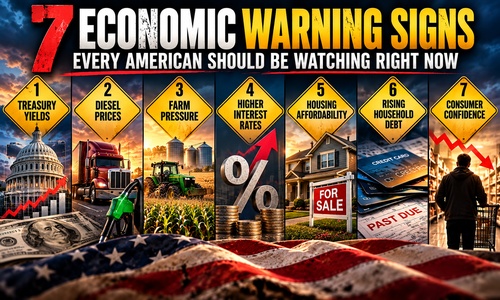
Here are seven warning signs worth watching.
1. Treasury Yields Are Sending A Warning
The bond market rarely makes dinner-table conversation, but perhaps it should.
Long-term Treasury yields have recently climbed to levels not seen in decades, with the 30-year yield reaching its highest level since 2004.
Why should the average American care?
Because Treasury yields influence borrowing costs throughout the economy. Mortgages, business loans and other forms of credit are affected by what happens in the bond market.
Higher government borrowing costs also matter because Washington must continually refinance an enormous national debt. The more expensive that becomes, the larger the government's interest burden becomes.
A move in Treasury yields may look like something happening on a trader's computer screen. Eventually, however, the consequences can reach Main Street.
2. Diesel Has Become Everybody's Problem
Diesel recently surged above $6 per gallon nationally, hitting record territory. Farmers have been particularly hard hit during one of the most fuel-intensive periods of the year.
But this isn't just a farmer problem.
Diesel powers tractors, combines and other agricultural equipment. It powers the trucks transporting produce, meat and dairy products. It moves construction equipment and countless commercial vehicles.
In other words, much of the physical economy runs on diesel.
When farmers spend dramatically more to harvest crops and truckers spend dramatically more to move them, somebody eventually has to absorb those costs. Businesses can swallow them temporarily, but not indefinitely.
That means the diesel price displayed at a truck stop hundreds of miles away may eventually appear in your grocery receipt.
3. America's Farmers Are Being Squeezed
Diesel isn't the only problem confronting agriculture.
The USDA expects inflation-adjusted net farm income to decline 5.5 percent in 2026. Meanwhile, total farm-sector debt is projected to climb 4.6 percent to approximately $605 billion.
Those numbers deserve more attention than they receive.
America's food supply depends upon producers who face many of the same problems households do: higher borrowing costs, higher energy costs and expensive inputs. Farmers cannot simply stop planting or harvesting because diesel, fertilizer or financing became too expensive.
They have to make the numbers work.
When they can't, they borrow more, cut expenses, postpone equipment purchases or eventually leave the business.
Americans may live hundreds of miles from the nearest farm, but every family visits a grocery store. What happens in farm country doesn't stay in farm country.
4. Interest Rates Are Moving The Wrong Direction Again
The Federal Reserve raised its benchmark interest rate by a quarter percentage point in September to a range of 3.75 to 4 percent, citing inflation that remains elevated.
That is significant because Americans had spent years waiting for relief from high borrowing costs.
Instead, inflationary pressure has complicated the picture again.
Higher rates make carrying credit-card balances more expensive. They affect auto financing, business loans and adjustable-rate debt. They also make it more difficult for companies to justify expansion and investment.
The painful reality is that fighting inflation itself can hurt.
If rates remain high because prices remain high, consumers can find themselves trapped between two problems: expensive goods and expensive money.
5. The Housing Affordability Crisis Isn't Going Away
The average 30-year fixed mortgage reached 7.03 percent in late September, according to Freddie Mac.
Consider what that means for an ordinary family.
A $400,000 mortgage at 3 percent carries principal and interest of roughly $1,686 per month. At 7 percent, it is roughly $2,661.
That's nearly $1,000 more every month for essentially the same amount of borrowed money.
Higher mortgage rates don't only affect people buying houses. They discourage existing homeowners with low-rate mortgages from moving, distort housing supply, affect construction and make it harder for younger Americans to establish themselves financially.
For millions of families, the American dream hasn't disappeared because houses don't exist. It has become harder because the monthly payment no longer works.
6. Americans Are Carrying An Enormous Debt Load
U.S. household debt stood at approximately $18.8 trillion at the end of the second quarter.
Credit-card balances alone reached $1.26 trillion, while auto-loan balances climbed to $1.71 trillion.
Those numbers become particularly important when borrowing costs remain elevated.
Debt can disguise financial stress for a while. A household facing higher grocery, insurance, utility and transportation expenses can maintain its lifestyle by putting more purchases on credit.
But borrowing doesn't eliminate the cost. It moves the bill into the future--and adds interest.
The New York Federal Reserve says new delinquencies on auto loans and credit cards remain elevated.
That doesn't mean American consumers are collapsing. It does suggest that some households have less room for another economic shock than the headline economic numbers might imply.
7. Consumers Are Losing Confidence
Perhaps the most revealing warning sign is also the simplest: Americans themselves are worried.
The Conference Board's Consumer Confidence Index plunged 6.7 points in September to 81.9--the lowest reading since April 2014.
Consumers reported increasing concern about prices, employment prospects and the economic outlook.
That matters because consumer spending is a critical engine of the American economy.
When families become nervous, behavior changes.
They postpone buying the car. They delay remodeling the kitchen. They eat out less frequently. They skip the vacation. They keep the old appliance another year. They begin saving whatever they can because they aren't certain what comes next.
One family's decision to spend less doesn't matter much.
Millions of families making that decision simultaneously certainly does.
The Real Warning Is That These Problems Are Connected
This is what makes the current situation worth watching.
Higher energy costs can contribute to inflation. Inflation can keep interest rates higher. Higher rates can increase mortgage and business borrowing costs. Higher farm and transportation costs can eventually increase consumer prices. Higher household expenses can push families toward credit. And eventually, squeezed consumers begin pulling back.
One pressure feeds another.
None of this means an economic collapse is inevitable. The labor market, for example, continues to show important signs of resilience, and parts of the economy remain strong.
But waiting until a crisis officially arrives before paying attention to warning signs defeats the purpose of watching them.
For most Americans, "the economy" isn't GDP, Treasury auctions or Federal Reserve statements.
It's whether the paycheck stretches until Friday.
It's whether the family can afford the mortgage.
It's whether filling the truck costs $80 or $140.
It's whether groceries require another $50 this week.
It's whether the credit-card balance is going down--or quietly climbing.
And it's whether a farmer can afford to plant next year's crop.
That's why these seven warning signs matter.
They may appear in completely different economic reports, but eventually they all arrive at the same place: the American household.
TOPICS: Business/Economy; Government; Society
KEYWORDS: consumer; debt; debttruth; economictruth; economy; inflation
To: sauropod
2
posted on
10/01/2026 8:49:54 PM PDT
by
sauropod
("They eventually succomb to the dollar" - President Donald J. Trump Ne supra crepidam)
To: SeekAndFind; Nervous Tick
Not to worry ☺️
I mentioned this kind of stuff in 2007-2008
warning of the looming Economic Crash just ahead
Most laughed or shrugged it off
And they did so again around May of 2008.
Everything is fine... until it isn’t lol
3
posted on
10/01/2026 8:53:45 PM PDT
by
SaveFerris
(Luke 17:28 ... as it was in the Days of Lot; They Did Eat, They Drank, They Bought, They Sold ......)
To: SeekAndFind
American governments (Federal, State and Local) have incurred huge, unpayable, historically unprecedented debts financing consumption for the unproductive and the fighting of useless wars. These debts are at the core of dollar weakness, inflation, high interest rates, political instability and economic decline.The uneducated and ignorant, dependent, non productivepeople have concluded that capitalism has “failed” and actually believe “socialism” will save them.
4
posted on
10/01/2026 8:53:51 PM PDT
by
allendale
To: SeekAndFind
So are you saying that the Democrats are going to fix these problems? Are you trying to demoralize people here from voting because you don’t like Trump? If we lose these next two elections this country will be no more. The barbarians are at the gates. If they win and pack the Supreme Court it is game over.This is not a time “to send a message to the RINOs”. We need everyone to get out and vote no matter how they feel about Trump, Paxton or Collins etc.
5
posted on
10/01/2026 9:11:12 PM PDT
by
willk
(Local news media. Just as big an enemy to this country as national media)
To: SeekAndFind
They postpone buying the car. They delay remodeling the kitchen. They eat out less frequently. They skip the vacation. They keep the old appliance another year. They begin saving whatever they can because they aren't certain what comes next. That sounds like just how I grew up and lived in our early (most of) our marriage.
And we still live like that.
6
posted on
10/01/2026 9:16:04 PM PDT
by
metmom
(He who testifies to these things says, “Surely I am coming soon." Amen. Come, Lord Jesus!)
To: willk
If we lose these next two elections this country will be no more. The barbarians are at the gates. If they win and pack the Supreme Court it is game over.This is not a time “to send a message to the RINOs”. We need everyone to get out and vote no matter how they feel about Trump, Paxton or Collins etc.DITTO!
Mortgage rates were a little over 7% when we bought our first house.
As they should be. Why?
So people can count on a decent retirement income.
One of my friends had about $2 million in stocks he planned on selling and buying bank CDs and living off the interest.
He needed 5% interest from a bank to make this work.
For that to happen, banks need to get 7% interest to pay their bills and make a profit.
I don't do my retirement that way, but a lot of folks do, so 7% or so should be the norm for mortgage interest rates.
7
posted on
10/01/2026 10:03:30 PM PDT
by
Mogger
( 7th generation Vermonter, refugee in New Hampshire hoping NH remains sane.)
To: willk
Diesel fuel problems are partly because of the Democrats. 2 major refineries shut down earlier this year in Newsom’s California taking diesel fuel off of the market. Forcing Ultra Low Diesel Fuel on the market...more expensive to make.
8
posted on
10/01/2026 10:26:26 PM PDT
by
kaktuskid
To: SaveFerris
Yep. Someone on here just the other day responded to me that GDP and the markets being up are all that mattered.
9
posted on
10/01/2026 10:35:09 PM PDT
by
voicereason
(When a bartender can join Congress and become a millionaire...there’s a problem.)
To: voicereason
They are usually wonderful things
Until The Black Swan appears
10
posted on
10/01/2026 11:29:36 PM PDT
by
SaveFerris
(Luke 17:28 ... as it was in the Days of Lot; They Did Eat, They Drank, They Bought, They Sold ......)
To: sauropod
Farmers are upset, truckers are upset...this won’t be pretty.
People don’t understand the incoming pain that we’re about to realize and we have it far better than what’s happening in other parts of the world. It’s almost as though that Trump is ushering the Great Reset while his family and friends are raking in billions. He’s making Biden looking like amateurs.
To: Mogger
Jimmie Carter gave me a 13.5% mortgage rate in 1980. I made double payments for 10 years to pay off my loan.
Damn Dems don’t know $hit.
12
posted on
10/02/2026 5:17:54 AM PDT
by
IAGeezer912
(One out of every 20 people on the face of the earth are Americans. We have won life's lottery.)
To: IAGeezer912
Government and government debt us behind all of these
To: willk
We have heard this before every election in the last 40 years.
Republicans really should of taken action when we placed them in power in 2024.
14
posted on
10/02/2026 6:09:12 AM PDT
by
KEVLAR
( )
Disclaimer:
Opinions posted on Free Republic are those of the individual
posters and do not necessarily represent the opinion of Free Republic or its
management. All materials posted herein are protected by copyright law and the
exemption for fair use of copyrighted works.
FreeRepublic.com is powered by software copyright 2000-2008 John Robinson