Transcript
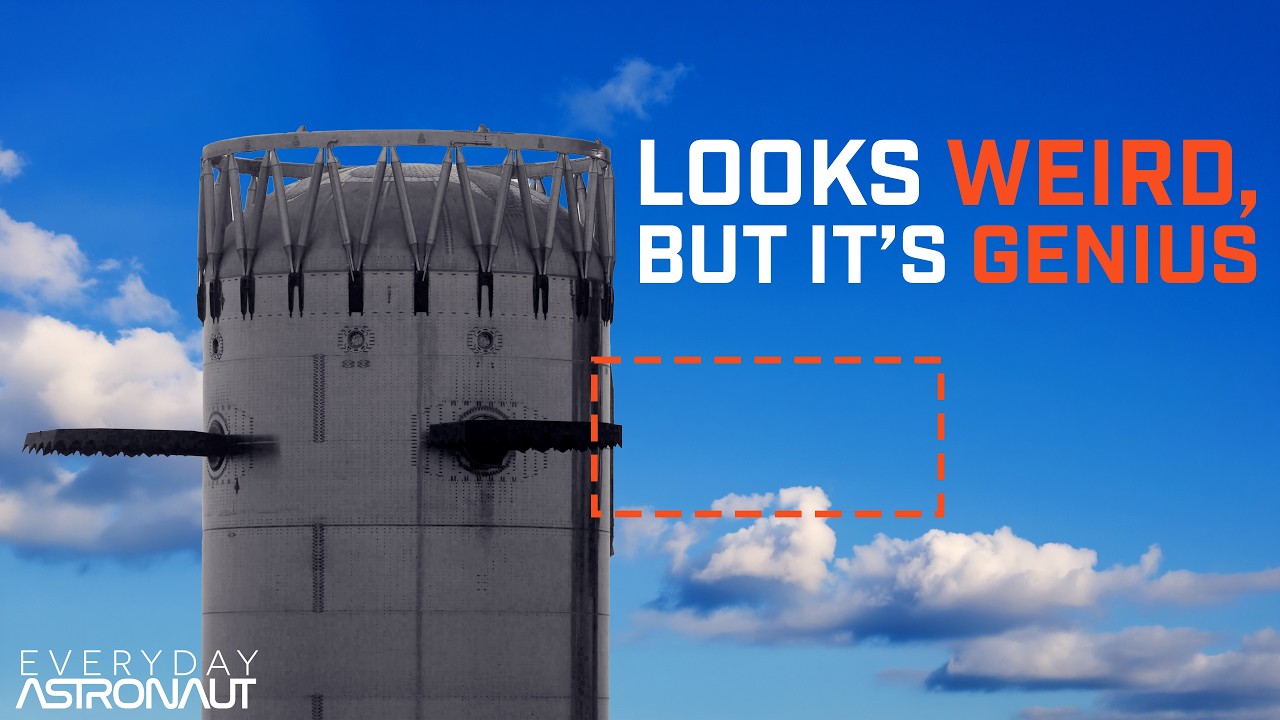
Perhaps one of the strangest and most obvious changes to SpaceX’s latest Starship or version 3 is the fact that the new Super Heavy booster now only has three grid pins instead of four. This makes the rocket look asymmetrical and honestly just kind of weird. But as strange as it looks, the reason they did this is actually quite clever. I’m Tim Dodd, the Everyday Astronaut. Today we’re going to dive into grid fins and what they’re for. We’ll compare the Falcon 9 and Starship grid fins. We’ll explain why this move from four grid fins down to three makes a lot of sense and how common this actually is in other applications that you’re likely familiar with. Okay, let’s get started.
Ever since I saw the first Falcon 9 with grid fins on it in 2015, I’ve been enamored by them. So much so that we really cared a lot about our rockets having little articulating and folding grid fins. So it was realistic on our model rockets that you can get at everydayastron.com/shop as well as we even put them on button-up shirts. And despite the average person probably thinking that they’re flywatter or like a waffle iron or something, today I wanted to give the grid fin some much-needed love. Okay, right at the top here I’m just going to tell you why exactly SpaceX went down to three grid fins. It’s mostly because one of the grid fins is in the wake of the rocket during re-entry and therefore it doesn’t have as much control authority. By making the remaining three grid fins bigger, they can make the booster both lighter and have more control. So, it’s a total win-win. And there’s your answer right here in the first few minutes of this video. But for those of you who want more than the answer, who want to soak up some good knowledge on grid fins, stick with me, ‘cause I actually think this topic is awesome. So, let’s start off with what exactly is a grid fin.
Grid fins are an aerodynamic control surface that can help steer and guide a vehicle in the atmosphere. They have the exact same function as an all-moving fin or rudder where they deflect and direct air which provides control. But instead of one large fin or structure, it’s basically a fin that’s broken up and placed into a grid. Hm. So, yeah, I guess that’s why it’s called a grid fin. A grid of small fins. Got it. But why would you use these instead of a traditional or planar fin or an all-moving control surface? Well, one of the key design features of grid fins that make them unique is their ability to fold up. This was their original intent when they were primarily used for guided bombs and missiles. This allowed the missiles to be stored and stacked in a hopper like a traditional bomb or placed into a silo. And then once it launched or was dropped, the grid fins could simply deploy and start steering the vehicle or be used passively to increase stability. They also were quite notable on the infamous N1 rocket that the Soviet Union built as their entry during the 1960s moon race. However, these were passive grid fins. They did not move or steer. They were simply there to help keep the rocket stable with its pointy end up and its flamey end down.
So, when SpaceX’s Falcon 9 started using them, the application was quite unique. Since SpaceX didn’t want to use them on ascent, they could simply be tucked in on the way uphill, which kept them out of the airflow and reduced drag. Then once they’re in space, they could be deployed to be used as active guidance on the way back down. We’ve seen them used successfully on over 600 missions with the Falcon 9 to date. Before we look at how SpaceX uses them on Starship and how they’re different, let’s talk more about how exactly they work. Well, like we said, they’re basically just an all-moving control surface. So, they deflect airflow similar to a rudder or horizontal stabilizer on a plane. In fact, you could literally use grid fins as your rudder and horizontal stabilizers on a plane if you wanted to. By rotating, they deflect airflow, and depending on how they move together, they can impart different movements into the vehicle. To control pitch, the two horizontal grid fins will move in unison up or down. To control yaw, the vertical grid fins move left or right. And to control roll, opposing pairs just have to move in opposite directions. So SpaceX is basically flying the booster back to the landing site autonomously like a backwards flying guided missile.
The Falcon 9 doesn’t inherently have a lot of lift since it’s just a cylinder. But even a cylinder has lift, which helps extend the cross-range capability of the booster. This means the booster can actually glide a little bit and aim even further downrange than its ballistic trajectory, which is a good thing. The more time it spends in the atmosphere, and the steeper its angle of attack, the more work the air is doing to slow the booster down. And the more work the atmosphere does to slow the booster down means less work the engines have to do for their landing burn, which means less propellant they need for the landing, which means more propellant they can use for ascent, which means a higher performing vehicle altogether.
One common misconception about grid fins is that they work by inducing drag to control the booster. While they inherently do induce some drag, drag is perpendicular to their direction of control. Again, it’s the same as the ailerons of a plane. When an aileron moves up or down, they deflect airflow up and down to induce the intended roll. But an aileron does produce some drag, especially when fully deployed, which induces what’s known as adverse yaw. So in the case of ailerons, the primary mode of control is the deflection of air causing roll along the center axis. But the secondary effect is drag, which pulls the wing back, causing a yaw effect. It’s rather unusual to use drag as your primary method of control, but a good example is the split ailerons on the B2 stealth bomber. Since it lacks a traditional vertical stabilizer and rudder in order to provide yaw stability and control, it actually opens up an opposing pair of ailerons. Doing so slows down whichever wing they’re deployed on, and that in effect causes yaw. This allows the jet to maintain control and not inadvertently spin off like a Frisbee when maneuvering. And having no vertical stabilizer cuts down on its radar signature, which helps increase its stealthiness.
Grid fins have been chosen versus traditional planar fins because like for like, they don’t need as big of a motor or an actuator to control them as you would need for a standard fin. Their short effective chord length means there’s less aerodynamic torque pushing on them as their angle of attack increases. They also work well at hypersonic and supersonic speeds. However, they do suffer during the transonic phase, and they aren’t quite as effective at subsonic speeds. And you may have noticed SpaceX started adding serrated teeth when they upgraded the Falcon 9 grid fins in 2017. These teeth are actually there to help the fin maintain control during that transonic phase, helping to break up the local speed of sound across the fins. SpaceX has continued to employ this design on Starship’s grid fins as well, but the trade has generally swayed towards grid fins for SpaceX rather than large fins like what Blue Origin’s new Glenn rocket has, despite effectively doing the same thing. Not to mention, they have a lot of experience with grid fins on the Falcon 9. So, they’ve kind of just kept with it.
So, that said, let’s dive into how they’re used on Starship and what’s different compared to how they’re used on the Falcon 9. The biggest thing you’ll notice about Starship grid fins is that these things are enormous. The Falcon 9’s grid fins are about 1.2 m wide and 1.6 m long, and they’re made out of titanium. Starship version 3’s grid fins are about 3.5 m wide, and they’re about 3.8 m long in that lattice area, and it’s made out of stainless steel. The next thing you’ll notice about them is that they’re always extended. They don’t retract for ascent at all. And compared to the Falcon 9, that just seems really weird. Conventionally, you don’t want an aerodynamic control surface too far forward on your vehicle. If an aerodynamic control surface is in front of your center of mass, it can lead to compounding instability. When a vehicle’s attitude moves outside of directly windward, the airflow will impart forces on the control surfaces and/or the wings. And when that control surface or wing or fin is in front of the center of mass of the vehicle, it will actually induce more pitch and compound the issue. So it’ll pitch the vehicle more which will put a greater angle of attack to the airflow which will induce even more pitch which will increase the angle of attack, etc., etc. It’s generally not good and can easily lead to a vehicle flying out of control.
But if the center of lift is behind the center of mass as the angle of attack increases, it will naturally try to push the vehicle back towards the airstream, which inherently makes it more stable. Okay. So why does SpaceX keep them extended? Well, the reason is fairly simple. The mechanism required to flip them out has mass, probably quite a bit of it. So, the engineering trade is whether deleting the mass of a deployment mechanism is higher performing than the drag induced by keeping them out, assuming there is a performance increase when removing the deployment mechanism. The next question is simply, can the rocket handle having them out on ascent from a stability point of view? Well, first off, Starship Super Heavy booster steers the stack with engine gimbals, not with grid fins, which are actually inactive on ascent. And next, the sheer mass of a loaded Starship rocket means the grid fins don’t produce much effect on it. So, keeping them out on ascent was really deemed not much of an issue. I mean, don’t forget, there’s even bigger flaps that are even higher up on the stack with the Starship upper stage. When you actually stop and look at it, it almost feels like they’re throwing a dart fins first and making it work. It’s actually pretty crazy.
Another major difference between Starship’s grid fins and the Falcon 9’s is that Starship controls the grid fins with electric motors, while the Falcon 9 uses hydraulic actuators to move the fins. Starship actually uses a lot of electronic actuators, like the engine gimbals and the flaps on Starship. Another unique thing about Starship grid fins is that two of them have catch pins integrated into them, which is something new on Starship version 3.
Now, obviously, the Falcon 9 isn’t caught by a tower, but previous Starships had separate catch ball things. This mount is now integrated into the grid fins themselves. So, now the big question: why did they remove one of them? Well, you already know the answer from the start of the video, but now with everything we’ve talked about, hopefully, it’s a little bit more obvious. The fourth grid fin was primarily removed because it was less effective during re-entry, especially at high angles of attack where it ends up mostly in the wake of the booster given its location on the top of the booster as it’s falling through the atmosphere. So because of that high angle of attack relative to the airflow, this means that the top fin would be biting into less air. So it’s not able to do as much work, especially not as much work as its counterpart on the underside of the booster, which is fully windward. So if you simply enlarge the other three fins, you can get more control authority and fully delete the fourth fin, its motor, and the underlying structure. Three fins is basically the minimum you need to provide pitch, yaw, and roll. And since the rocket is really trying to increase its angle of attack as much as possible, having a full pair of grid fins for pitch 180° apart is extra effective rather than spacing them out every 120°.
Although this seems unusual, it’s actually quite conventional when you think about aircraft. Look at pretty much any plane. They tend to have a pair of horizontal stabilizers and a vertical stabilizer. But it’s mostly a clearance reason why planes don’t have a vertical stabilizer extend downward below the empennage as much as it extends upwards since it would strike the ground. But yeah, three fins is actually super normal. But clearance might be another reason why they went with three for Starship. Since the fins are all 90 degrees apart from each other, and with the fins now being larger, the fourth fin would have very little clearance during landing or even kind of during stacking operations. And this is especially true because of the fact that the catch points are now integrated into the side fins. The fourth fin would have to be directly in the pinch point of the catch arms and they would extend straight towards the tower. This is different from earlier Starship designs like V1 and V2 boosters where the fins were oriented closer together and not at 90° and the catch point was between those fins which kept the fins quite far from the tower.
And there’s one more fun little detail with that lone third fin that I think is pretty cool. The lattice fins themselves inside the grid fin are actually at a small angle to help counteract the fin’s little amount of drag induced pitch. You can even see how the one little fin’s lattice structure is more visible from this point of view compared to the side fins despite them being at basically the same relative angle to the camera. Let me explain this in a little more detail. Because all the fins do induce a bit of drag, that lone fin has no opposing fin to counteract it. This means there’s a little bit of adverse pitch induced from the drag. Now, it’s not that much pitch since the center of mass of the booster is so far away from the grid fin. But it is inducing some pitch in the wrong direction. So, in order to counteract that, SpaceX put a slight angle into the inner grid itself, almost like they were trimming it out like you would an airplane. This allows the side fins to remain closer to neutral, which is good since they might have some mixed inputs like roll and pitch. The booster also has those chines near the aft end which help it produce more lift and maintain a greater angle of attack relative to the airstream. And the greater the angle of attack, the more drag the booster produces and the slower it goes and the further its cross range can be and also means the less work that the engines have to do for landing, which ultimately means a higher performing vehicle altogether.
All this to say, version 3 should be able to come in at a very high angle of attack, which will be awesome. So, what do you think? Do you think three is better than four? Think we’ll see any other companies taking off a fourth fin anytime soon? Or do you think this whole thing is just a weird fad? Let me know your questions and thoughts in the comments below.
As always, I owe a huge thank you to my Patreon supporters and all of you who support online, but especially our mission directors here that are listed on screen. If you want to support the work I do, head on over to patreon.com/everydayastronaut or become a YouTube member or an subscriber or you can even find us on Nebula at go.nebula.com at nebula.tv/everydayastronaut. And while you’re online, be sure and check out our amazing shop at everydayastronaut.com/shop where you can find shirts like our orange to the core shirt, our new Artemis core hats that I can’t believe we made. I think they’re awesome, as well as our Falcon 9 model rockets that are all metal construction, super high quality, the most detailed rockets you’ll find online, as well as those grid fin dress-up button-up shirts that I was talking about, and lots of other really cool spaceflight stuff over at everydayastronaut.com/shop.
Thanks, everybody. That’s going to do it for me. I’m Tim Dodd, the Everyday Astronaut, bringing space down to earth for everyday people. You are go with throttle up.