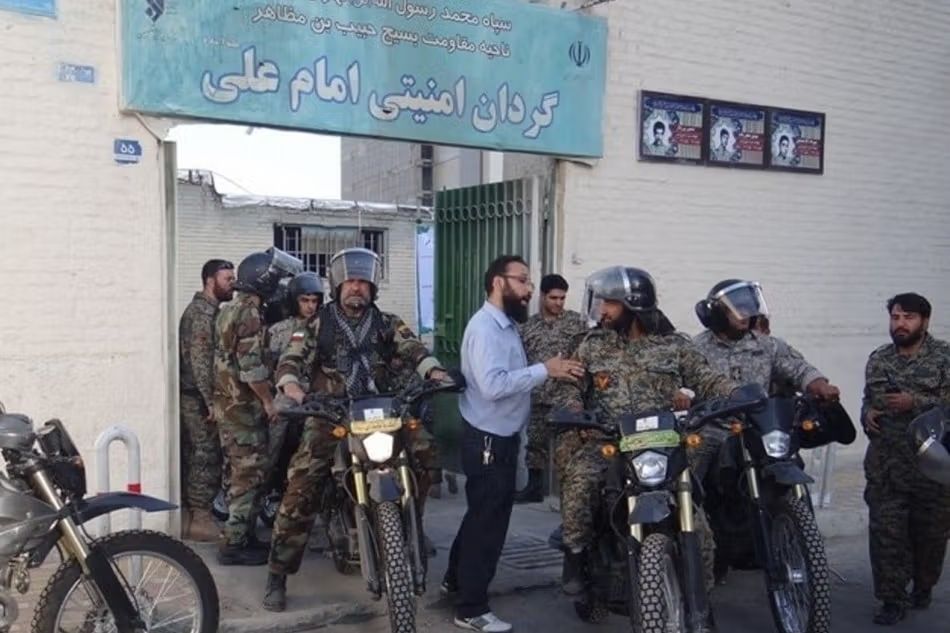
Motorcycle-riding security agents from the Imam Ali battalions, one of the forces used to suppress street protests in Iran.
Posted on 04/07/2026 3:43:35 PM PDT by MeanWestTexan
srael’s campaign in Iran has reached far beyond missile depots and military command. Over roughly a month, it has also hit the architecture of domestic repression: intelligence compounds, police stations, Basij bases, judicial buildings, and senior officials tied to crackdowns.
That matters not only because of the damage done, but because of what these places meant. In Iran, repression has never depended on one institution alone. It has been built as a layered system, running from the top decision-making bodies in Tehran down to the neighborhood police station, the local Basij outpost and the courthouse where detainees are processed.
A review by Iran International of citizen reports and source material found that, in about one month after the war began, at least 130 sites tied to internal repression were destroyed or hit.
They included 57 Basij buildings or bases, 43 police (FARAJA) facilities, 10 Revolutionary Guards compounds, and 11 security complexes involved in repression. Other targets included judicial buildings and the state broadcaster, institutions that helped complete the chain through prosecutions, propaganda and coerced confessions.
Iran International sources also put the toll among security forces at nearly 5,000 dead and about 21,000 wounded.
From the command center to the street
The internal security system has long worked in three layers.
At the top sits the command structure: the Supreme Leader, the Supreme National Security Council, provincial security councils and, in Tehran, the IRGC’s Tharallah headquarters, which can take control of multiple security organs during major unrest. Around the capital, a similar role has been played by the Seyyed al-Shohada corps.
Below that are the operational forces: The Police Command of the Islamic Republic of Iran (abbreviated as FARAJA); special anti-riot units; provincial Revolutionary Guards formations; and IRGC’s specialized units such as Saberin and Fatehin.
Alongside them is the Basij, the paramilitary network embedded in neighborhoods across the country. Its Imam Ali battalions, often arriving on motorcycles, became one of the most recognizable instruments of street repression after the 2009 protests.
The third layer is institutional support: intelligence bodies, courts, prisons and state media.
The strikes appear to have touched every layer.
Senior figures reported killed include Ali Khamenei, the longtime ultimate authority over crackdowns; the intelligence minister and several of his deputies; senior Guards and Basij commanders; commanders tied to Tehran’s suppression apparatus; police intelligence officials; and members of the judiciary, including officials linked to Evin prison and Tehran’s prosecutorial system.
The symbols that fell
The targets were not only militarily useful. Many were symbols.
In Tehran, the Ministry of Intelligence and compounds linked to the Revolutionary Guards’ intelligence arm were hit again after earlier strikes in the June 12-day war. Tharallah-linked facilities in northern Tehran, security clusters in eastern Tehran, anti-riot police facilities and Basij sites across the capital were also struck.
Some locations had an importance that went beyond their walls. Tehran’s Revolutionary Court building on Moallem Street was one of them. For decades, it stood as a symbol of summary trials, political prosecutions and death sentences. Its destruction carried a message larger than the physical damage.
The same was true of the state broadcaster. For many Iranians, it was not just a media institution but a place associated with forced confessions and public humiliation of dissidents. Seeing it hit again mattered for that reason.
Even when buildings had been partly emptied, they still housed the tools of coercion: files, servers, records, communications systems, vehicles and equipment.
In some post-strike videos, papers and official documents could be seen scattered in the streets after blasts ripped through buildings that looked outwardly residential or commercial.
One attack in western Tehran offered a different picture: a strike on the 12,000-seat Azadi sports hall, where anti-riot personnel appear to have been moved. Iran International’s reporting estimates that between 900 and 1,200 security personnel may have been killed there.
A missile strike destroyed the 12,000-seat indoor arena at Tehran’s Azadi sports complex on Thursday morning, Iranian state media reported.
What happened in Tehran was echoed outside it.
On the capital’s outskirts, command centers in Rey, Karaj and Mahdasht were hit, along with Basij and police-linked sites in surrounding towns.
In the provinces, Iran International identified heavy strikes on intelligence, police, judicial and Guards facilities in cities including Isfahan, Khorramabad, Ilam, Sanandaj, Semnan, Shiraz, Urmia and Tabriz.
In small towns, local police posts carry a special weight. They are often the clearest symbol of the central government’s presence, and one of the first places where people encounter coercion directly.
That is what makes a place like Abdanan important. The town had already become known for the violence used against residents during the January uprising. Even a mourning ceremony for local victims was met with gunfire.
Days later, residents watched their police station and Guards facilities explode. For people who had just buried their dead, the collapse of those buildings was not just another wartime image. It was the visible breaking of a local order that had seemed untouchable.
Security forces fired at a large gathering of mourners during 40th-day memorials on Tuesday in Abdanan for those killed in the protests, injuring several people, a video received by Iran International showed.
What remains after the strikes stop
If the campaign ends soon, the central question will not be only what has been destroyed, but what has been exposed.
The Islamic Republic’s internal coercive machine appears weaker, less insulated and less imposing than before.
Walls around intelligence compounds have fallen. Buildings long associated with fear have been reduced to rubble. Officials who once threatened subordinates from the top of the pyramid are gone.
But the country that remains will also be poorer and angrier.
Official figures show point-to-point food inflation in the last month of the Persian year running above 113%, with some staples such as cooking oil up as much as 220% and bread up 140%, while wages rose only 20% to 30%.
Power cuts, already worsening before the war because of years of underinvestment, point to deeper structural decay that long predates the current fighting.
The war will end. What will remain for ordinary Iranians is a country already battered by record food inflation, stagnant wages and years of neglected infrastructure long before the current fighting began.
For many of those who lost relatives in the January crackdown, that larger story may be distilled into one image: not an oil turbine or a military depot, but the police station, Basij base or courthouse that once embodied fear, now lying in ruins.
A good start, but far from enough.
The rulers of Iran pay foreigners to kill their own people. Thousands of Arab, Afghan, and African mercenaries have also been brought in.
The mercenaries should also be eliminated. Otherwise, the Iranian people stand no chance in any uprising.
Like all criminal gangs, Iran only pretends to be autonomous.
But like all criminal gangs, Iran answers up to a more powerful gang.
The Global Crime Syndicate.
Yes, they’ve been importing Afghan and Iraqi militias.
“Power flows from the barrel of a gun”
Where are the guns?
the kurds stole them all
What are we in, our 38 day is it? It is an incremental but deliberate, attack on the forces that threaten the citizens. It’s not gpoing to be, quick, yet it will not be a forever war either or even come close to being a long protracted operation. The IRGC and Iran’s abilities have been systematically degraded, and their ability to repair and bring back into operation, is also being done to make their hopes become dashed. Trus me, Iran is in severe panic mode. The only thing that keeps them going isd their believe that Allah will save them, but that is not going to happen.. Which is why they are hitting the panic stage, but they refuse to cave. Eventually they will have to cave, because they are rapidly losing their ability to respond.
I hope there is an after picture for bomb damage assessment.
As you say, it is a good beginning for weakening the forces of oppression. However, unless weapons are gotten to people who can use them well, change will be minimal. I heard a recent reports about Kurds doing something, but it was not clear what they were doing, and in whose favor.
The time to arm the people of Iran was when bombs were falling on IRGC. And those convoys of mercenaries, coming in from Afghanistan and Iraq, should have been blown to smithereens before the mercenaries reached major population centers.
Now that a cease fire is effect, and there are thousands of mercenaries, arming the people of Iran will lead to a bloody civil war of unambiguous end result.
I heard that one plan was to liberate a smaller city, and then use that as a launch pad.
But this cease fire changes everything. And Iran’s proposed 10-point plan is basically a US conditional surrender.
Let’s see if PDJT is playing 4D chess, or if he is just a frustrated 80 year old New Yorker whose plans did not pan out as expected.
The one fact that gives me hope is that He had a lot of experience working around the Mafia in new York City, and probably in Atlantic City as well. Perhaps this will enable his instincts in dealing with these religious criminals. He does need to understand that many have a different relationship with death, although others just want to get rich and powerful.
My question is how do you do “Art of the Deal” with religious fanatics who think triggering a apocalyptic nuclear event is a viable choice?
My prediction is they’ll dance around, string this ceasefire along (or several ceasefires!) and wait Trump out until he’s gone (or severely weakened by midterms!). Then in 20 years we’ll have to do this again. Likely it will be a nuclear boom first, my mother always said no one truly learns unless they feel the consequences of not learning!
Here are my thoughts on the beset path forward - fully recognizing, of course, that I don’t have access to information and resources available to our commander in chief:
https://freerepublic.com/focus/news/4374046/posts?page=299#299
Disclaimer: Opinions posted on Free Republic are those of the individual posters and do not necessarily represent the opinion of Free Republic or its management. All materials posted herein are protected by copyright law and the exemption for fair use of copyrighted works.