
Posted on 07/29/2022 1:23:42 PM PDT by Red Badger
A recurrent trope in American politics is that affluent liberals like electric vehicles, vote for politicians who subsidize them, and want the government to order companies to build them. As a result, many conservatives have an almost visceral reaction against E.V.s.
We at the Anderson Economic Group argue that conservatives should neither love nor hate E.V.s. Instead, they should insist on a powerful principle: those who purchase and drive E.V.s should do so with their own money. If you really want to form public opinion, one of the most powerful weapons is also one of the simplest: let people see how much something costs.
Michael Fumento recently remarked in this publication on conservatives' almost reflexive aversion to E.V.s. He argues this is a mistake, and that E.V.s have advantages that should be acknowledged. We agree that unthinking antipathy to any technology makes no sense. But Mr. Fumento makes the same error he sees in others, by equating the Anderson Economic Group's comparative cost analyses with the advocacy journalism that promotes E.V.s. As a co-author of those reports, I want to underline our guiding principle: we neither push people to buy E.V.s nor criticizing them for doing so. Instead, we tell people how much they cost.
Anderson Economic Group’s recent EV study identifies four categories of fueling costs for both E.V.s and internal combustion engine (ICE) vehicles: the energy (gasoline, diesel, or electricity); the excise taxes charged for roads; the cost of a pump or charger; and the cost of driving to a gas station or charging station. Americans are quite familiar with these costs for gas- and diesel-powered vehicles. They are also accustomed to paying road taxes as part of the per-gallon price of gasoline or diesel fuel.
The same cannot be said for EVs. The true cost to fuel EVs is opaque to most consumers, because:
First, E.V. drivers must consider the cost of the energy consumed from both home and commercial charging. This requires decomposing energy consumption by charging source while accounting for complicated tariffs and fees.
Second, consumers must add the cost of the charger and its installation if they intend to charge at home.
Third, electric vehicle owners avoid paying the federal road taxes charged on fuel. However, half of all U.S. states now require a special E.V. tax in lieu of the state road taxes included in the cost of gasoline and diesel fuel.
Fourth, drivers must travel to and from E.V. charging stations, especially when traveling away from their home area. Because these are far less ubiquitous than gas stations, the additional miles required cost both time and money.
Fifth, many E.V. users consider their charging “free” because some commercial charging is subsidized by government agencies, utilities, and businesses. However, electricity and charging equipment are clearly not “free,” and consumers need to understand how they pay for this service.
The AEG reports carefully add and compare each of these categories, apples-to-apples, for both types of vehicles. Once hidden costs are included, we find that the cost to fuel E.V.s is often more, not less, than comparable ICE vehicles. Indeed, in 2021 a typical mid-priced E.V. cost slightly more, and a luxury E.V. less, to fuel than comparable ICE cars.
For example, a consumer driving a mid-priced EV about 12,000 miles a year who obtained most of his energy at home paid about $10.34 in fueling costs to drive 100 miles. Counting the same costs, a similar ICE vehicle cost approximately $10.79. For E.V. drivers reliant upon commercial chargers—e.g., those who travel extensively and those who cannot charge at home—the cost was closer to $14.34 per 100 miles.
This shouldn’t be surprising. Charging and fueling equipment costs money; electricity and gasoline are not free; and roads cost a lot to build and maintain. Driving either an E.V. or an ICE vehicle means incurring all the above costs.
Conservatives should welcome exercises like the Anderson Economic Group studies that reveal the true cost of important consumer goods. We should also insist that the government stop subsidizing one class of buyers at the expense of others. In this, we can join liberals in an obvious demand: stop subsidizing auto purchases with incentives that heavily benefit the wealthy. It should be jarring to see that 78 percent of the federal EV tax credits have gone to Americans with incomes over $100,000. This means taxpayers who walk, bike, drive old used cars, or use public transportation foot part of the bill for high-priced E.V.s purchased by affluent households. There is no public policy justification for this.
Americans should be given more facts—and less guilt—when making car-buying decisions. To that end, the Anderson Economic Group encourages readers to access our full report and learn about the actual costs of driving E.V.s and ICE vehicles. We do not censor our results to match the political winds of the day. Instead, we provide taxpayers and consumers with information that empowers them to decide for themselves.
And it will only go up...electricity doesn’t just fall out of the sky...
Try to sell a used EV with 40,000 miles.
Home charging station installation can cost as much as $25,000.
Per GM exec, electricity comes “from the building” concerning GMs EV charging. SMDH 🤔😵🐎💩
Supersite Cleanups for electric car minerals. How much are they costing taxpayers
Congress loves subsidizing the wealthy—because they get campaign contributions from the wealthy.
Life is simple when you know the rules.
Actually it does fall out of the sky.
It is called lightening. But impossible to harness that one.
Does that include rebuilding your house after it burns down?
They need to do an extreme push for EV in Los Angeles to get ready for the day the turbines at the hoover dam fail due to subcritical water level
You better book ahead for your on the road charging or you’re SCREWED
I showed my kids pictures of electric cars from around 1910.
They had the same problems then. Charging time and limited range.
Going back 100 years for something new.
Interesting that they agree with the Enlightenment as far as the advance of technology goes, but when it comes to political thought they are stuck in the past with John Locke and Adam Smith.
To be consistent, if the Enlightenment gave us the scientific method, the Industrial Revolution, and all the neat gadgets we have today, then why do they shun socialism, communism, postmodernism, etc. and all the "neat" political philosophies that were spawned by the Enlightenment?
"Actually it does fall out of the sky. It is called lightening. But impossible to harness that one." and "Home charging station installation can cost as much as $25,000."
How about $4K to install a charger (still significant, but a lot less than $25K)? That's for not only a 240V/40A charger and circuit, but in my case it's a whole new electrical panel and two circuits (one outlet tied to the old panel and one outlet tied to the new panel). And if you live in the southern half of the U.S. you can effectively harness power that falls out of the sky without having to do it in Dr. Emmett Brown fashion. It's called "solar power" and it's pretty darn effective if you do it yourself and don't depend on red-tape loving bureaucrat crony capitalists to make it happen at the utility level (which makes utility power less stable and is a bad place to implement solar).
8% rate increase here in Nevada.
To pay for “Reliable Green Energy”, which does not exist.
If I could play Devil’s Advocate:
ICE cars require types of maintenance that EVs do not. Of course, EV batteries are a huge expense. Overall, though, ICE vehicles need more maintenance and attention than EVs. Not a huge expense in modern cars, but significant.
ICE:
Short to Medium Term:
Oil and oil filters
Air filter
Tires
Starter battery
Longer term:
Brakes
Anti-freeze
Transmission Fluid/filter
Belts/hoses
Water Pump
Timing chain/belt
Spark plugs
Very long term, or clunker items:
Shocks/Struts
Transmission
Engine
Fuel-Injection System
Distributor
Computer/Electronics
On EVs:
Short to Medium Term:
Tires (more often than ICE vehicles due to weight/ and off-line torque)
Longer term:
Belts (fewer)
Very long term, or clunker items:
Batteries
Shocks/Struts
Computer/Electronics
I stand to be corrected by those who own or have more than a casual knowledge of EVs.
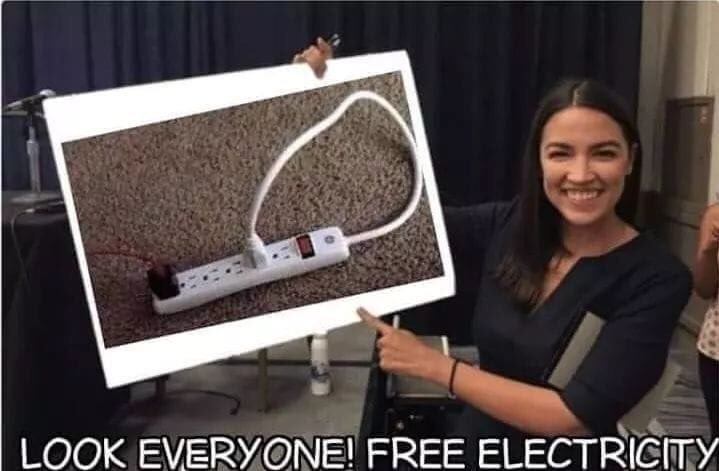
Come on! Electricity flows out of the holes in the walls for free.
Yes, Edison wasted big chunk of his money on vane tries to make a competitive electric car. And he was pretty smart kind of guy!
Unfortunately for Edison, there were no subsidies available for electric cars then!
Disclaimer: Opinions posted on Free Republic are those of the individual posters and do not necessarily represent the opinion of Free Republic or its management. All materials posted herein are protected by copyright law and the exemption for fair use of copyrighted works.