Posted on 05/16/2022 10:03:50 AM PDT by Red Badger
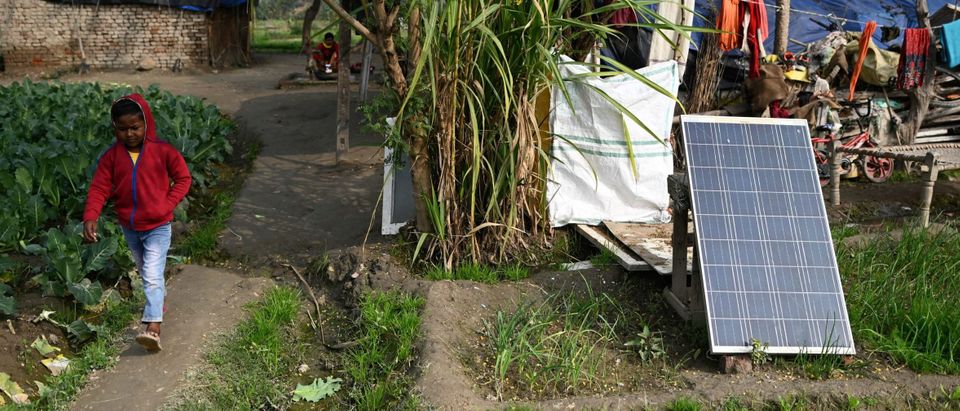
A Greenpeace-funded solar energy project in India has become completely defunct just years after it was built, according to local media reports.
“When this solar farm went defunct, it was primarily because of two reasons,” said Vijay Jayaraj, an India-based researcher. “One, is the cost of the power and the second is reliability.”
“No one uses solar power anymore here,” Ravi Kumar, a local shopkeeper, told an India-based news outlet.
Eco-activist group Greenpeace brought solar power to Dharnai, India, in 2014, constructing a green micro-grid it said would make the tiny village “energy independent” and a model for the rest of the country to follow.
Eight years later, reports indicate the solar micro-grid is not only defunct, but being used as a cattle shed. The Dharnai venture is only one of many failed attempts by environmental groups, like Greenpeace, to “green” the developing world, according to one of its co-founders.
“It’s the same thing that’s happened a lot across Africa: goody two-shoes comes in and builds them a small solar facility,” CO2 Coalition Director Patrick Moore, who co-founded Greenpeace in the 1970s, told The Daily Caller News Foundation.
“Then, pretty soon the battery wears out and it just doesn’t get repaired and they don’t know what to do because they don’t have any expertise,” said Moore, who departed Greenpeace in the 1980s after he said the group lost touch with its original purpose. “There’s plenty of those stories.”
In July 2014, Greenpeace celebrated the project, claiming that it made Dharnai the first village in the state of Bihar to run entirely on solar energy. The project quickly collapsed, though, as batteries became overused, causing the entire grid to fall into disrepair, environment-focused news outlet Mongabay-India reported in December.
Today, paddy straw is piled up around the project, which is now being used to shelter cattle, according to Mongabay-India. In addition, solar panels are covered in dust and rods supporting the green tech are heavily-rusted.
#Solar energy has changed the lives of these kids in #Dharnai, and they’re so happy 🙂 >>> http://t.co/JUDyBxXuiC pic.twitter.com/HvYod84aQB
— Greenpeace (@Greenpeace) July 23, 2014
“When this solar farm went defunct, it was primarily because of two reasons,” Vijay Jayaraj, an India-based researcher at the environmental group Cornwall Alliance, told TheDCNF. “One is the cost of the power, and the second is reliability.”
“In 2016 and 2017, when the village was finally connected to the grid — and the grid was powered by coal power plants — they understood that coal power is much more reliable,” he continued.
Jayaraj added that non-governmental organizations like Greenpeace often market renewable energy alternatives to remote villagers with little or no electricity in developing countries. Such groups are able to avoid heavy scrutiny since the areas they approach are in dire need for power.
“These programs and solutions don’t talk about the sustainable nature of the programs, the longevity of the programs, what happens when the technologies age or how much of the current demand it could meet,” he said. “So, by pushing these questions under the carpet, these programs have started to take root in a lot of developing countries. India is no exception.”
While some villagers expressed optimism about Dharnai, India, solar facility in 2014, others protested it saying they didn’t want “fake” electricity, according to Mongabay-India. At the time, Nitish Kumar, the chief minister of Bihar, applauded the project and told locals that coal power would diminish over time while solar power would always be around.
“In the first three years, it worked well and people were using it. But after three years the batteries were exhausted and it was never repaired,” Ravi Kumar, a local shopkeeper, told Mongabay-India. “So now, while the solar rooftops, CCTV cameras and other infrastructure are intact, the whole system has become a showpiece for us.”
“No one uses solar power anymore here,” he continued. “The glory of Dharnai has ended.”
WATCH:
VIDEO AT LINK................
The number of solar connections in Dharnai and surrounding neighborhoods with access to the solar grid fell from 255 in 2014 to 120 in 2016, a Nalanda University study published in 2020 concluded. The study blamed high prices associated with solar power and the grid’s unreliability — villagers were warned not to use high power appliances like televisions and refrigerators — on the decreasing connections.
“We left solar connection after using it for one year. How can poor people like us pay such amounts of money?” an anonymous local told Nalanda University. “They used to give electricity only for two hours. During rain, they do not use to give electric supply and so does during the fog in the winter.”
Dharnai was eventually connected to the region’s coal-powered grid in 2016, giving villagers access to a much cheaper and more reliable power source, Mongabay-India reported. Coal power also allowed them to use high-power appliances.
Greenpeace apparently stopped posting about the Dharnai solar farm on social media and in blog posts back in 2015. The group didn’t respond to requests for comment from The DCNF.
Still, developers of the project said the venture was a success because it provided a model for future energy independent solar grids.
“The project first showed how decentralized solar projects can work in such areas. It exposed the state to the idea of the utility of solar energy for the state,” Ramapati Kumar, the CEO of the Center for Environment and Energy Development which helped fund the project with Greenpeace, told Mongabay-India. “It was for demonstration purpose and suffered later due to upkeep issues.”
The 3rd is probably that no one in particular owned the panels or the project, so when things malfunctioned, no one bothered to fix them.
Decades ago, I read that the hallmark of advanced societies is its networks run by professionals with a lot of expertise. Power networks, communications networks, water networks, waste disposal networks, sewer networks, distribution system networks.
We all depend on the millions of unseen professionals running those networks in the background. Those people and the companies they work for deliver highly reliable services at low price.
Why people think they can run their own power plant (i.e., solar) in their home or in small, underdeveloped villages is beyond me. I do not want to be bothered with the maintenance and upkeep of those systems. I want to pay the professionals to keep all those services running.
This Indian village is a perfect example of how NOT to do things. But the Greenpeace people had their hearts in the right places (yes, that’s sarc). Good intentions don’t count for squat — RESULTS do.
“...and a model for the rest of the country to follow.”
It is. The rest of the country can learn from its failure. 😂
Solar sucks unless you take a DIY attitude. Even then it’s good only from a cost reduction goal, not a see-all do-all for all of your power needs.
But the Greenpeace people had their hearts in the right places..........and their heads up their asses............
Reminds me of a project in Nepal IIRC where they emplaced a solar panel on each residence. The panel was sufficient to power an electric hotplate and a small radio. This was advertised as an example for the rest of us.
While they paid for the power, it is clear there was no reserve in place for maintenance or new batteries.
Designed to fail.
Greenpeace tested and found out It’s Crap ,LOL
Maybe they did call the technical support hotline but couldn’t understand the person on the other end and were afraid it a scam when they were asked to provide personal information
Night came, the day followed... and no batteries.
Genesis.
5.56mm
Well, Greenpeace felt good about it, and that’s all that matters to them...
Hold on. Your saying that socialism/communism once again was proven to be a failure. That an incentive to produce. That incentive being either a profit or method to feed yourself was the most effective system ever created(capitalism).
Many people do not realize this. It is never taught in schools. The Pilgrims who landed in Massachusetts almost starved to death because of socialism. The first year they tried collective farming. That harvest was so bad many died. The following year they all became responsible for raising their own food. We all know the rest of the story.
Socialism NEVER works. No matter who tries it. It has never worked. It never will.
Solar sucks unless you take a DIY attitude.
As a test I built a stand from a 4 x 4 fence post....Put the post in the ground with concrete and installed 2 100 watt panels with a couple batteries...Over a year and a half ago and the batteries stay charged daily...Charge phones....Run several led lights all night....Run the coffee maker.....Ran a couple large fan for 6 hours until power came back on....This convinced me to expand the system so I ordered a few more panels and a couple more batteries....
They probably called the help desk in Mumbai. They probably could not understand their dialect in this remote part of India.
When something becomes too much of a problem to maintain, it will be abandoned.
Funny how groups tend to use poor people to experiment on. They upended a village for what they now call, a demonstration rather than a workable solution for the people. I notice they tend to do the same on vaccines. I guess they figure failures of the experiment are less likely to hit the press or courts if the people are poor and isolated.
I like it so much I'm upgrading it and getting an EV. I plan to be about 90% self-sufficient and it all pay for itself around the 9th year (8 years from now), assuming a 3% inflation rate for power rates. But that's because I'm in an optimum situation (live in the south where we get lots of sun and when I converted my natural gas appliances to electric I spent a little extra to make them uber-efficient).
I for one encourage Greenpeace to continue spending their funds on these projects.
It is relatively harmless and their failure provides a valuable lesson to everyone. In addition it deprives them of money which could be used for their more obnoxious projects.
I want to see someone run a solar panel and component factory on solar power.
Run all the machinery, lighting, electric fork lifts, electric company vehicles to build solar panels, charge controllers & batteries.
Disclaimer: Opinions posted on Free Republic are those of the individual posters and do not necessarily represent the opinion of Free Republic or its management. All materials posted herein are protected by copyright law and the exemption for fair use of copyrighted works.