
Click here: to donate by Credit Card
Or here: to donate by PayPal
Or by mail to: Free Republic, LLC - PO Box 9771 - Fresno, CA 93794
Thank you very much and God bless you.
Posted on 10/09/2026 6:45:35 AM PDT by Red Badger
SpaceX announced an agreement on Thursday to “acquire a nationwide low-band spectrum license portfolio” that will establish the foundation to help the company become a “major mobile carrier” in the United States.
“With this new spectrum and our Gen2 constellation, Starlink Mobile can ensure Americans have access to high-speed mobile broadband no matter where they are,” the company stated.
CNBC has more:
Shares of AT&T, Verizon and T-Mobile tumbled in extended trading.
The deal involves the acquisition of a spectrum portfolio from Grain Management, which specializes in digital infrastructure, and is subject to approval by the Federal Communications Commission. SpaceX said in a statement that it’s a “license portfolio of up to 14 megahertz of paired spectrum in the 800 MHz band.”
“This prime low-band spectrum addresses one of the key remaining technical gaps that will pave the way for Starlink Mobile to become a major mobile carrier in the US,” SpaceX said.
“Very big deal,” Elon Musk commented.
“This is the last critical piece of the spectrum puzzle needed for SpaceX to provide complete phone coverage in America,” Musk said in another post.
“The incumbent wireless carriers have been vocal in expressing skepticism that SpaceX’s network will be able to match the quality of their networks,” William Blair analysts said, according to Reuters.
“We expect SpaceX to offer a very compelling Starlink broadband and Starlink Mobile bundle. The company may also include Grok in the package,” it added.
Reuters shared further:
“We are going to see more investment, more opportunities for a range of providers, and America leading the world in next-gen technologies — to the benefit of consumers all across the country,” FCC Chair Brendan Carr said in response to the deal between SpaceX and Grain.
Grain CEO David Grain said the deal has “the potential to change where and how Americans connect.”
Most existing mobile handsets support the 800 MHz frequency band, eliminating the need for consumers to purchase proprietary satellite phones.
Verizon spokesman Rich Young noted there were still hurdles after SpaceX’s spectrum purchase. “This company can have tons of spectrum available, but if they do not have the network to use it, it doesn’t matter. It’s just empty airwaves,” Young said.
The FCC also approved Starlink Mobile’s Gen2 constellation application this week, authorizing SpaceX to launch 15,000 satellites that are optimized for 2 GHz spectrum globally.
|
|
Click here: to donate by Credit Card Or here: to donate by PayPal Or by mail to: Free Republic, LLC - PO Box 9771 - Fresno, CA 93794 Thank you very much and God bless you. |
October 8, 2026
BUILDING THE WORLD’S MOST ADVANCED MOBILE NETWORK
This week marked two major milestones for Starlink Mobile.
SpaceX announced an agreement to acquire a nationwide low-band spectrum license portfolio of up to 14 megahertz of paired spectrum in the 800 MHz band. This prime low-band spectrum addresses one of the key remaining technical gaps that will pave the way for Starlink Mobile to become a major mobile carrier in the US.
Once we receive final FCC approval, Starlink Mobile will deploy a flexible architecture combining our satellite-to-mobile constellation in space with an advanced terrestrial deployment that can seamlessly connect devices everywhere. While Starlink Mobile’s global 2 GHz mid-band spectrum will provide high-bandwidth capacity in the United States, this new low-band spectrum will provide a coverage layer that ensures Starlink Mobile’s signal penetrates through obstacles, such as walls, and can provide service to customers’ devices even when they are in buildings. Critically, most existing mobile devices already support this underused band.
Starlink already operates the world’s most advanced broadband network from space, serving millions of customers across the United States and around the world with high-speed internet. With this new low-band spectrum and our Gen2 constellation, Starlink Mobile can now become the first network operator to deploy both satellite and terrestrial spectrum. One network that provides Americans with a reliable service indoors, outdoors, in cellular dead zones, and everywhere in between.
FCC Approves Next Gen Starlink Mobile Constellation
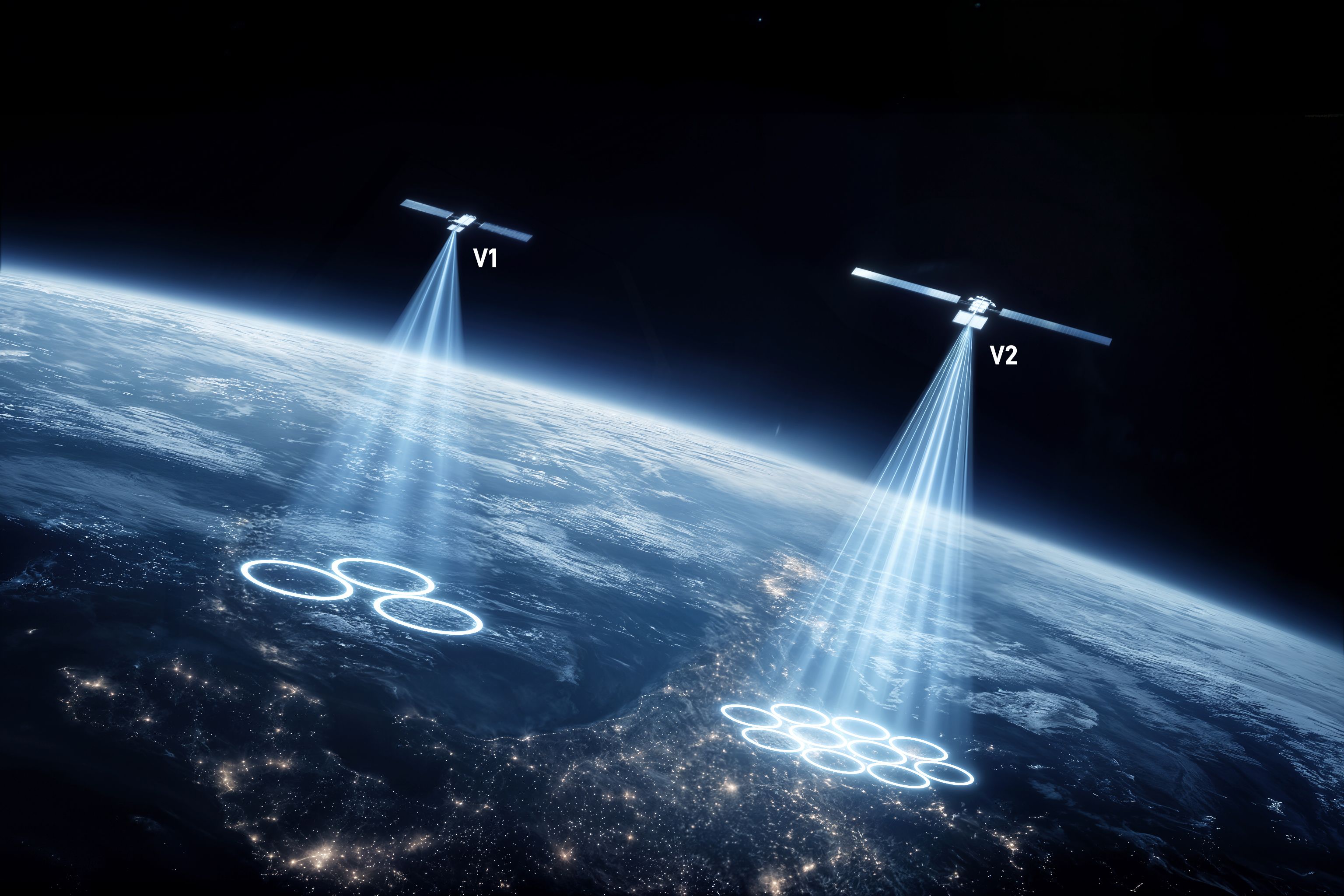
The Federal Communications Commission (FCC) also approved Starlink Mobile’s Gen2 constellation application this week, authorizing SpaceX to launch 15,000 satellites that are optimized for 2 GHz spectrum globally. The V2 Starlink Mobile satellites will deliver more than 100 times the bandwidth of our current generation, bringing high-speed service directly to unmodified devices anywhere in the world. Additionally, the FCC authorized the full range of backhaul bands (in Ka/V/E/W) used by Starlink’s V3 broadband satellites, enabling them to operate with the existing Starlink gateway network.
We appreciate all the work the FCC staff put in to authorize this critical step toward the next era of satellite-to-mobile connectivity. From dense cities to the most remote and rural communities, this next-generation service will keep Americans connected no matter where they are.
Space Tech Ping!.............
A couple of related X posts. Worth checking out.
https://x.com/aakashgupta/status/2108464230278299930?s=20
https://x.com/elonmusk/status/2108309429128974617?s=20
Advancing tracking ability?
“Here’s why it matters so much. Starlink’s satellite signal at 2 GHz can reach your phone outdoors, but it dies at the first wall. 800 MHz penetrates buildings. Most phones already have the band built in. So satellites handle the open sky, this low-band layer handles indoors, and suddenly Starlink Mobile covers everywhere a normal carrier does without the tower network.”
This is the clincher.
I already knew this because that’s my area of work............
Space X could put Verizon, AT&T, Comcast/Xfinity all out of business.
My daughter has had one of their internet dishes for about a year. They got rid of cable internet and TV. If you can get internet, streaming TV and Satellite phone service all from one provider, I would think that a millions/billions might be interested in that.
HERE’s the full TWEET:
T-Mobile spent five years trying to get rid of the exact spectrum Elon just called “the last critical piece” of complete phone coverage in America.
This 800 MHz block is Sprint’s old Nextel spectrum, the stuff that powered push-to-talk walkie-talkie phones in 2004. The DOJ forced T-Mobile to divest it as a condition of the $26 billion Sprint merger. Dish had first rights at $3.59 billion and walked away because it couldn’t raise the money. T-Mobile finally offloaded it to an investment firm called Grain Management last year for $2.9 billion plus a spectrum swap.
Grain’s original plan was selling it to utilities for private networks.
Fourteen months later, SpaceX buys the whole portfolio, and shares of the carriers who passed on it fall as much as 8% in a single afternoon.
Here’s why it matters so much. Starlink’s satellite signal at 2 GHz can reach your phone outdoors, but it dies at the first wall. 800 MHz penetrates buildings. Most phones already have the band built in. So satellites handle the open sky, this low-band layer handles indoors, and suddenly Starlink Mobile covers everywhere a normal carrier does without the tower network.
Stack the moves. $17 billion for EchoStar’s 50 MHz of 2 GHz spectrum. FCC approval for 15,000 Gen2 satellites this week. Now the low-band coverage layer.
Verizon, AT&T, and T-Mobile paid $81 billion in a single auction for C-band spectrum in 2021, then spent years and tens of billions more deploying it on towers. SpaceX assembled a nationwide carrier out of a distressed-asset sale, a forced divestiture castoff, and rockets it already owns.
The walkie-talkie spectrum from 2004 ended up being the piece that lets satellites replace cell towers. Nobody who touched it for twenty years saw that coming.
Elon is a gift from God...............
While I don't have a problem with Elon as a person, I'm not sure one person should have this much influence over everyone's lives.
Yes, I know we all have choices. We all add choices until ATT bought up every carrier several decades ago. We had choices until cable companies "negotiated" monopolistic areas. I just see this coming, and not sure if there's anything to be done.
I wonder if a satellite based phone system will make it easier for other countries to record all our phone calls like the NSA does in the US.
Doesn’t matter. They will do it no matter what method is used...........
I hate AI. I hate the way it speaks. I hate the way it "explains" things. I hate everything about it.
Please stop using it.
I have wondered for some time if everyone is eventually going to flock to SpaceX as a carrier.
I WISH I had bought more SPACEX @ $113
I still don't understand... but I guess over the next year or two we'll all start to 'get it'.
I bought at $155 - it went up then down then back up again.. I’m thinking of buying more at $168
I SOLD Palantir @ $123 to buy the SPACEX.
I owned Palantir @ $88. So, I still made money, but now it is back up around 171.
As my first boss used to say:
“kid, you can’t go broke taking a profit”
There's another important piece of the puzzle hinted at in that sentence. Those satellites are at a low orbit (326–335 km) and experience atmospheric drag. Without propulsion to reboost, typical lifetimes are on the order of months to a couple years.
SpaceX does not try to make the satellites in that orbit long-lived on their own. It treats drag as a continuous operating cost and offsets it with propulsion, then replaces satellites on a regular cadence once the propellant is gone. The constellation is therefore sized as a replenished fleet, not a set-and-forget one. Maintaining full density means launching thousands of replacements a year as older vehicles finish controlled re-entries.
So how to you establish a fast launch cadence? Simple! You build your own heavy-lift rockets and launch facilities. Nothing to it. Right?
Fifteen thousand satellites replaced every five years is 3,000 a year, about 58 a week, or roughly eight a day. Early failures and satellites retired short of five years push that toward the high end of 50–100 a week. That is the steady state after the shell is full, not the build-up.
The management load is not one reentry. It is thousands of propellant budgets, failure watches, and ocean-targeted entries running at the same time, plus the launches that replace them.
All eyes have been on the SpaceX launch system and rockets to orbit. But managing this end-of-life satellite problem is no easy task.
That Sprint push-to-talk was the coolest thing at the time. My buddy was talking to his friends in Argentina from Maui all the time. I got one and and besides the fact that you could throw the phone across a parking lot and nothing would happen to it it was basically a freebe way to communicate with others that had that service.
Musk is a genius.
Disclaimer: Opinions posted on Free Republic are those of the individual posters and do not necessarily represent the opinion of Free Republic or its management. All materials posted herein are protected by copyright law and the exemption for fair use of copyrighted works.