Posted on 08/10/2026 6:20:35 PM PDT by Red Badger
2026's El Niño is on course to be the most severe on record, even hotter than the 1997/98 event that caused trillions in damage and thousands of deaths.
An El Niño event like nothing we’ve ever seen before is cooking in the Pacific. Its mounting strength is so unprecedented that climate scientists aren't even sure what impact it will have when it hits full tilt, but they say this “uncharted territory” should be a cause for concern.
What is El Niño? And why is 2026 so weird?
El Niño is a climate phenomenon characterized by warmer ocean temperatures across the central and eastern tropical Pacific Ocean, triggering a domino effect that has a broad influence on the weather across the world.
It's part of a cycle that wavers through three distinct phases every few years: El Niño (the warm phase), La Niña (the cool phase), and ENSO-Neutral.
Scientists officially declare the emergence of El Niño when sea surface temperatures in this part of the Pacific rise to at least 0.5°C above the long-term average. The US National Oceanic and Atmospheric Administration (NOAA) announced we had passed this threshold back in early June, just as models predicted.
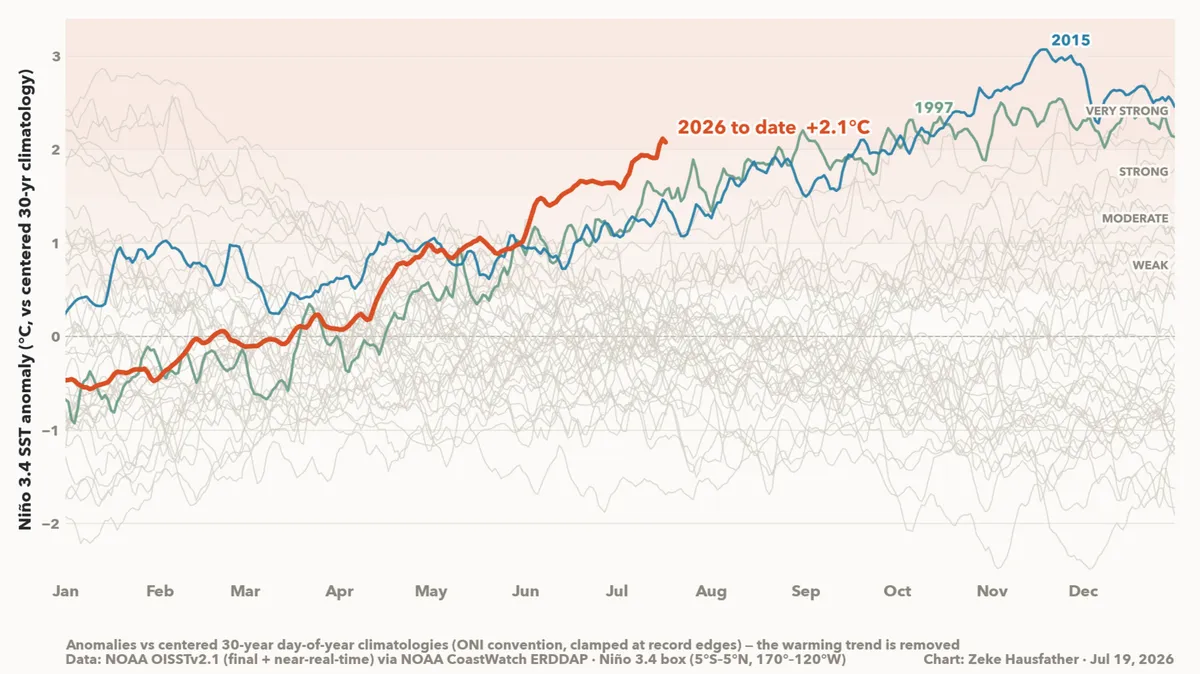
However, this El Niño has continued to muster strength at a remarkable pace despite still being relatively young. In the first week of August, temperatures in the eastern Pacific were 2.6°C above normal.
If temperatures continue to rise on this trajectory, we're in for one of the hottest El Niño phases on record.
“To put it in perspective, anything above 2°C is considered a 'super El Niño.' So we're already, at least for daily temperatures, well within a very strong or ‘super El Niño’ territory,” Zeke Hausfather, a climate scientist at Berkeley Earth, told IFLScience.
“It’s nuts how quickly the event is developing and how strong it is to date,” he added.
Satellite-derived daily temperature changes in the Central Pacific Niño 3.4 region, showing how powerful 2026 is compared with other "very strong" ones in 1997 and 2015. Image courtesy of Zeke Hausfather / Berkeley Earth
The best comparison we have is the record-breaking El Niño of 1997/98, the strongest event in recent memory, which cost the global economy trillions and killed thousands. However, as the graph above shows, this year's El Niño is currently charging ahead even of that year's trajectory.
“We haven't had El Niño anywhere near as strong as this before at this time of year. We're in uncharted territory as far as that goes,” explained Hausfather.
Will the skyrocketing temperature line taper off early in a slightly different trajectory from previous years? It's a possibility, but most models suggest the current El Niño will go on to become the strongest on record, peaking late in 2026.
The global impact
All of this is set to have a profound impact on climate and weather across the globe. The most significant effect of El Niño is an increase in global temperatures, leading to more frequent heatwaves, disrupted rainfall patterns, and an elevated risk of drought in some regions alongside severe flooding in others.
However, the phenomenon affects different parts of the world in many other, subtler ways. In the US, El Niño typically pushes the jet stream south, bringing wetter conditions to the Gulf Coast and Southern California, milder and drier winters to the Pacific Northwest and northern states, and reduced Atlantic hurricane activity due to increased wind shear.
Elsewhere in the world, these changes can be more severe.
“In the tropical Pacific, we tend to get drier conditions. Indonesia, Southeast Asia, Eastern Australia, Southern Africa, the Northern Amazon, and India tend to be drier and have a weaker monsoon. Those are probably, of all the effects of El Niño, the ones I'd be most concerned about because they have a big impact on agricultural yields,” noted Hausfather.
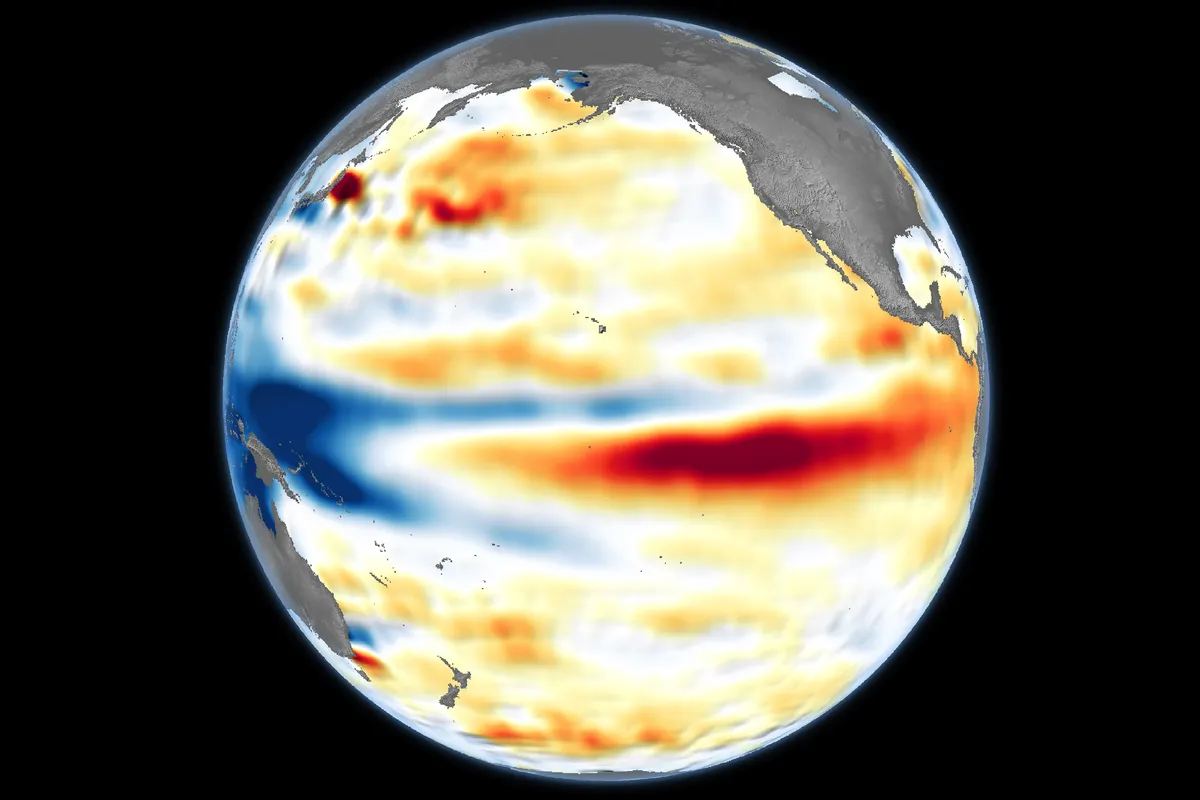 El Niño is characterized by warmer ocean temperatures across the central and eastern tropical Pacific Ocean. Image credit: NASA Earth Observatory image by Lauren Dauphin, using modified Copernicus Sentinel data (2023) processed by the European Space Agency and further processed by Josh Willis, Severin Fournier, and Kevin Marlis/NASA/JPL-Caltech
These impacts were made starkly clear in the 1997/1998 El Niño event, where thousands of people died across the world from flooding, drought, famine, fires, extreme heat, and disease outbreaks.
It's also likely to spark record-breaking coral bleaching around the world, dealing a devastating blow to the planet's already struggling reefs.
The first globally synchronous coral bleaching event occurred in 1998, coinciding with the strong El Niño. Since then, nearly every strong El Niño event has triggered a new wave of global coral bleaching.
Known unknowns
There’s no telling yet whether 2026 will be anywhere near as catastrophic as 1997/1998, partially because scientists have little idea of how the rest of the story might pan out.
“I don't want to be overly alarmist about it, but I think we should be preparing right now for something that we have never seen before,” said Hausfather.
“I hope countries, particularly in the tropics, are already starting to prepare for reduced harvests and the impacts that'll bring. I don't think we can be complacent, particularly because this event is so far outside of anything we've experienced before,” he added.
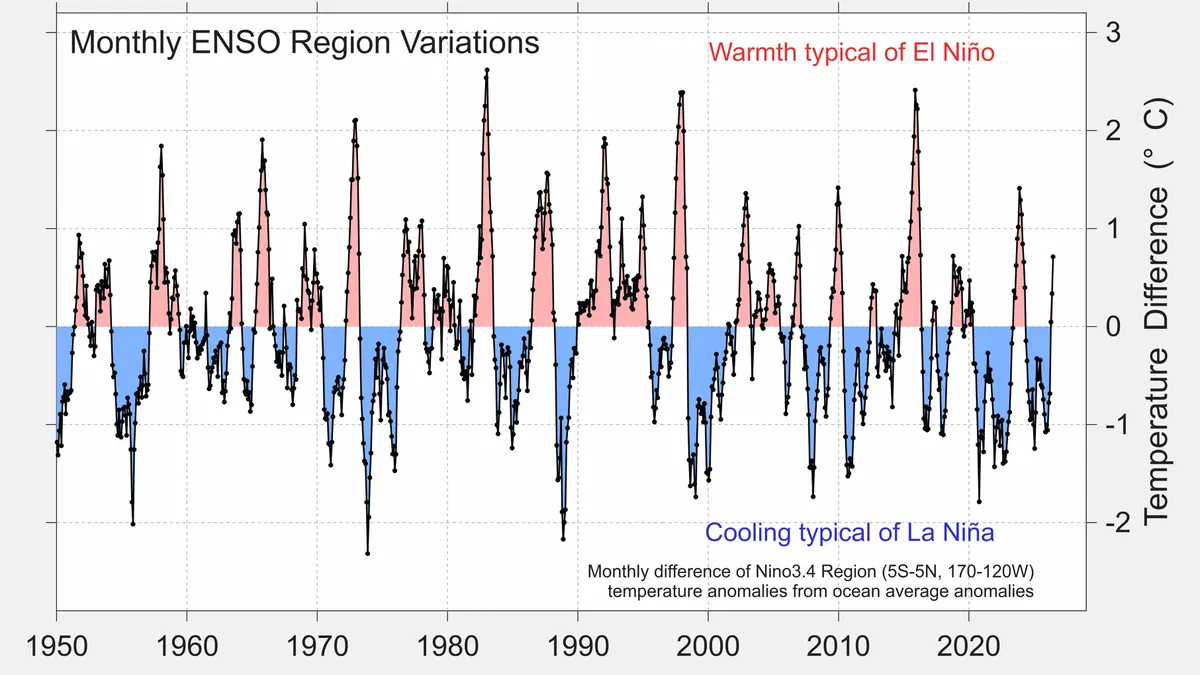
Monthly temperature differences in the Niño 3.4 region from 1950 to 2026. Image courtesy of Zeke Hausfather / Berkeley Earth
Another reason it's difficult to draw direct comparisons with El Niño of 1997/1998 is that Earth was a very different place just 28 years ago. In 2026, the planet is considerably warmer than it was in previous decades as a result of climate change, adding an additional sting to El Niño phases.
“1998 was a record-shattering year at the time for temperatures. If it occurred today, it would be exceptionally cold. That puts in perspective how much human contribution has changed things in addition to things like El Niño,” continued Hausfather.
“The last time we had a year as cold as 1998 was 2011. Every year since 2011 has been hotter than 1998,” he added.
This rapidly changing baseline is precisely what fuels the misconception that any extreme weather can be shooed away as "just El Niño" and swept under the rug. Hausfather pushes back firmly against that framing and, instead, believes that these events only further highlight the perils of climate change.
“There's a certain class of very online climate sceptics who are like ‘oh, it's all El Niño, you're just blowing natural variability out of proportion.’ But no, El Niño just gives us a sneak peek at what the new normal is going to be a decade from now,” he warned.
Perhaps you are confusing named storms, of which there have been two. Both forned in the Gulf of the United States, and they must have reached tropical storn strengths to have been named. 😁
Bertha didn't even bring rain to where I live 90 miles north of N.O. Since I do not even remember Arthur, it must have been nothing as well.
Even NOAA forecasted a below-normal season, expecting a total of 7 to 13 named storms, 2 to 6 hurricanes, and 0 to 2 major hurricanes for the remainder of the year.
Bewst yes. according to this article we are all doomed. Sp, you are right on that staement. 🤣👍
Just a note, I reconized the sarcasm you were presening. 😁🤙
There is a Total Eclipse today/tomorrow, depending on your time zone, and that always happens on a New Moon.
Earth, Moon and Sun are in a line, with the Moon in the middle.
Gravitational effect is additive.
There was a very strong earthquake in Colombia yesterday.
Expect more..........................
AOC has some on ice for you knock yourself out
I remember in the early 1980s a massive September snow storm in north Colorado-Nebraska area. The local weather chick 900 miles to the South east used the “El Nino” word to try to frighten the TV watchers that was the cause of the storm.
Oh Scheisse, we are all dead!!!
The one city that has it right is Las Vegas. They dont use their share but, they certainly are going to suffer.
Right now, the new water intake they completed is sucking in increased amounts of silt from the increase in Delta Flow as a result of bank erosion along the system.
And like you said, years ago there wasnt the population.
I remember when there was no houses in between Henderson and Boulder City at the Railroad Pass. And that was just 20 years ago.
I lived up in the White Mountains in AZ for seven months Fall ‘75 - Spring ‘76. It was a sleepy backwater back then. No traffic lights for 100 miles in any direction (all the way to Holbrook). It really felt like the “old West” back then. Cowboy and rodeo country. I returned 20 years later and didn’t recognize the place. I can only imagine what it looks like now.
I grew up in a country of 150 million people. Now there are 180 million MORE people. Water is the key, especially in the arid west.
Yup. They developed all of it without long term considerations.
And its gonna become very political immediately.
One side will start with the usual man made climate change. They’ll have one thing right. Its man made, and it wasnt the climate that was changed.
I was stationed in Denver in September 1974, we had snow..........
This brief is part of a series under the China Environment Forum’s Cooperative Competitors: Building New Energy and Water NetworksInitiative, made possible by support from the Blue Moon Fund, Rockefeller Brothers Fund, U.S. Agency for International Development,and Vermont Law School
I don't know why the Vermont Law School got involved, though. I do remember during the initial construction/relocation period seeing a picture of angry Chinese peasants armed with pitch forks, scythes and other farm implements going up against PLA troops with rifles.
Maybe VLS was signed on to handle expected lawsuits.
You know how technocrat/corporate types are.
Vermont = Bernie Sanders..............
U.S. Agency for International Development = USAID = Democrat Money Laundering Slush Fund.............now defunct......
It was actually the earliest and most contentious political issues in the American West. Water rights shaped the West's law and politics in ways still felt today.
The core problem was that Eastern water law (riparian rights, tied to owning land along a waterway) didn't work in a arid landscape. Miners during the California Gold Rush developed "prior appropriation" instead: whoever first put water to beneficial use had the strongest claim, regardless of whether they owned land next to the water source. That principle — "first in time, first in right" — became the backbone of Western water law and was formalized in state constitutions and court decisions starting in the 1850s-1870s (Colorado's constitution codified it explicitly in 1876).
This created enduring conflicts: farmers versus miners (mining runoff polluted irrigation water), upstream versus downstream users, agricultural versus urban interests, and states versus each other over shared rivers. The Wyoming v. Colorado (1922) and Arizona v. California (1963) Supreme Court cases, the multi-state Colorado River Compact (1922), and the Owens Valley/Los Angeles aqueduct fights of the early 1900s are classic examples of how water disputes became major legal and political battles — sometimes violent ones, as in the "California Water Wars."
John Wesley Powell's 1878 report warned that the West's aridity would require fundamentally different land and water policy. It is often cited as an early, but largely ignored, call to grapple with this politically. Water rights also drove the creation of federal institutions like the Bureau of Reclamation (1902) to fund irrigation infrastructure, since the scale of the problem exceeded what individual states or settlers could manage alone.
Remember the movie "Chinatown," the neo-noir mystery film directed by Roman Polanski and written by Robert Towne? It starred Jack Nicholson and Faye Dunaway and was set in 1930s Los Angeles. It was inspired by the California Water Wars—early 20th-century conflicts over water rights that enabled Los Angeles to access resources from the Owens Valley.
The California Water Wars weren't a "war" in the military sense — no direct combat deaths are attributed to it. The conflict played out mainly through sabotage and legal/political maneuvering. Between 1924 and 1927, Owens Valley farmers dynamited the Los Angeles Aqueduct at least 10-11 times, most notably a 500-pound blast near Lone Pine on May 21, 1924, carried out by a caravan of about 40 people. In November 1924, a group of ranchers seized the Alabama Gates spillway and held it for several days in an armed standoff with LA officials — but it ended without violence or bloodshed. These acts of sabotage were largely symbolic protest rather than lethal attacks; historical accounts don't record any deaths directly caused by the dynamiting or the standoffs.
The one mass-casualty event associated with this era of LA's water infrastructure was the St. Francis Dam collapse on March 12, 1928, which killed 435 people. That was a catastrophic engineering failure of a dam built to store aqueduct water, not a direct act of the water-rights conflict itself. But it was an indirect consequence. William Mulholland, a self-taught engineer who'd risen to chief of the LA water system without formal training, sited the dam on treacherous geology: one abutment sat atop a fractured mica schist over an ancient landslide, the other on sandstone that disintegrated when soaked with water. California's 1917 engineering licensure law exempted municipal engineers like Mulholland from outside review, so he designed, built, and inspected the dam entirely in-house with no independent geologists checking his work. The coroner's inquest cleared him of crimes but concluded a project of that scale should never rest on one man's judgment alone.
Back to "Chinatown." It drew heavily on Mulholland's story. The film's chief engineer character, Hollis Mulwray, is widely understood to be based on Mulholland — the name itself is an obvious echo. Ironically, Mulwray is murdered after opposing a dam project on safety grounds (an inversion of real history, since it was Mulholland who pushed the actual dam through despite the risks). The villain, Noah Cross, is generally seen as a composite drawing on Mulholland along with Fred Eaton, the LA mayor and water official who partnered with Mulholland on the original Owens Valley aqueduct scheme.
It's been about 170 years since water rights problems blossomed in the west and there's no end in sight. It's worse because all the water projects allowed the population to explode and, as you said, no long-term consideration about this issue and what happens when periodic long-term droughts recur. There's no end in sight for water politics in the West.
Onooo we’re all gonna dieeeeeee/s.🙄
Thise are all facts. What i was referring is that this will become political nationwide. Not just the southwest.
And Agriculture might be at the center.
Wait. The news will hit as soon as they have to shut down those turbines. It is just now starting to hit.
Desalination wil have to be done.
A couple of us have kicked the idea of digging a shipping canal up from the Gulf Of California to Yuma Az. Just a litte wider than a small/mid sized freighter. Then, put a desalination plant up and direct at least two oil refinerys built on government land and managed by commercial refinery companies.
The canal would have to be about 200 foot deep. The narrow size would allow the ships to actually extra pump sea water up to the desalination plant.
The refineries allow the excess gas to be used for electric generation. I understand that is how they fuel some of the systems over in the mid east.
Aside from that. The location would be a way to get around the crap California pulls that chased out refineries there.
The shipping would be containers or some other shipping.
Instead of spending our taxpayer money on wars in regions we should have nothing to do with, it spends it here for the general welfare. The refineries on government land are useful buildings.
All constitutional and can be done by EO.
All the rail and road infrastructure is there at Yuma.
Be a hell of a project, will require dealing with the dam Mexicans, but we will have to deal with themselves bastards anyways.
Need small modular nukes powering desalination.
END GLOBAL WEATHER NOW!!!
The Rockefeller Foundation used to seed programs they eventually turned over to US taxpayers. I took notice when President Trump shut down USAID.
A Sudden End to the Rockefeller Foundation’s Rural Reconstruction Program
After a rocky start, communication among the participating groups began to improve in the second year of the program, but any real progress was cut short by the 1937 Japanese invasion, which forced the participating organizations to shut down or to relocate to Southwest China. Support continued in a reduced way for some aspects of the program in Southwest China through 1946, but the cooperative heart of the program ended with the invasion.
Despite its lack of overt success, the Rural Reconstruction program and the lessons learned from it are largely credited with providing a model for the subsequent community development initiatives of the RF and other international aid organizations, as well as a prototype of Point IV, the US technical assistance program that eventually became the Agency for International Development (USAID).
President Trump shut it down in the first six months of his second term and has been targeted ever since.
Brookings is the step brother to the Rockefeller foundations and are familiar with the deep state terrain as they UNwittingly describe here https://www.brookings.edu/articles/redesigning-the-us-state-department-and-usaid-assistance-programs/
I don't get the Sanders/Vermont Law School connection. Did he attend?
This is what is making Asia nervous these days.
We need any and all.
Since when has this country quit building basic needs infrastructure?
Instead, like you indicated, we destroy. Then expect to build crap like AI without the means to supply power.
So my question remains to those who “think” we dont need this...what is the choice? Food? Or artificial things?
Sanders is their Senior Senator........
Disclaimer: Opinions posted on Free Republic are those of the individual posters and do not necessarily represent the opinion of Free Republic or its management. All materials posted herein are protected by copyright law and the exemption for fair use of copyrighted works.