Free Republic
Browse · Search
General/Chat
Topics · Post Article

To: wardaddy; rxh4n1; DiogenesLamp

Let us recount the words of Frederick Douglass, who knew Lincoln very well, in a speech delivered at the unveiling of The Freedmen’s Monument in Lincoln Park, Washington, D.C. in 1876:

“It must be admitted, truth compels me to admit, even here in the presence of the monument we have erected to his memory, Abraham Lincoln was not, in the fullest sense of the word, either our man or our model. In his interests, in his associations, in his habits of thought, and in his prejudices, he was a white man.

He was preëminently the white man’s President, entirely devoted to the welfare of white men. He was ready and willing at any time during the first years of his administration to deny, postpone, and sacrifice the rights of humanity in the colored people to promote the welfare of the white people of this country.

In all his education and feeling he was an American of the Americans. He came into the Presidential chair upon one principle alone, namely, opposition to the extension of slavery. His arguments in furtherance of this policy had their motive and mainspring in his patriotic devotion to the interests of his own race. To protect, defend, and perpetuate slavery in the states where it existed Abraham Lincoln was not less ready than any other President to draw the sword of the nation.

He was ready to execute all the supposed guarantees of the United States Constitution in favor of the slave system anywhere inside the slave states. He was willing to pursue, recapture, and send back the fugitive slave to his master, and to suppress a slave rising for liberty, though his guilty master were already in arms against the Government.

The race to which we belong were not the special objects of his consideration. Knowing this, I concede to you, my white fellow-citizens, a preëminence in this worship at once full and supreme. First, midst, and last, you and yours were the objects of his deepest affection and his most earnest solicitude.

You are the children of Abraham Lincoln. We are at best only his step-children; children by adoption, children by forces of circumstances and necessity. To you it especially belongs to sound his praises, to preserve and perpetuate his memory, to multiply his statues, to hang his pictures high upon your walls, and commend his example, for to you he was a great and glorious friend and benefactor.

Instead of supplanting you at his altar, we would exhort you to build high his monuments; let them be of the most costly material, of the most cunning workmanship; let their forms be symmetrical, beautiful, and perfect; let their bases be upon solid rocks, and their summits lean against the unchanging blue, overhanging sky, and let them endure forever!

But while in the abundance of your wealth, and in the fullness of your just and patriotic devotion, you do all this, we entreat you to despise not the humble offering we this day unveil to view; for while Abraham Lincoln saved for you a country, he delivered us from a bondage, according to Jefferson, one hour of which was worse than ages of the oppression your fathers rose in rebellion to oppose.”

https://teachingamericanhistory.org/document/oration-in-memory-of-abraham-lincoln/


84 posted on 02/17/2026 11:59:26 AM PST by Pelham (President Eisenhower. Operation Wetback 1953-54)
[ Post Reply | Private Reply | To 82 | View Replies ]


To: Pelham
Frederick Douglas was a very talented wordsmith.

I think his understanding of the situation was exactly correct.

87 posted on 02/17/2026 1:52:48 PM PST by DiogenesLamp ("of parents owing allegiance to no other sovereignty.")
[ Post Reply | Private Reply | To 84 | View Replies ]

To: Pelham
Let us recount the words of Frederick Douglass, who knew Lincoln very well, in a speech delivered at the unveiling of The Freedmen’s Monument in Lincoln Park, Washington, D.C. in 1876:

People should read the entire speech. Douglass brilliantly uses these critical words of Lincoln at the beginning to offset and contrast with his praise of Lincoln later in the speech. For example:
I have said that President Lincoln was a white man, and shared the prejudices common to his countrymen towards the colored race. Looking back to his times and to the condition of his country, we are compelled to admit that this unfriendly feeling on his part may be safely set down as one element of his wonderful success in organizing the loyal American people for the tremendous conflict before them, and bringing them safely through that conflict. His great mission was to accomplish two things: first, to save his country from dismemberment and ruin; and, second, to free his country from the great crime of slavery. To do one or the other, or both, he must have the earnest sympathy and the powerful coöperation of his loyal fellow-countrymen. Without this primary and essential condition to success his efforts must have been vain and utterly fruitless. Had he put the abolition of slavery before the salvation of the Union, he would have inevitably driven from him a powerful class of the American people and rendered resistance to rebellion impossible. Viewed from the genuine abolition ground, Mr. Lincoln seemed tardy, cold, dull, and indifferent; but measuring him by the sentiment of his country, a sentiment he was bound as a statesman to consult, he was swift, zealous, radical, and determined....

Had Abraham Lincoln died from any of the numerous ills to which flesh is heir; had he reached that good old age of which his vigorous constitution and his temperate habits gave promise; had he been permitted to see the end of his great work; had the solemn curtain of death come down but gradually—we should still have been smitten with a heavy grief, and treasured his name lovingly. But dying as he did die, by the red hand of violence, killed, assassinated, taken off without warning, not because of personal hate—for no man who knew Abraham Lincoln could hate him—but because of his fidelity to union and liberty, he is doubly dear to us, and his memory will be precious forever.
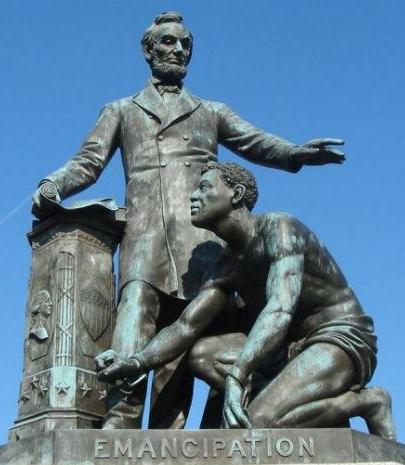
Douglass gave this speech at the unveiling of the Freedmans' Memorial in Washington DC, 1876.


88 posted on 02/17/2026 2:35:10 PM PST by Antoninus (Republicans are all honorable men.)
[ Post Reply | Private Reply | To 84 | View Replies ]

Free Republic
Browse · Search
General/Chat
Topics · Post Article


FreeRepublic, LLC, PO BOX 9771, FRESNO, CA 93794
FreeRepublic.com is powered by software copyright 2000-2008 John Robinson