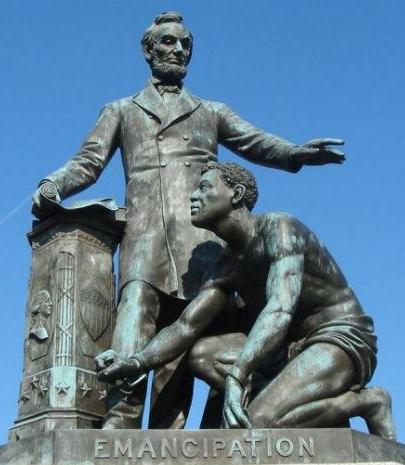
I have said that President Lincoln was a white man, and shared the prejudices common to his countrymen towards the colored race. Looking back to his times and to the condition of his country, we are compelled to admit that this unfriendly feeling on his part may be safely set down as one element of his wonderful success in organizing the loyal American people for the tremendous conflict before them, and bringing them safely through that conflict. His great mission was to accomplish two things: first, to save his country from dismemberment and ruin; and, second, to free his country from the great crime of slavery. To do one or the other, or both, he must have the earnest sympathy and the powerful coöperation of his loyal fellow-countrymen. Without this primary and essential condition to success his efforts must have been vain and utterly fruitless. Had he put the abolition of slavery before the salvation of the Union, he would have inevitably driven from him a powerful class of the American people and rendered resistance to rebellion impossible. Viewed from the genuine abolition ground, Mr. Lincoln seemed tardy, cold, dull, and indifferent; but measuring him by the sentiment of his country, a sentiment he was bound as a statesman to consult, he was swift, zealous, radical, and determined....Douglass gave this speech at the unveiling of the Freedmans' Memorial in Washington DC, 1876.
Had Abraham Lincoln died from any of the numerous ills to which flesh is heir; had he reached that good old age of which his vigorous constitution and his temperate habits gave promise; had he been permitted to see the end of his great work; had the solemn curtain of death come down but gradually—we should still have been smitten with a heavy grief, and treasured his name lovingly. But dying as he did die, by the red hand of violence, killed, assassinated, taken off without warning, not because of personal hate—for no man who knew Abraham Lincoln could hate him—but because of his fidelity to union and liberty, he is doubly dear to us, and his memory will be precious forever.
Lincoln had a significant fan club praising him. This one was written by a foreign correspondent for Horace Greeley’s GOP newspaper, who here is listed as the Corresponding Secretary for Germany:
Sir:
We congratulate the American people upon your re-election by a large majority. If resistance to the Slave Power was the reserved watchword of your first election, the triumphant war cry of your re-election is Death to Slavery.
From the commencement of the titanic American strife the workingmen of Europe felt instinctively that the star-spangled banner carried the destiny of their class. The contest for the territories which opened the dire epopee, was it not to decide whether the virgin soil of immense tracts should be wedded to the labor of the emigrant or prostituted by the tramp of the slave driver?
When an oligarchy of 300,000 slaveholders dared to inscribe, for the first time in the annals of the world, “slavery” on the banner of Armed Revolt, when on the very spots where hardly a century ago the idea of one great Democratic Republic had first sprung up, whence the first Declaration of the Rights of Man was issued, and the first impulse given to the European revolution of the eighteenth century; when on those very spots counterrevolution, with systematic thoroughness, gloried in rescinding “the ideas entertained at the time of the formation of the old constitution”, and maintained slavery to be “a beneficent institution”, indeed, the old solution of the great problem of “the relation of capital to labor”, and cynically proclaimed property in man “the cornerstone of the new edifice” — then the working classes of Europe understood at once, even before the fanatic partisanship of the upper classes for the Confederate gentry had given its dismal warning, that the slaveholders’ rebellion was to sound the tocsin for a general holy crusade of property against labor, and that for the men of labor, with their hopes for the future, even their past conquests were at stake in that tremendous conflict on the other side of the Atlantic. Everywhere they bore therefore patiently the hardships imposed upon them by the cotton crisis, opposed enthusiastically the proslavery intervention of their betters — and, from most parts of Europe, contributed their quota of blood to the good cause.
While the workingmen, the true political powers of the North, allowed slavery to defile their own republic, while before the Negro, mastered and sold without his concurrence, they boasted it the highest prerogative of the white-skinned laborer to sell himself and choose his own master, they were unable to attain the true freedom of labor, or to support their European brethren in their struggle for emancipation; but this barrier to progress has been swept off by the red sea of civil war.
The workingmen of Europe feel sure that, as the American War of Independence initiated a new era of ascendancy for the middle class, so the American Antislavery War will do for the working classes. They consider it an earnest of the epoch to come that it fell to the lot of Abraham Lincoln, the single-minded son of the working class, to lead his country through the matchless struggle for the rescue of an enchained race and the reconstruction of a social world. [B]
Signed on behalf of the International Workingmen’s Association, the Central Council:
Longmaid, Worley, Whitlock, Fox, Blackmore, Hartwell, Pidgeon, Lucraft, Weston, Dell, Nieass, Shaw, Lake, Buckley, Osbourne, Howell, Carter, Wheeler, Stainsby, Morgan, Grossmith, Dick, Denoual, Jourdain, Morrissot, Leroux, Bordage, Bocquet, Talandier, Dupont, L.Wolff, Aldovrandi, Lama, Solustri, Nusperli, Eccarius, Wolff, Lessner, Pfander, Lochner, Kaub, Bolleter, Rybczinski, Hansen, Schantzenbach, Smales, Cornelius, Petersen, Otto, Bagnagatti, Setacci;
George Odger, President of the Council; P.V. Lubez, Corresponding Secretary for France; Karl Marx, Corresponding Secretary for Germany; G.P. Fontana, Corresponding Secretary for Italy; J.E. Holtorp, Corresponding Secretary for Poland; H.F. Jung, Corresponding Secretary for Switzerland; William R. Cremer, Honorary General Secretary.
https://www.marxists.org/archive/marx/iwma/documents/1864/lincoln-letter.htm