Skip to comments.
The Best-Preserved Mycenaean Palace [4:01]
YouTube ^
| January 2, 2026
| Scenic Routes to the Past (Garrett Ryan, Ph.D)
Posted on 01/14/2026 4:58:49 PM PST by SunkenCiv
The Palace of Nestor at Pylos is the best-preserved Mycenaean royal residence. This short tour explores some of the building's most remarkable features. The Best-Preserved Mycenaean Palace | 4:01
Scenic Routes to the Past | 54.2K subscribers | 11,327 views | January 2, 2026

(Excerpt) Read more at youtube.com ...
TOPICS: History; Science; Travel
KEYWORDS: carlblegen; garrettryan; godsgravesglyphs; greece; iliad; megaron; nestor; pylos
1
posted on
01/14/2026 4:58:49 PM PST
by
SunkenCiv
[Transcript]
In the Homeric epics, Nestor is the oldest of the Greek leaders at Troy. Though a bit prone to rambling, he is respected for the wisdom of his counsel and is responsible for the reconciliation of Achilles and Agamemnon. He is also a powerful king. Only Agamemnon brings more warriors to Troy. His home is Sandy Pylos, where Tmicus, the son of Odysseus, visits him at the beginning of the Odyssey.
Until the 20th century, the location of Pylos was unknown. Excavations only began here in 1939 when the American archaeologist Carl Blagen identified this as the site of a Mycenaean palace. In the first few hours of his excavation here, he found Linear B tablets and fragments of frescoed walls. Soon hundreds of tablets, then unreadable, were discovered.
The onset of World War II and the subsequent Civil War then postponed work for 13 years. Then at last, Blagen returned and excavated the rest of the best-preserved Mycenaean Palace. The palace consisted of several blocks of two-story buildings. We’ll focus on the main building here. The outer walls were masonry. The inner walls were plastered rubble. The upper story was mud brick and wood.
We’re standing at the propylon, the entryway. The famous Linear B tablets were found in a pair of rooms to the left of the entrance. These appear to have been archives. When the palace burned down around 1180 BC, the tablets kept here were baked, preserving them. Within was a courtyard. The porch of the Megaron, or throne room, is just below us.
In the rooms to our left, vast quantities of pottery were stored. They were made in palace workshops, apparently for distribution and sale. A room equipped with large wine jars may have been set aside for petitioners waiting to see the king. The king and his family may have occupied the rooms to the right of the courtyard. Here we find the famous terracotta bathtub. Now at the center of the screen, beyond the porch where guards were almost certainly posted, we come to the Megaron itself. At the center is the great circular hearth. Just behind it from our perspective was the throne itself.
The bases of the columns that supported the roof can still be seen around the hearth. Olive oil was stored in the rooms behind the Megaron.
The so-called queen’s Megaron mirrored the main Megaron on a smaller scale. It may have actually been used by court officials. Here, the outer wall of the palace with its large dressed blocks is fairly well preserved.
A short walk from the palace is this Tholos-style tomb. It’s much older than the palace and was robbed in antiquity. It had to be partially rebuilt in the 20th century, but though not quite in the scale of its counterparts in Mycenae, it’s still pretty impressive.
Looking now from the palace out toward the wine-dark sea and the bay where Nestor launched his ships for Troy.
2
posted on
01/14/2026 4:59:18 PM PST
by
SunkenCiv
(NeverTrumpin' -- it's not just for DNC shills anymore -- oh, wait, yeah it is.)
To: StayAt HomeMother; Ernest_at_the_Beach; 1ofmanyfree; 21twelve; 24Karet; 2ndDivisionVet; 31R1O; ...
3
posted on
01/14/2026 5:01:04 PM PST
by
SunkenCiv
(NeverTrumpin' -- it's not just for DNC shills anymore -- oh, wait, yeah it is.)
To: SunkenCiv
So they now think Nestor was real? Was he the King of this palace?
Do they are are they starting to think maybe Odysseus (Ulysses) was real?
Pretty interesting stuff here.
4
posted on
01/14/2026 6:13:19 PM PST
by
Beowulf9
To: Beowulf9
There was a king in that palace, and thanks to Schliemann et al, in the 19th c and into the 20th, it was in vogue to label various finds and locales in accordance with, for example, Homer’s works. It makes more sense to keep using those names rather than the modern name, or some modern person.
https://en.wikipedia.org/wiki/Nestor_(given_name)
Nestor (given name)
Gender male
Origin
Meaning homecoming (Greek)
Nestor, or Néstor, is a given name of Greek origin. In Greek mythology it comes from that of Nestor, the son of Neleus, the King of Pylos and Chloris.[1] The Greek derivation is from a combination of νέομαι, néomai, ‘go back’, and νόστος, nóstos, ‘one who returns from travels’.[citation needed]
5
posted on
01/15/2026 9:03:47 AM PST
by
SunkenCiv
(NeverTrumpin' -- it's not just for DNC shills anymore -- oh, wait, yeah it is.)
To: SunkenCiv
I like they label the various finds in accordance with Homer’s works.
Thank you, Schliemann.
6
posted on
01/15/2026 9:54:11 AM PST
by
Beowulf9
Bronze Age Burial Uncovered in Greece
| Archaeology Magazine | January 14, 2026
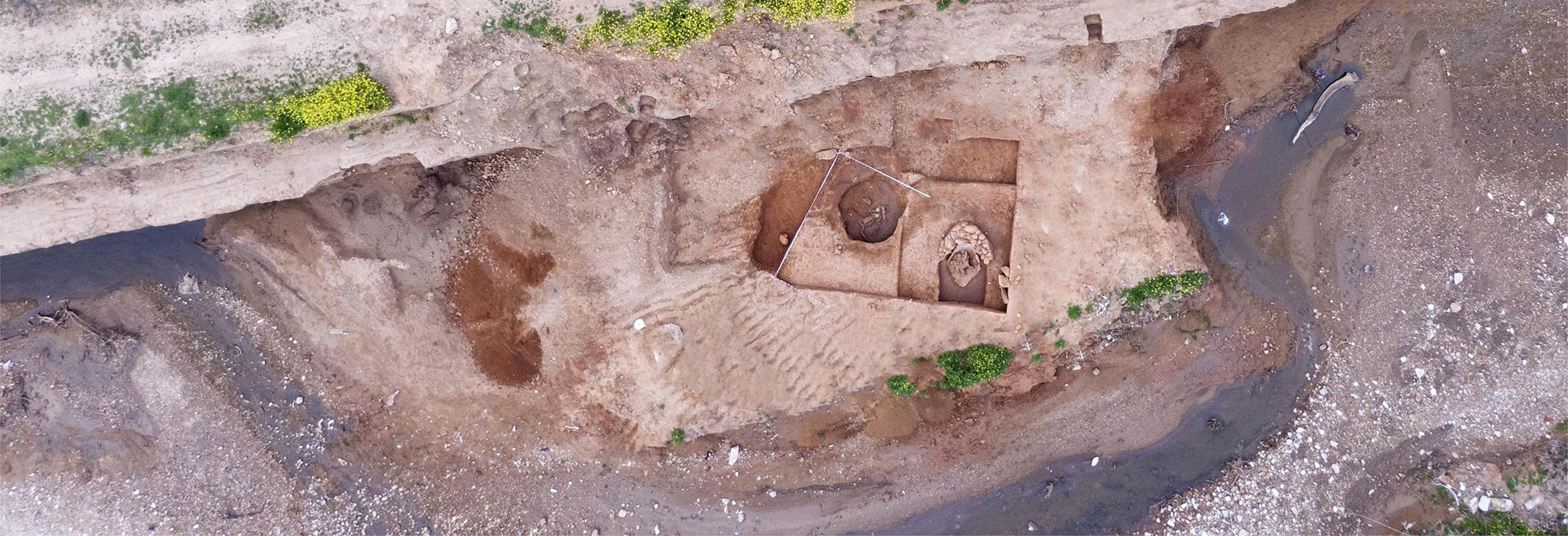
La Brújula Verde reports that a Bronze Age burial and a large circular pit were uncovered on the banks of a stream in eastern Attica. Researchers from Greece’s Ephorate of Antiquities of Eastern Attica found a pithos measuring nearly six feet long in the tomb. The jar features corded relief decorations around its neck and handles, which had been placed horizontally on its belly. The mouth of the vessel was sealed with a simulated door made of two large stones and smaller slabs that was then covered with a semicircular wall made of river pebbles. Resting on sand and pebbles within the jar, the researchers found the bones of two people that had been covered with large stones. A copper awl, an ovoid stone thought to have served as a plaque, obsidian points, and ceramic vessels were also found in the burial. Some six feet away, the excavators discovered a large circular pit bearing traces of fire and long ritual use. The skull of a bull, ceramics, and copper coins were recovered from the upper layers of the pit. Near the bottom, a layer of ash and burned materials, the bones of an equid, and the bones of smaller animals were found. The animal bones are thought to be cremains, or the remains of animals that had been cooked as sacrifices. Dating of the burial and the contents of the pit could help researchers determine if the two are linked. For more on the archaeology of Attica, go to "Regime Change in Athens," one of ARCHAEOLOGY's Top 10 Discoveries of 2016.
Aerial view of Bronze Age burial site during excavations, Rafina, GreeceGreek Ministry of Culture and Sports
7
posted on
01/16/2026 8:25:22 PM PST
by
SunkenCiv
(NeverTrumpin' -- it's not just for DNC shills anymore -- oh, wait, yeah it is.)
Disclaimer:
Opinions posted on Free Republic are those of the individual
posters and do not necessarily represent the opinion of Free Republic or its
management. All materials posted herein are protected by copyright law and the
exemption for fair use of copyrighted works.
FreeRepublic.com is powered by software copyright 2000-2008 John Robinson
