Posted on 09/30/2025 1:07:15 PM PDT by Red Badger
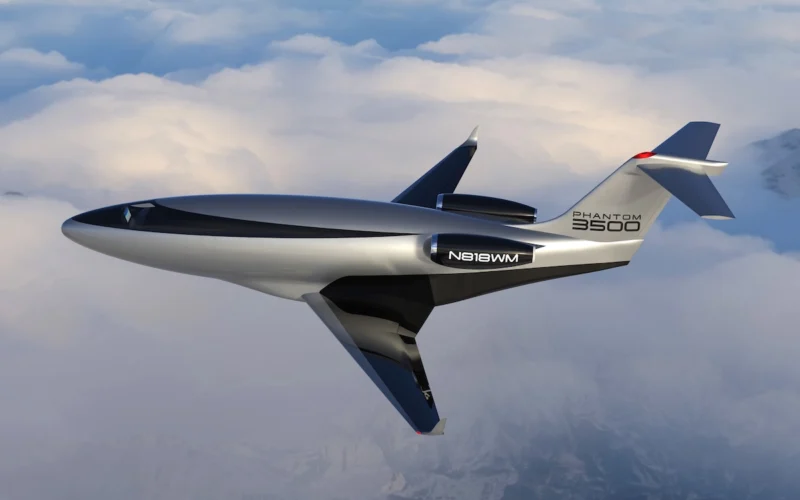
Executive jet operator Flexjet has been unveiled as the launch customer for the Phantom 3500, the revolutionary executive jet being developed by Otto Aerospace.
The announcement was made during the UP.Summit, an event dedicated to aerospace innovation, which took place in Bentonville, Arkansas, from September 28 to 29, 2025.
This is a landmark deal for Otto Aerospace (previously Otto Aviation) and secures an order for 300 aircraft from one of the largest executive fleet operators in the United States. Flexjet will also become an authorized service provider for Otto Aerospace’s aircraft.
The Phantom 3500 has a clean-sheet design which encapsulates decades of work by Otto Aerospace in the field of laminar flow. This is a physics principle through which air moves smoothly along a surface, minimizing drag and turbulence.
By optimizing for laminar flow, Otto Aerospace claims its aircraft is able to reduce fuel and emissions by 60% compared to traditional aircraft in the same category.
In this regard, the Phantom 3500 will be competing with business jets such as the Embraer Praetor 500, the Cessna Citation X, and the Bombardier Challenger 3500.
Another singular characteristic of the Phantom 3500 is that, in order to achieve this laminar flow effect, it does not have windows along its fuselage. However, Otto Aerospace is compensating for this by providing what could be defined as a next generation cabin experience, making extensive use of wall screens and lighting to provide a comparable, and in some regards even enhanced, experience.
The Phantom 3500 design is an evolution of the Celera 500L, an experimental eye-catching aircraft with a teardrop shape and a single rear propeller, which Otto Aerospace used to flight test the laminar flow concept between 2018 and 2021.
The Phantom 3500 is expected to take its first flight in 2027, with certification and deliveries towards 2030. In June 2025, during the Paris Air Show, Otto Aerospace announced that it had received financial backing from the state of Florida to build an industrial scale manufacturing facility adjacent to Cecil Airport (VQQ) in Jacksonville.
Flexjet, which is part of the OneSky private aviation group, operates a fleet of around 300 jets of all sizes, ranging from the Embraer Phenom 300 light jet to the ultra-long-range Gulfstream G700.
Earlier in 2025, Flexjet placed another major order, valued at $7 billion at catalogue prices, for 182 Embraer aircraft (plus 30 options), including an unspecified mix of Phenom 300E and Praetor 500 and 600 aircraft.
Windows disrupt the airflow and impacts fuel use and emmissions.
Do you like movies about gladiators?
Do you like movies about gladiators?
That sort of thing never happened with three ring binders and clipboards.
Ugly as sin.
300 is a good number for a smallish company. Plane looks pretty cool too.
Bread puddin’s extra runny tonight.......
That ain’t Christmas Vacation.
Looks like the Seabreacher finally grew up and sprouted wings!
https://m.youtube.com/watch?v=-oemkh5aH8w
“Look outside for fire before opening the emergency exit.” Ummm…
“Form follows function” is still true.
..who described the circulation vortex generated by the wing tip tabs and the exact shape of the airfoil for optimum lift in level flight.
And based on Admiral Lord Nelson's battle plan in 1805 at Trafalgar...established the mathematical formulation of Warfare (Aircraft in Warfare published in 1916)

Does it come with an Otto pilot?
Video screens instead of windows? Kinda claustrophobic. Sorta like the “OceanGate Titan Titanic experience” only at altitude.
think they’ll even be in business by then?
“I don’t understand why it can’t have windows.”
They are a structural weak point. The body is acting as a wing (of sorts) and subject to more strain and is more of a “rivetless” (not exactly correct) construction with much larger pieces you don’t want to compromise by cutting holes in.
And, although this is minor, windows (and rivets) mess up the airflow, similar to why to polish ports in a carb.
We actually had the discussion earlier about the Natilus Horizon (a more extreme blended wing aircraft, but which has similar design features) that is also going into production that similarly has limited windows for these reasons.
I’m sure those two little babies pack some serious punch
THey claim their”aircraft is able to reduce fuel and emissions by 60% compared to traditional aircraft.
In other words, 60% less drag, which I find very doubtful. The wing drag would have to be about the same (since the wings would still have to support the same weight of aircraft). The drag over the fuselage would be lower (because of the more perfect aerodynamic shape), but that’s not going to be enough tp lower the total drag by 60%
“it does not have windows along its fuselage.”
As one who has been in the aircraft manufacturing industry for over 20 year ai can not tell anyone outside of the industry how big a deal putting windows in an aircraft are. Getting rid of them is yuge.
Disclaimer: Opinions posted on Free Republic are those of the individual posters and do not necessarily represent the opinion of Free Republic or its management. All materials posted herein are protected by copyright law and the exemption for fair use of copyrighted works.