Posted on 05/30/2024 8:00:43 AM PDT by Red Badger
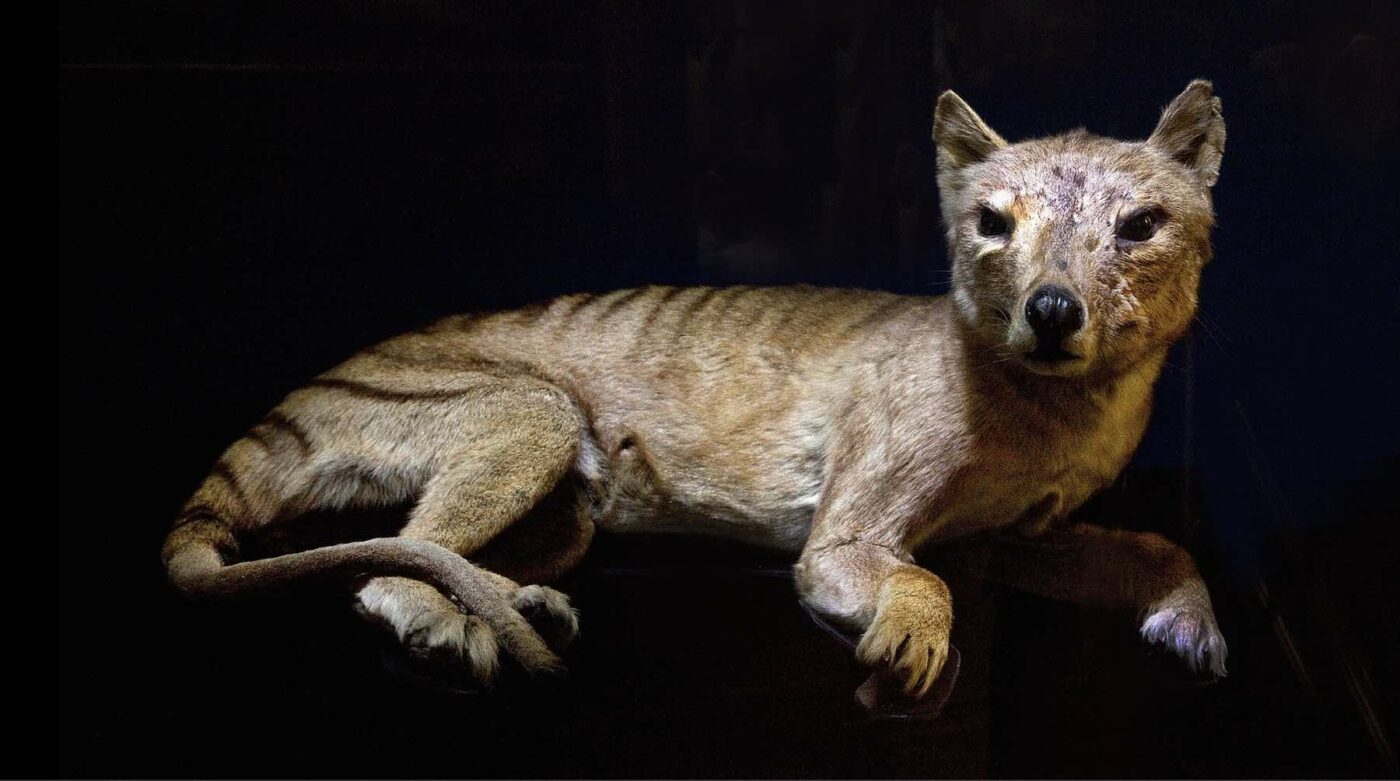
On September 7, 1936, the last known thylacine, often referred to as the Tasmanian tiger, is believed to have died in captivity in Hobart, Tasmania.
Since then, the species, long presumed extinct, has taken on a near-mythical status. The thylacine still captures the public’s imagination, having earned its place as a modern symbol of both loss, and also possibilities. The creature’s unmistakable striped appearance has also helped propel it to its current position as a pop cultural icon and a constant reminder of humanity’s more destructive side.
Yet what is perhaps the most intriguing about the thylacine is that, for many decades, alleged sightings of the creatures have continued, causing even some of the most skeptical wildlife experts to wonder whether the beloved Tasmanian tiger might have survived extinction, remaining alive but critically endangered in some of Tasmania’s most remote forests.
Last year, a comprehensive analysis of 1,237 thylacine sightings reported since 1910 indicated the possibility that the creatures might have indeed persisted until as recently as the 1980s, if not more recently. The study, led by Professor Barry Brook from the University of Tasmania and published in the journal Science of the Total Environment, based its evaluations on the quality of observations by assigning them a credibility rating, providing a fresh perspective on the timing and location of the thylacine’s potential last days.
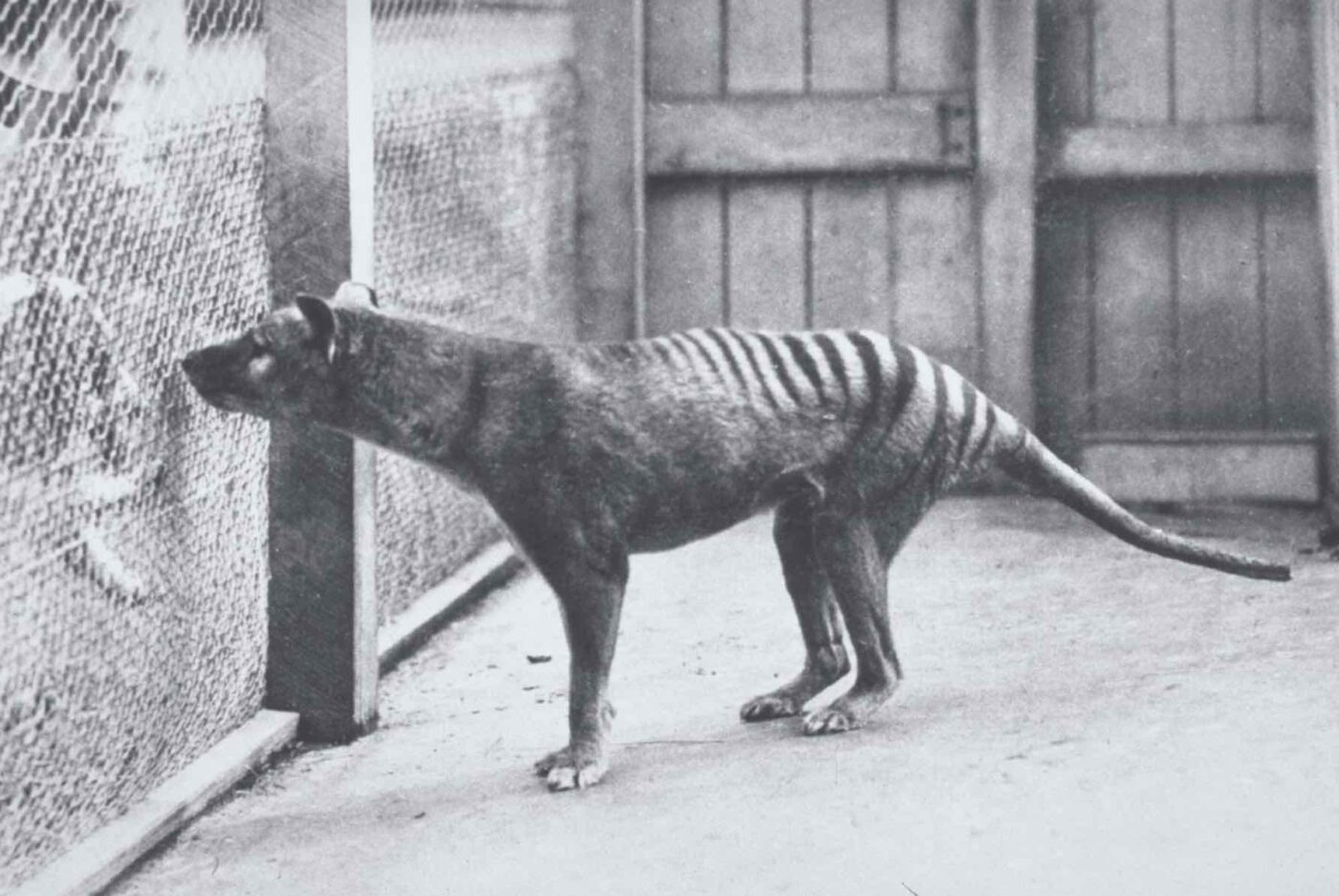
Above: A living Thylacine on display at the Hobart Zoo in 1928 (public domain). According to the study’s findings, contrary to the widely accepted death of the last known thylacine in 1936, which marked its extinction, the species likely survived until sometime between the 1940s and 1970s, with the northwest of Tasmania near Waratah serving as its likely final stronghold.
Following the death of the last officially recognized thylacine in the 1930s, hopes remained that confirmation of the species’ existence would be obtained, but after several decades of intriguing sightings, the International Union for Conservation of Nature officially declared the thylacine extinct in 1982. However, Brook’s study also examined sightings of slightly lower reliability that were logged in later decades, which indicated an intriguing possibility: that at least a few representatives of Australia’s most iconic marsupial species may have lived long enough to have seen the arrival of the new millennium.
CREDIBLE SIGHTINGS
Among the most credible sightings of thylacines that occurred after their accepted extinction was a report by Hans Naarding, a park ranger who said he observed one of the creatures for several minutes while illuminated by torchlight in 1982. The sighting was deemed so credible that it resulted in a search for the species by Tas Parks, in cooperation with Dr. Eric Guiler, which lasted more than two years.
Peter Murrell, then Director of the Tasmanian Parks and Wildlife Service, cited the Naarding sighting as the best “in the history of the service,” which he called “irrefutable and conclusive” evidence of the creature’s survival.
Such sightings prompted numerous additional searches. Between 1982 and 1983, Parks and Wildlife Officer Nick Mooney attempted to confirm Naarding’s sighting during searches conducted near the Arthur River in northwestern Tasmania, which failed to find any conclusive evidence of the creatures. The following year, in 1984, Tasmanian Wildlife Park owner Peter Wright conducted similar unsuccessful searches. Then, in 1988, photographers Dave Watts and Ned Terry spent several years seeking evidence of Thylacines but eventually gave up their search in 1993.
Despite the failed searches, a few intriguing reports continued. In one instance, a thylacine was reportedly shot near Adamsfield, Tasmania, in the early 1990s, after which a photograph of one of the creature’s feet was compared with a specimen kept at Museum Victoria. Chris Rehberg, who manages the website Where Light Meets Dark, which collects information on sightings of rare fauna like the thylacine, wrote, “It is my opinion that the features shown in the photograph categorically demonstrate the animal to be Thylacine, to the exclusion of all other candidate species in Tasmania.”
COULD THE THYLACINE STILL EXIST?
Brook believes that while the 2023 study’s findings are compelling, there is a less than 1% chance that the creatures are still alive today. Still, some compelling—though unconfirmed—accounts and photographs could point to this intriguing possibility, which served as the basis for a 60 Minutes segment that aired in April 2024.
In May 2024, new photos allegedly depicting a Tasmanian tiger in the wild were publicized by wildlife biologist Forrest Galante on his YouTube channel. During an interview with the alleged photographer, identified only as “Zack,” Galante expressed the view that some of the images looked legitimate, but that he remained skeptical about at least one of the photos and planned to have them examined by an expert.
In 2022, The Debrief spoke with Professor Andrew Pask from the University of Melbourne, who, along with the U.S.-based company Colossal Biosciences, announced a cooperative effort with hopes of reviving the thylacine with help from modern genetic technologies.
VIDEO AT LINK......................
Pask told The Debrief that he remains skeptical about the thylacine’s possible survival and that the creatures would likely have only lasted a few generations beyond the death of the last known thylacine in captivity in 1936.
Pask also emphasized that the loss of the thylacine played a significant role in destabilizing the environment in which the creatures once thrived.
“That role as an apex predator was incredibly important in the ecosystem in which it sits,” Pask told The Debrief. “There are no other marsupial apex predators at all.”
“When that animal was lost, it really affects that entire ecosystem. It really has massive effects on multiple other species,” Pask said.
While questions remain about how long thylacines may have persisted, as well as the seemingly very slim possibility that a few of the creatures may remain alive today, Australia’s most enigmatic marsupial lives on through stories, art, scientific endeavors, and even recent studies like those conducted by Brook, reminding modern generations of the fragile balance between humanity and nature, and helping to inspire interest in conservation that may help other species that are currently designated as critically endangered.
Micah Hanks is the Editor-in-Chief and Co-Founder of The Debrief. He can be reached by email at micah@thedebrief.org. Follow his work at micahhanks.com and on X: @MicahHanks.
I’m interested in whether the high radiation they keep finding in some areas is possibly connected to a meteorite-and you just know that as long as the govt was there doing some kind of research, they must have found or disturbed something out of the ordinary.
This series is way more interesting than Oak Island, since I’m guessing with all the digging on Oak Island over 200 years any treasure has mostly been found and carted off-and with the finders staying shut up to keep the Canadian tax folks from screwing them to the wall. Anything left in that pit is probably just leftovers...
About 20 years ago a bird expert saw one in a swamp in Arkansas.
Completely agree!
Thrilled to find a like mind.
I wish they would take their state of the art “future”technology and use it to look into the past.
As far as Oak Island, I expect them to find “treasure “ far more significant than gold or silver.
Hidden history is way better, IMO
Yes, because of the number of sightings and audio evidence. They found in pretty inaccessible areas, which is probably a good thing.
Several years ago there was a Northern hawk-owl which flew down more south than they usually go. The mouth-breathers around here started to throw mice around the tree where it was perched. Somehow it got injured (possibly shot is what I heard) and a rehabber helped get the bird healed and released.
If anyone connected with the Knights Templars actually were there to lie low for awhile and maybe hide some things, I hope some of it was records and/or other artifacts-those would be far more valuable in a historical sense than any gold, silver, etc, since they might explain some of the history of that group that has been open to speculation for centuries.
I worked for an engineer friend of mine until 2015, when he was taken by a brain tumor. One of the customers we did a lot of work for was a real estate attorney who was actually a member of a Knights Templar group that had a lot of interesting rituals and theories-he said he and all the members all claimed ancestors who had been Knights Templars-it sounded like Freemasons on ‘roids, but very interesting...
There are more things in Heaven and Earth, Horatio, than are dreamt of in your philosophy.”
;)
I am so glad to have someone of like thoughts
:)
Disclaimer: Opinions posted on Free Republic are those of the individual posters and do not necessarily represent the opinion of Free Republic or its management. All materials posted herein are protected by copyright law and the exemption for fair use of copyrighted works.