Skip to comments.
Iranian Regime tv Channel One hacked while it was airing Khamenie speech
various
| 10-8-22
Posted on 10/08/2022 1:05:38 PM PDT by nuconvert
Iranian Regime national tv Channel One hacked about an hour ago. During a broadcast of Khamenie speech, a red crosshair appeared over his face and chanting of Women. Life. Freedom. There was writing to the side saying "Rise up. Join us". Also 4 photos at the bottom of the screen of young people killed and additional writing: "The blood of our youth is dropping from your paws".
Also, there was a huge banner in the middle of Tehran highway today that read: We are no longer afraid of you. We will fight.
Also, attempted attack on IRI ambassador in Denmark. Her bodyguard was stabbed. Diplomatic Security intervened before the attacker could stab the ambassador.
TOPICS:
KEYWORDS: basij; deathtothemullahs; denmark; ebrahimrigi; erdogan; iran; iranprotests; iraq; irgc; iri; israel; khameini; khamenei; kurdistan; lebanon; mahsaamini; mullahloversonfr; mullahsmustbekilled; najisharifizindashti; protests; qudsforce; raisi; receptayyiperdogan; shahrammaroufmola; syria; turkey; yemen; zahedi
Navigation: use the links below to view more comments.
first previous 1-20 ... 2,301-2,320, 2,321-2,340, 2,341-2,360 ... 2,401 next last
2,321
posted on
08/02/2026 7:27:49 AM PDT
by
AdmSmith
(GCTGATATGTCTATGATTACTCAT)
To: nuconvert; gleeaikin
Caspian Report: How the Gulf states plan to checkmate Iran
The Gulf states are investing billions in pipelines, railways, and trade corridors to reduce their dependence on the Strait of Hormuz, but geography stands in the way.
https://www.youtube.com/watch?v=T5W2LWLYpms
18 min that describes different proposals. good maps w animations
2,322
posted on
08/02/2026 8:42:16 AM PDT
by
AdmSmith
(GCTGATATGTCTATGATTACTCAT)
Iran Update Special Report, August 2, 2026
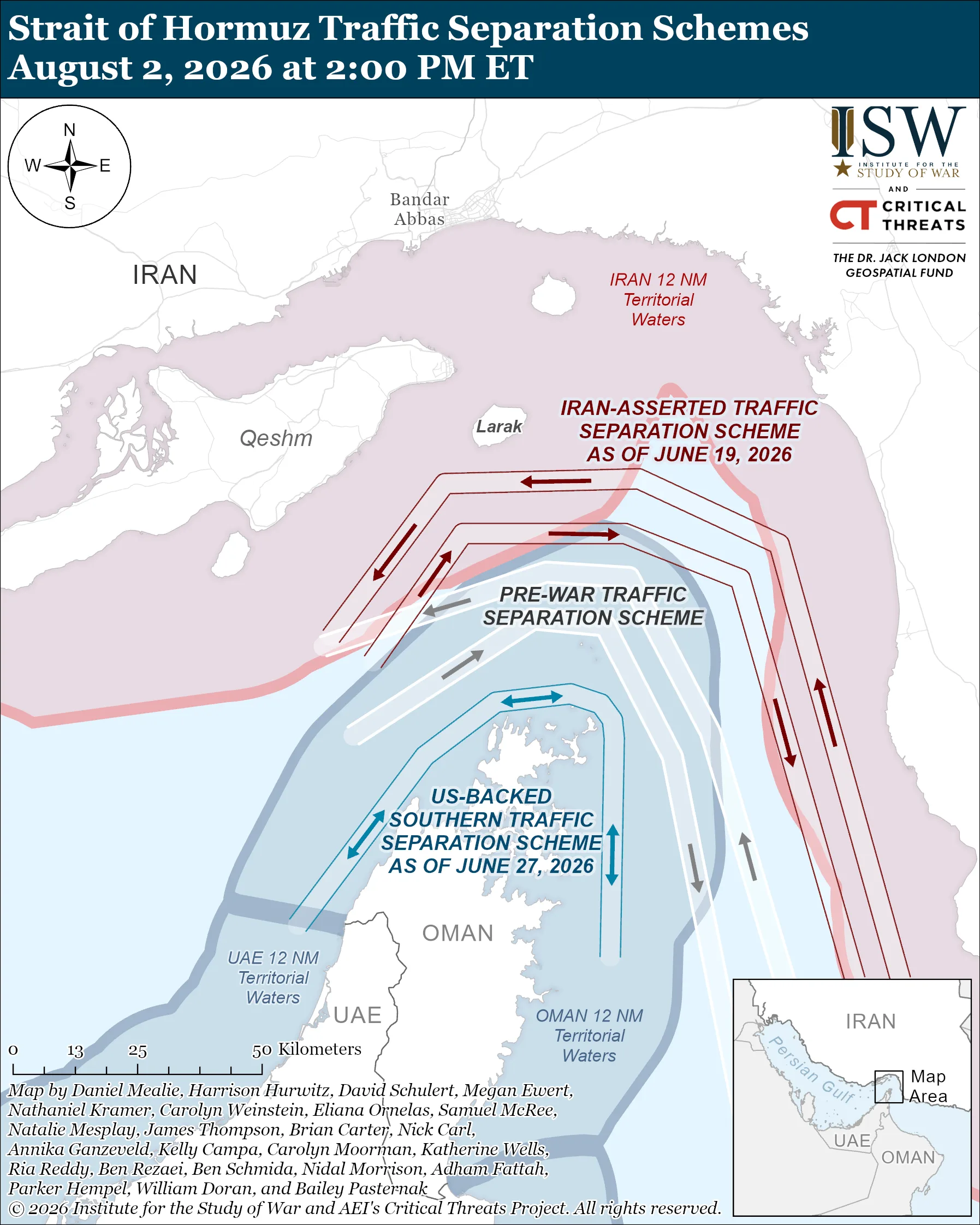
Iranian negotiators such as Foreign Affairs Minister Abbas Araghchi may be willing to make limited compromises with the United States over the extent of Iranian control over the Strait of Hormuz. The Islamic Revolutionary Guards Corps (IRGC) faction led by IRGC Commander Major General Ahmad Vahidi, which appears to be currently dominating regime decision-making, will likely reject any arrangement that meaningfully reduces Iranian control over the waterway, however. US President Donald Trump stated on August 1 that he canceled planned strikes on Iran after Iran—presumably referring to Iranian negotiators — and regional states informed him that they had agreed on the parameters of a deal that reportedly includes the “immediate, complete, and total opening” of the strait and “an end to Iran's nuclear threat.”[1] The Wall Street Journal reported on August 2 that Qatari mediators presented Iran with a new proposal to reopen the strait and that Iranian diplomats responded “positively.”[2] Israeli media also reported on August 2 that Araghchi agreed to a US- and Qatari-formulated proposal in which vessels would enter the Persian Gulf through Iranian waters and exit through Omani waters.[3] An Iranian official previously told Reuters on July 29 that Iran must control the strait's “entire inbound route” and “part of the outbound route.”[4] Iranian Foreign Affairs Ministry Spokesperson Esmail Baghaei stated on August 2 that the transit route agreed upon in the proposal is neither the current Iranian traffic separation scheme nor the southern route along Oman's coast and emphasized that the proposal “has nothing to do with” opening the strait.[5] An arrangement in which Iran controls inbound traffic in the Strait of Hormuz would still enable Iran to control which vessels can enter the Persian Gulf and thus continue to undermine the United States’ interests as well as global commerce. Iranian officials have repeatedly emphasized that they seek to prevent “hostile” vessels, including US Navy vessels, from entering the Persian Gulf.[6]
IRGC-affiliated Fars News denied on August 2 that Iran agreed to a plan to reopen the strait.[7] An informed Iranian military source told Fars News that the strait will remain closed as long as the United States continues to conduct “hostile actions.”[8] The source added that vessels can only transit through Iran's traffic separation scheme and with permission from the IRGC Navy.[9] This report highlights how some IRGC factions, likely including Vahidi’s faction, seek to retain full control over all traffic in the strait and likely oppose an arrangement in which Iran would only control inbound traffic in the strait. The IRGC controls the forces that have repeatedly attacked shipping in the strait in recent months, and it could therefore try to undermine an arrangement in the Strait of Hormuz that it deems contrary to the regime's interests.
Iranian negotiators’ reported openness to the US- and Qatari-formulated proposal is consistent with Iranian “pragmatist” actors’ support for negotiating a diplomatic settlement to advance Iranian objectives. “Pragmatist” officials such as Araghchi, Parliament Speaker Mohammad Bagher Ghalibaf, and President Masoud Pezeshkian have consistently advocated for using diplomacy to secure Iranian interests, such as securing Iranian control over the Strait of Hormuz and obtaining economic relief.[10] Iranian President Masoud Pezeshkian has repeatedly voiced concerns about the economic costs of war, and he convinced Supreme Leader Mojtaba Khamenei to accept the memorandum of understanding (MoU) in June by highlighting the MoU’s economic benefits.[11]
Some Iranian regime officials may be seeking to appease ultra-hardliners by emphasizing that the regime is exploiting pauses in US military operations and periods of diplomacy to reconstitute military capabilities and import new equipment. Iranian Artesh Spokesperson Brigadier General Mohammad Akraminia explicitly stated on August 2 that Iran “fully exploited” the MoU and ceasefire to import new equipment, repair and reconstruct damaged systems, and produce new systems.[12] Akraminia made these remarks in response to criticism from ultra-hardline parliamentarians affiliated with the Paydari (Stability) Front who reject diplomacy with the United States.[13] Akraminia may have sought to reassure these critics that the ceasefire strengthened Iran's military position rather than forced Iran to concede to the United States or abandon its objectives.
Akraminia’s remarks also corroborate ISW-CTP’s assessment that Iran has exploited pauses in fighting and the MoU to reconstitute its military capabilities in preparation for potential renewed conflict with the United States and Israel.[14] Akraminia added that Iran has developed new drones during the ceasefire that Iran recently used in attacks against US bases in Gulf states.[15] Iranian media reported on July 29 that Iran recently used an upgraded version of the Hadid 110 drone for the first time.[16] This drone uses a jet engine and solid-fuel booster to fly lower and faster with greater stealth, likely reducing air defense detection and interception time.[17]
Akraminia’s reference to “importing new equipment” may include Iran's reported recent purchases of Russian Verba and Chinese shoulder‑fired man-portable air-defense systems (MANPADS).[18] Iran has reportedly used “Russian-enhanced versions” of Shahed drones and Russian targeting intelligence to attack US forces and assets during the war, according to US intelligence officials.[19]
https://understandingwar.org/research/middle-east/iran-update-special-report-august-2-2026/
2,323
posted on
08/02/2026 11:37:26 PM PDT
by
AdmSmith
(GCTGATATGTCTATGATTACTCAT)
A Russian naphtha tanker just turned the Mediterranean into a dead end. The Sea Icon loaded at least 100,000 tons of Novatek naphtha at Ust-Luga on July 1, bound for Asia. It entered the Mediterranean planning to use Suez and Bab el-Mandeb.
Then the Houthis declared a maritime blockade against Saudi Arabia. The tanker turned back before reaching the Red Sea, exited through Gibraltar and is now heading around Africa, signalling Cape Town as its next destination.
That distinction matters. The vessel did not reach Bab el-Mandeb and make a dramatic U-turn off Yemen. The threat was enough to change the voyage thousands of miles earlier. A Cape reroute can add roughly 10,000 nautical miles, 34 days and more than $5M in freight costs, depending on the route and vessel.

https://x.com/jackprandelli/status/2084178235403665481
source https://www.reuters.com/world/africa/product-tanker-carrying-russian-cargo-reroutes-around-africa-after-red-sea-u-2026-08-03/
2,324
posted on
08/03/2026 1:11:05 AM PDT
by
AdmSmith
(GCTGATATGTCTATGATTACTCAT)
To: nuconvert; BeauBo; blitz128; gleeaikin
22JUL2026 Cinema Rex:The First Medical Account of Mojtaba Khamenei’s Condition; A Report by Professor Parasta Professor Amir Mobarez Parasta recounts for the first time the precise details and medical narrative of the physical condition and ill health of Mojtaba Khamenei.
The first topic is a new statistic of the number of our people who were killed by the forces of the Islamic Republic regime on November 8 and 9. Amir Mobarez Parasta’s new report announces the number of deaths at more than 54,200 people.
The second topic is the medical file and physical condition of Mojtaba Khamenei; an investigative report prepared by Professor Amir Mobarez Parasta and his colleagues and presented for the first time among Persian-language media and other media around the world on Cinema Rex. This report is considered one of the most important documents published so far on the condition of Mojtaba Khamenei, the third leader of the criminal regime of the Islamic Republic; A man whose health has been kept almost completely secret by the Iranian government for months. No audio or video footage of him has been released, and he has not even attended the funerals of his father and wife.
The medical report claims that Mojtaba Khamenei suffered severe brain damage after a structure exploded and collapsed on February 28, 2026: massive intracranial hemorrhage, nerve cell damage, emergency surgery to remove part of the skull bone, weeks in intensive care, dependence on a ventilator and a feeding tube, and ultimately, severe paralysis on the right side of his body, serious memory impairment, decreased cognitive abilities, and a complete inability to perform daily tasks.
According to the document, he was able to speak a few words and answer some simple questions at one point, but he never returned to normal. This documentary report, written by Amirmobarz Parasta and his colleagues, says that the condition of the regime's third dictator has deteriorated sharply again since mid-June: severe pulmonary infection, decreased blood oxygen, inability to clear lung secretions, decreased level of consciousness, unstable blood circulation, and transfer to the intensive care unit again.
The assessment of doctors familiar with Mojtaba Khamenei’s case shows that his level of consciousness and physical condition are very poor, and even if he passes this stage, the likelihood of his returning to his previous condition is small.
But along with all these details, one very important point should not be overlooked: the authors of the document have clarified that this report is based on the memories and accounts of seven doctors and that they did not have access to the original medical records, CT scan images, test results, and official hospital documents. Therefore, what is recounted in this program, due to restrictions and security considerations, is a “medical reconstruction”; not a definitive report based on forensic medical documents.
https://www.youtube.com/watch?v=i28kxMCC-W0
2,325
posted on
08/03/2026 6:08:39 AM PDT
by
AdmSmith
(GCTGATATGTCTATGATTACTCAT)
Iran has made a rare admission of ground operations inside Iraq's Kurdistan Region, but left one crucial detail unanswered: when did they happen?
Brig. Gen. Mojtaba Jafari, adviser to Iran's Army commander, claimed commandos from the 23rd NOHED Airborne Special Forces Brigade conducted 14 operations around Sulaymaniyah and Erbil against Iranian Kurdish opposition groups.
Jafari said an unspecified number of fighters were killed and others captured, while all Iranian troops returned without losses.
If recent, this would represent a serious escalation beyond Tehran’s missile and drone strikes, with Iranian soldiers physically crossing into Iraqi territory. Yet the statement gave no dates, precise locations, named targets or casualty figures, and there has been no independent confirmation from Baghdad or the KRG. The omission of a timeline may be the most important part.
https://x.com/AlexiaNoel94927/status/2084248831454044305
The Iranian Army says its 23rd Airborne Special Forces Brigade carried out 14 ground operations against Iranian Kurdish militias in Sulaymaniyah and Erbil in Iraqi Kurdistan over the past two months, killing and capturing several operatives.
According to Mojtaba Jaafari, adviser to the commander-in-chief of the Iranian Army, the latest operation occurred last night when Iranian special forces apprehended two Kurdish men in Sulaymaniyah. Jaafari said all Iranian forces returned to Iran without suffering any losses.
Iraqi authorities or Kurdistan Regional Government officials have not yet issued a statement addressing the claimed operations.
https://x.com/ariel_oseran/status/2084332003650855051
2,326
posted on
08/03/2026 11:52:15 AM PDT
by
AdmSmith
(GCTGATATGTCTATGATTACTCAT)
Iran Update Special Report, August 3, 2026
Iranian Supreme Leader Mojtaba Khamenei may be trying to reduce President Masoud Pezeshkian and other “pragmatist” officials’ ability to influence the regime's approach toward the United States in the current conflict. Senior cleric Mohammad Bagher Kharrazi, who has familial ties to Mojtaba, claimed on August 3 that Mojtaba formally warned Pezeshkian in a written statement that he would accept Pezeshkian’s resignation if Pezeshkian tried to resign again.[1] Kharrazi claimed that the warning caused Pezeshkian to “back down.”[2] Mojtaba may have made this warning to prevent Pezeshkian from using the threat of his resignation to influence regime policies. Four senior Iranian officials told the New York Times on July 4 that Pezeshkian previously threatened to resign if Mojtaba rejected the US-Iran memorandum of understanding (MoU), which increased pressure on Mojtaba to approve the deal.[3] Mojtaba stated on June 18 that he had authorized the MoU despite holding “a different opinion in principle” and emphasized that Pezeshkian and the Supreme National Security Council (SNSC) are responsible for protecting Iranian and Axis of Resistance interests.[4] ISW-CTP assessed on June 18 that Mojtaba likely placed responsibility for the agreement on Pezeshkian and the SNSC to distance himself from any failure resulting from the MoU or negotiations.[5] Kharrazi does not appear to hold significant influence over current regime decision-making, and he provided no evidence to substantiate his claims. His remarks are nevertheless noteworthy given his familial ties to Mojtaba Khamenei and Kamal Kharrazi, who previously served as a senior adviser to the Supreme Leader.[6]
Kharrazi’s comments come as a contingent of “pragmatist” regime officials has directly and indirectly questioned how much effort the regime should exert to control the Strait of Hormuz. Former Iranian Foreign Affairs Minister Mohammad Javad Zarif, who played a central role in the 2015 Joint Comprehensive Plan of Action (JCPOA) negotiations, warned on August 3 that a prolonged closure or “short-term exploitation” of the Strait of Hormuz could generate an international consensus against Iran, including from the People's Republic of China (PRC).[7] Zarif added that Iran has a time-sensitive window of opportunity to capitalize on its control of the strait and argued that Iran should use the strait as leverage in negotiations to recover economically and avoid further US military action.[8] Zarif previously served as the vice president for strategic affairs under President Masoud Pezeshkian, who has similarly advocated for a diplomatic settlement to end the war.[9] Pezeshkian stated on August 2 that all SNSC members supported the MoU and that Iran must strive to compel the United States to uphold it, suggesting that Pezeshkian supports a return to the MoU and may, therefore, not support continued fighting over the Strait of Hormuz.[10] An Iranian media outlet that was previously associated with Iran's chief negotiator and Parliament Speaker Mohammad Bagher Ghalibaf also argued in July that Iran does not have to allocate excessive resources to controlling the strait, particularly if doing so requires Iran to sacrifice other objectives, such as preserving its nuclear program or ensuring regime stability.[11] Araghchi, who is also part of Iran's negotiating delegation, also reportedly expressed support for a recent US- and Qatari-formulated proposal in which inbound traffic in the Strait of Hormuz would go through Iranian waters while outbound traffic would pass through Omani waters.[12]
The Islamic Revolutionary Guard Corps (IRGC) faction that currently appears to be dominating regime decision-making has likely not diverged from its maximalist positions and will likely maintain these positions in reported upcoming talks with the United States. US President Donald Trump announced on August 2 that US and Iranian officials would soon meet to discuss reopening the Strait of Hormuz and nuclear issues.[13] Supreme Leader Military Adviser Major General Mohsen Rezaei, whom ISW-CTP assesses is part of the IRGC faction controlling regime decision-making, stated on August 3 that Iran will not allow the use of a second corridor in the strait “under any circumstances.”[14] It is unclear whether Rezaei was referring to the recent proposal about inbound and outbound traffic or the current southern route along the Omani coast, but Rezaei’s statement nevertheless highlights his view that traffic through the Strait of Hormuz must only pass through Iran's traffic separation scheme. The Wall Street Journal separately reported on August 3 that Iranian negotiators supported the proposal on inbound and outbound traffic but that they are awaiting approval from the IRGC.[15] This report highlights how the IRGC continues to wield outsized authority in the regime. On August 2, IRGC-affiliated media denied that Iran had agreed to reopen the strait. The Assembly of Experts, which is an 88-member clerical body that is responsible for appointing and supervising the Supreme Leader, separately described on August 3 “calls for surrender” in negotiations with the United States as an “unforgivable betrayal” and grounds for legal action.[16]
The IRGC continued to use force to assert Iranian control over the Strait of Hormuz on August 2, which reflects the IRGC’s unwillingness to compromise on its control over the waterway. United Kingdom Maritime Trade Operations (UKMTO) reported on August 2 that an explosion occurred near a civilian vessel off the coast of Oman.[17] An Iranian projectile or mine may have exploded near the tanker. The IRGC Navy has repeatedly attacked vessels attempting to transit through the strait using the southern route along Oman's coast because traffic on this route undermines Iranian efforts to assert full control over the strait.
Mojtaba may be trying to increase his control over key regime institutions. Kharrazi claimed that Mojtaba wants to replace SNSC Secretary Mohammad Bagher Zolghadr with Major General Mohsen Rezaei.[18] The SNSC is the regime's highest national security and foreign policy decision-making body.[19] IRGC Commander Major General Ahmad Vahidi previously pressured Pezeshkian to appoint Zolghadr as the SNSC secretary.[20] Mojtaba appointed Rezaei as one of his military advisers in March.[21] Rezaei’s appointment as a military adviser was one of only three political appointments that Mojtaba has made since becoming Supreme Leader in March.[22] Mojtaba’s reported desire to replace Zolghadr with Rezaei may reflect an effort by Mojtaba to assert more direct control over the SNSC by removing Vahidi’s appointee and replacing him with Rezaei, who is part of his inner circle. Iranian outlet Tabnak, which is affiliated with Rezaei, notably circulated Kharrazi’s claim.[23]
An Artesh Ground Forces special forces brigade reportedly conducted multiple ground raids against Kurdish opposition groups in Iraqi Kurdistan, which would be consistent with the Iranian regime's heightened concern about the threat that these groups pose to Iranian security.[24] An adviser to the Artesh commander, Brigadier General Mojtaba Jafari, claimed on August 3 that the Artesh’s “23rd Nohed Brigade” conducted at least 14 raids against anti–regime Kurdish fighters in Erbil and Sulaymaniyah provinces, killing and capturing several Kurdish fighters.[25] No Iraqi or Kurdish sources have confirmed Jafari’s claim at the time of this writing, and it remains unclear when the Iranian special forces raids took place. Jafari made the claim during a press conference discussing Iranian armed forces achievements during the 12-Day War and the current US-Iran War, suggesting that the Artesh conducted these raids in one or both of these conflicts.[26] The “23rd Nohed Brigade” is likely the Artesh Ground Forces 65th Airborne Special Forces Brigade, also referred to as NOHED, which separated from the Artesh Ground Forces 23rd Division in the early 1990s.[27] The 65th Brigade is an elite Artesh special forces unit that specializes in irregular warfare and previously deployed to Syria during the civil war in 2016.[28]
Jafari’s claim comes amid heightened regime concern about the threat of Kurdish opposition groups. IRGC Ground Forces Commander Brigadier General Mohammad Karami threatened to turn northwestern Iran into a “graveyard” if anti-regime groups attacked Iranian forces during a field tour of the IRGC Ground Forces Hamzeh Seyyed ol Shohada Operational Base in northwestern Iran on August 3.[29] Karami’s statement follows an increase in Kurdish anti-regime activity along Iran's northwestern border, including a likely Kurdistan Free Life Party (PJAK) engagement with IRGC forces from the IRGC Ground Forces Hamzeh Seyyed ol Shohada Operational Base in Mahabad and Piranshahr cities in West Azerbaijan Province.[30] Armed Forces General Staff-run Defa Press previously reported in June that Iran had replaced “purely defensive reactions” with an “active deterrence” doctrine against Kurdish fighters while closely monitoring Kurdish-populated provinces.[31] Iran may have also deployed reinforcements to the Iran-Iraq border in July over concerns that Kurdish opposition groups would exploit heightened US-Iran tensions, according to Iraqi media.[32] Iran and Iranian-backed Iraqi militias have consistently conducted drone attacks on anti-regime Kurdish fighters since the US-Iran War began on February 28.[33] Jafari’s statement is the first claim that ISW-CTP has observed that Iran has conducted ground operations against these groups in the conflict, however.
Lebanese President Joseph Aoun met with the Beirut Rafic Hariri International Airport Security Chief, Lebanese Armed Forces (LAF) Brigadier General Fadi Kfoury, on August 3 to discuss efforts to strengthen airport security.[34] The Lebanese government did not publish details of what measures Aoun and Kfoury discussed. Aoun and Kfoury’s meeting comes amid recent tensions between the Lebanese government and Hezbollah over Hariri International Airport. Hezbollah Political Council Deputy Chairman Mahmoud Qamati threatened on July 21 that Hezbollah may shut down the airport in response to Lebanese government restrictions on Iranian influence in Lebanon.[35] Hezbollah officials and supporters have long accused Kfoury of serving US interests against Hezbollah and enforcing discriminatory sectarian practices against Shia employees at Hariri International Airport as part of Hezbollah's broader effort to delegitimize the Lebanese government.[36]
Yemeni military sources told Saudi media on August 3 that the Houthis have reinforced drone and missile launch sites on the Red Sea coast with IRGC assistance, which suggests more extensive Houthi coordination with the IRGC in recent weeks.[37] The sources claimed that the IRGC helped the Houthis reinforce launch sites on high ground overlooking the Bab al Mandeb Strait and the Houthis’ main port at Hudaydah.[38] The sources added that the Houthis have also developed a base for conducting attacks using explosive fast attack craft, drones, and missiles on Kamaran Island in the Red Sea, although the sources did not specify whether IRGC operatives assisted the Houthis on Kamaran Island as well.[39] The Houthis have reportedly coordinated directly with the IRGC and other Axis of Resistance members in recent weeks to advance shared interests. These interests include weakening Saudi Arabia's willingness to continue its blockade against the Houthis and resisting Iranian control of the Strait of Hormuz.[40] Iranian sources told Reuters on July 23 that the IRGC dispatched senior commanders and advisers with weapons components and gold to Houthi-controlled territory on July 13, shortly before the Houthis imposed a blockade on Saudi Arabia in the Red Sea on July 20.[41] A Yemeni journalist also reported that US-Saudi airstrikes in Iraq killed a senior Houthi member on July 29.[42] Regional sources separately told Reuters on July 30 that Saudi Arabia has assessed that the Houthis conducted attacks on Saudi Arabia from Iraqi territory in coordination with the IRGC and Iraqi militias.[43]
https://understandingwar.org/research/middle-east/iran-update-special-report-august-3-2026/
2,327
posted on
08/03/2026 11:31:46 PM PDT
by
AdmSmith
(GCTGATATGTCTATGATTACTCAT)
To: nuconvert
Conflicted: Donald Trump has once again stepped back from a threatened major attack on Iran. So has America lost the Iran War? Or is Trump’s apparent hesitation part of a longer strategy to exhaust the Iranian regime?
Aimen and Thomas discuss:
•Whether Iran has outmanoeuvred Trump despite America’s overwhelming military superiority
•Aimen’s three possible futures for the war: US withdrawal, prolonged attrition or extreme escalation
•Why an American retreat could unleash an even more destructive regional war
•Israel, the Gulf states and Pakistan in a Middle East without American restraint
•The revival of the US–Iran MoU and President Pezeshkian’s lack of authority over the IRGC
•America’s possible ‘death by a thousand cuts’ strategy against Iran’s military and economy
•Iran’s collapsing currency, soaring inflation and ability to withstand prolonged pressure
•Trump’s highly personal style of government and the absence of a stable American war strategy
•The limits of air power and America’s repeated failure to convert destruction into political victory
•The danger of nuclear escalation if Iran races towards a bomb or misreads Trump’s restraint as weakness
https://x.com/AimenDean/status/2084523956204367924
2,328
posted on
08/03/2026 11:41:20 PM PDT
by
AdmSmith
(GCTGATATGTCTATGATTACTCAT)
Iran Update Special Report, August 4, 2026
US officials and Iranian negotiators continue to present competing interpretations of the emerging arrangement on the Strait of Hormuz. The Iranians’ inconsistent messaging in these negotiations is likely a product of the competing Iranian regime factions’ approaches to control over the strait and negotiations with the United States writ large. US officials, including US President Donald Trump and US Secretary of State Marco Rubio, continue to insist that the strait must remain open to international shipping and not be subject to Iranian control.[1] Western reporting on August 3 and 4, citing regional mediators, suggests that US and Qatari mediators have floated a compromise to return traffic through the strait to pre-war levels – a US objective – under which inbound traffic would transit through Iranian waters, while outbound traffic would pass through Omani waters.[2] US and regional officials made it clear in these talks that this system would not involve tolls, according to these reports.[3] Western media also reported on August 4, citing regional mediators and a senior Iranian source, that Iranian diplomats sought to retain maritime monitoring and intervention rights while demanding “service fees,” blockade relief, and sanctions relief, however.[4] The Iranian Foreign Affairs Ministry is concurrently framing talks over this arrangement as an issue to be managed between Iran and Oman rather than part of broader US-Iran negotiations.[5] Iran's negotiating team may be framing these talks as such, to avoid the appearance of agreeing to a US-brokered plan over the strait and of conceding to the United States, to its domestic audience, amid pressure from other negotiation-skeptical regime factions.
Iran's broader military establishment, which appears to currently dominate regime decision-making, maintains its position against significant concessions over the Strait of Hormuz because they assess that Iran can outlast the United States in the war. The supreme leader's military adviser, Major General Mohsen Rezaei, told regime media on August 3 that Iran should not abandon its control over the strait, while claiming that Iran's drone and missile attacks on US regional bases have compelled US commanders, forces, and equipment further out of the region.[6] This implies that Rezaei believes that the United States is not willing to keep its forces close to Iran where they can be struck more easily. Rezaei’s stance is reflective of the broader continued confidence among the Islamic Revolutionary Guards Corps (IRGC) faction exemplified by Major General Ahmad Vahidi.[7] This faction controls Iran's current military operations, including the IRGC Navy's continued coercive actions to disrupt shipping through the strait aimed at reinforcing Iranian claims over the strait and threatening the shipping companies, both of which impose costs on the United States.[8] The United Kingdom Maritime Trade Operations (UKMTO) reported on August 4 that the IRGC Navy harassed a vessel on August 2, before an unknown projectile fell in the vessel's vicinity, which suggests that the IRGC Navy conducted the subsequent failed attack on the vessel.[9]
Iranian President Masoud Pezeshkian and other pro-negotiation officials continue to advocate for diplomacy to settle the conflict and prioritize Iran's economic challenges, while facing mounting pressure from the other regime factions that oppose compromise and seek more maximalist regional objectives. This intra-regime divide will likely impede Iran's ability to concretely come to an arrangement over the strait.[10] Pezeshkian and former Iranian Foreign Affairs Minister Mohammad Javad Zarif, who played a central role in the 2015 Joint Comprehensive Plan of Action (JCPOA) negotiations, publicly voiced their support for diplomatic engagement on August 3 and 4.[11] Zarif recommended that Iran use the strait as a “bargaining chip” to extract further economic relief from the United States.[12] Pezeshkian has publicly defended his pro-negotiation stance and indicated he will remain president despite speculation that Iranian officials are pressuring him to leave office.[13] This speculation escalated after senior cleric Mohammad Bagher Kharrazi, who has familial ties to Supreme Leader Mojtaba Khamenei, claimed on August 3 that Mojtaba formally warned Pezeshkian in a written statement that he would accept Pezeshkian’s resignation if Pezeshkian tried to resign again.[14] Kharrazi claimed that a warning from Mojtaba caused President Pezeshkian to ”back down,“ hinting that Mojtaba sought to prevent Pezeshkian from using resignation threats to influence regime policy after Pezeshkian reportedly threatened to resign if Mojtaba rejected the US-Iran memorandum of understanding (MoU) in May.[15] The Supreme Leader's Public Relations Office on August 4 rejected reports claiming to describe Mojtaba’s reaction to a letter from Pezeshkian, almost certainly in response to Kharrazi’s August 3 statement, however.[16]
The report that Mojtaba warned Pezeshkian that he would accept any future resignation, if true, suggests that Mojtaba is strongly supportive of the IRGC faction's current efforts to accomplish their maximalist objectives through force during negotiations. It would also demonstrate that Mojtaba is unwilling to let Iranian officials use resignation threats as a political tool to box in the supreme leader.
Ultra hardline parliamentarians have intensified public criticism of the government's diplomatic approach and are increasingly portraying negotiations as a sign of weakness. Paydari (Stability) Front-affiliated Parliamentarian Hosseinali Hajideligani stated that lawmakers are preparing impeachment proceedings against Foreign Minister Araghchi because they believe he failed to force the United States to accept maximalist Iranian demands.[17] Hajideligani suggested that they could also impeach Pezeshkian in response to a question about Pezeshkian’s pro-negotiations stance.[18] The demands cited by Hajideligani include preserving complete Iranian control over the strait, removing Israeli forces from Lebanon, and pushing the United States out of the region.[19] Hajideligani is the deputy chairman of Parliament's Article 90 Committee that investigates parliamentary complaints against executive, legislative, and judicial branches.[20] It is possible that other negotiations-skeptic factions or individuals, including Mojtaba himself and Vahidi, are also putting political pressure on the negotiating team. Such pressure is likely a factor contributing to the slow progress of the strait negotiations, as Iranian negotiators seek to balance diplomatic objectives against intra-regime constraints.
Supreme Leader Mojtaba Khamenei appears to be downplaying these intra-regime divisions to portray a unified front against the United States, however. The Supreme Leader's Public Relations Office on August 4 rejected reports claiming to describe Mojtaba’s reaction to a letter from Pezeshkian.[21] The Public Relations Office emphasized that only the Office of the Supreme Leader and the Office for the Preservation and Publication of the Leader's Works are authorized to publish messages, statements, and positions attributed to Mojtaba.[22] The statement asserted that circulating social media quotations and reports fueled public concern and political division, and stressed that material published outside official channels lacked “authenticity and validity.”[23] The office further highlighted that Mojtaba has consistently emphasized the importance of preserving national unity and maintaining the dignity of government officials, “especially the esteemed government.”[24]
The United States has continued to enforce its naval blockade against Iranian ports and vessels that it reimposed on July 14.[25] US Central Command (CENTCOM) confirmed on August 4 that US forces have redirected 45 commercial vessels, disabled two vessels, and boarded two vessels to ensure compliance with its blockade on Iranian ports.[26] UKMTO reported that an unknown projectile struck the engine room of a cargo ship that was transiting northbound of the Strait of Hormuz in Omani territorial waters on August 3, causing fire and a power outage on the vessel.[27] Iranian media reported on August 4 that an “unknown projectile” hit a Greek-owned cargo ship, MINOAN PIONEER, off the Omani coast near the strait's entrance.[28] Another Iranian outlet reported on August 4 that the MINOAN PIONEER had previously transited the Iranian route safely on July 29.[29] Commercially available shipping data confirmed that the Greek-owned, Liberian-flagged MINOAN PIONEER had docked at the Iranian port of Mahshahr in the northern Persian Gulf.[30] The vessel then loitered near Sohar, Oman, from July 30 to August 2 before proceeding towards Fujairah, the United Arab Emirates (UAE).[31] The vessel then turned off its automatic identification system transponder on August 3.[32] CENTCOM has not confirmed that it struck the MINOAN PIONEER specifically at the time of this writing.
The Lebanese Armed Forces (LAF) announced on August 4 that it seized a weapons shipment smuggled from Syria near Aarsal, Baalbek-Hermel Governorate, that was likely intended for Hezbollah.[33] The LAF stated that it seized at least a dozen Grad rockets.[34] Hezbollah has historically used Grad rockets to target Israel.[35] The LAF seizure coincides with recent Lebanese government initiatives to curb Hezbollah smuggling efforts. Lebanese media reported on July 27 that the LAF is implementing a “broad security plan” to close land-based smuggling routes and tunnels along the Lebanon-Syria border, including several routes in Hermel District, Baalbek-Hermel Governorate, which is a Hezbollah stronghold.[36] UK-based, Saudi-owned media reported on July 27 that Lebanon installed new scanners and security measures at Beirut Port, Rafic Hariri International Airport, and the Masnaa border crossing to curb Hezbollah weapons and money shipments.[37]
LAF efforts to disarm Hezbollah in the “pilot zones” in southern Lebanon will likely fail if the Lebanese government does not stipulate and ensure that military forces have authorization and the will to search private property to confiscate Hezbollah materiel. LAF sources told Saudi media on August 1 that the Lebanese judiciary has not yet authorized the LAF to search private homes and property pursuant to the government's efforts to disarm Hezbollah.[38] The sources confirmed that LAF units have not searched for Hezbollah materiel on private property in the “pilot zones,” which include areas surrounding Zawtar el Gharbiyeh, Froun, and Ghandouriyeh in Nabatieh Governorate, as a result.[39] Lebanese judicial officials previously told Saudi media on July 22 that the Lebanese judiciary was considering several possible means to authorize the LAF to search private property and confiscate Hezbollah materiel, including search warrants that would apply to individual properties or municipalities as a whole.[40] Hezbollah frequently conceals its materiel in civilian homes and private property to prevent Lebanese authorities from seizing the group's weapons and deter adversaries from striking assets in civilian-populated areas.[41] Legal restrictions preventing the LAF from searching and clearing Hezbollah materiel on private property preclude the LAF from fulfilling its obligation under the June 26 Trilateral Framework Agreement to completely disarm Hezbollah.[42] Lebanese government leaders must also ensure that LAF units operating in the “pilot zones” implement government directives to search private property. LAF personnel may avoid searching private property to avert confrontation with Hezbollah, absent strong enforcement efforts by LAF leaders and international partners, including the United States.[43]
The LAF’s limited progress in searching private property comes amid resumed US-brokered Israel-Lebanon talks in Rome from August 4 to 6.[44] Lebanese media reported on August 4 that the Israeli and Lebanese negotiating delegations discussed issues relevant to implementing and verifying LAF efforts to disarm Hezbollah in the pilot zones.[45]
Unspecified security and political sources told Iraqi media on August 4 that the Iraqi federal government has begun taking measures to prevent Iranian-backed Iraqi militia attacks on neighboring countries.[46] The sources said that these measures include imposing “severe penalties” on security officials proven to have conducted attacks from their area of responsibility (AOR) and conducting “close surveillance” on Iraqi desert areas bordering Saudi Arabia and Jordan.[47] Iraqi Prime Minister Ali al Zaydi also ordered the formation of a “joint security committee” on August 1 to develop “deterrent measures” to prevent future militia attacks against nearby countries.[48] These security measures come after Saudi Arabia, Jordan, and Kuwait reportedly warned the Iraqi government that they would strike Iranian-backed Iraqi militias in Iraq if the militias launch any new attacks against their countries, according to a senior Iraqi official speaking to US-funded Arabic-language media on July 31.[49] Nearby countries, including Saudi Arabia, had previously urged the Iraqi government to prevent Iranian-backed Iraqi militias from launching attacks on neighboring countries from Iraqi territory.[50] Iranian-backed Iraqi militias have conducted several attacks against nearby countries in recent weeks.[51]
These measures follow US and Saudi strikes on Iranian-backed Iraqi militia sites on July 28 in response to attacks on US interests in Iraq and Saudi oil infrastructure.[52] Zaydi reportedly postponed his visit to Saudi Arabia following the strikes, but will visit the country next week, according to an informed source speaking to Iraqi media on August 3.[53]
A member of Iranian-backed Iraqi militia Asaib Ahl al Haq’s political party claimed on August 4 that Popular Mobilization Commission (PMC) Chairman Faleh al Fayyadh had prior knowledge of the US and Saudi strikes targeting Iranian-backed Iraqi militia sites on July 28, which is likely an attempt to create a political scandal that will result in Zaydi firing Fayyadh.[54] Unspecified political sources similarly told Iraqi media on August 3 that Zaydi had informed Fayyadh about the upcoming strikes.[55] The PMC chairman is roughly equivalent to a US military service chief (though he reports directly to the prime minister, not the defense minister) and controls the Popular Mobilization Forces (PMF), which is an Iraqi security service that includes many Iranian-backed Iraqi militias that answer to Iran instead of the Iraqi prime minister.[56] Only the Iraqi prime minister has the authority to fire the PMC chairman.[57] The US and Saudi strikes on July 28 killed at least 20 PMF members, which Asaib Ahl al Haq may use to pressure Zaydi to dismiss Fayyadh by accusing him of failing to evacuate PMF bases despite prior knowledge of the strikes.[58] Iraqi media reported on August 3 that some Shia Coordination Framework parties doubted the political sources’ claims that Fayyadh had prior knowledge and viewed them as politically motivated, however.[59] Asaib Ahl al Haq has called for Fayyadh’s removal from his position as PMC chairman since 2024.[60]
The United States reportedly made its release of nearly $30 billion of Saddam Hussein-era Iraqi funds contingent on the Iraqi federal government's disarmament of Iranian-backed Iraqi militias.[61] An informed source told Iraqi Kurdish media on August 2 that the United States withheld funds expected during Zaydi’s Washington visit and conditioned their release on Iraqi efforts to restrict arms to the state and permit greater US investment.[62] This report follows several others from Iraqi and regional media in recent months about US efforts to pressure the Iraqi federal government to disarm the Iraqi militias, including through conditioning aid to Zaydi’s government.[63] The Iraqi government has set the end of September as the deadline for its disarmament campaign, coinciding with the planned US-led coalition withdrawal from Iraq.[64] Multiple Iraqi militias, including those closest ideologically to Iran and most kinetically active in recent months, continue to refuse to disarm.[65] Iraqi and regional media have also detailed the various ways the militias attempted to circumvent the government's campaign, including by handing over “scrap” missiles and inoperable drones.[66]
The PMF Ninewa Operations Command reportedly ordered the complete evacuation of its headquarters and formations in Ninewa Province in anticipation of further US strikes.[67] The PMF is an Iraqi state security service that includes multiple Iranian-backed Iraqi militias that answer to Iran instead of the Iraqi prime minister.[68] A PMF source told Iraqi media on August 2 that the PMF Ninewa Operations Command's directive ordered the redeployment of PMF forces to alternative headquarters while leaving “minimal security” at headquarters throughout the province.[69] Ninewa Operations Command Commander Khadhir al Matrohi is affiliated with the Badr Organization.[70] US-Israeli strikes in March and April, as well as US-Saudi strikes on July 28, targeted PMF positions in Ninewa Province.[71] The US-Israeli combined force also reportedly struck the Ninewa Operations Command headquarters on March 19.[72] Multiple PMF units based in Ninewa Province, particularly the Kataib Hezbollah and Harakat Hezbollah al Nujaba-affiliated 50th Brigade and the Badr-affiliated 30th Brigade, supported militia attacks on targets in Iraqi Kurdistan in March and April.[73] A Kurdistan Democratic Party member also said on July 28 that an unspecified PMF brigade in the Ninewa Plains has been conducting attacks on Iraqi Kurdistan, likely in reference to the 30th and 50th PMF brigades.[74]
The United States has reportedly urged Saudi Arabia not to retaliate against the Houthi blockade and attacks on Saudi-flagged vessels amid reported indirect Saudi-Houthi de-escalation talks.[75] Regional and Western diplomats told Bloomberg on August 4 that US officials have privately discouraged Saudi retaliatory strikes in response to Houthi attacks on Saudi shipping.[76] Saudi Arabia has not struck Houthi-controlled Yemeni territory since July 25, when Saudi-led coalition aircraft struck likely Houthi drone and missile launch sites in Jawf and Marib Governorates.[77] Sources familiar with the matter told Bloomberg on August 4 that Saudi Arabia has recently conducted indirect negotiations with the Houthis via Omani mediators in an attempt to deescalate Saudi-Houthi tensions.[78] The sources said that the Houthis have demanded that Saudi Arabia make unspecified economic concessions during the talks.[79] Houthi National Negotiating Delegation member Abdulmalik Alejri stated on August 4 that the Houthis expect Saudi Arabia to “seriously respond” to Houthi demands, including paying Houthi officials’ salaries and lifting the ”blockade” on Yemeni ports and airports.[80] The Houthis have repeatedly demanded that Saudi Arabia pay Houthi civil servant salaries since 2018.[81] Saudi Arabia is reportedly continuing to plan for potential military operations against the Houthis should these negotiations fail.[82] Saudi Arabia is reportedly concerned that expanded conflict between the Houthis and the Saudi-led coalition could hurt Saudi's oil industry and economy, however.[83] These concerns were one of the reasons that Saudi Arabia reached a ceasefire in 2022 with the Houthis. Saudi Arabia has increasingly relied on Yanbu and other Saudi Red Sea ports to export oil and circumvent Iran's control over the Strait of Hormuz.[84] Saudi oil exports via the Red Sea have increased to 3.5 million barrels per day, up from 120,000 barrels per day before the current war, according to the Economist on July 30.[85]
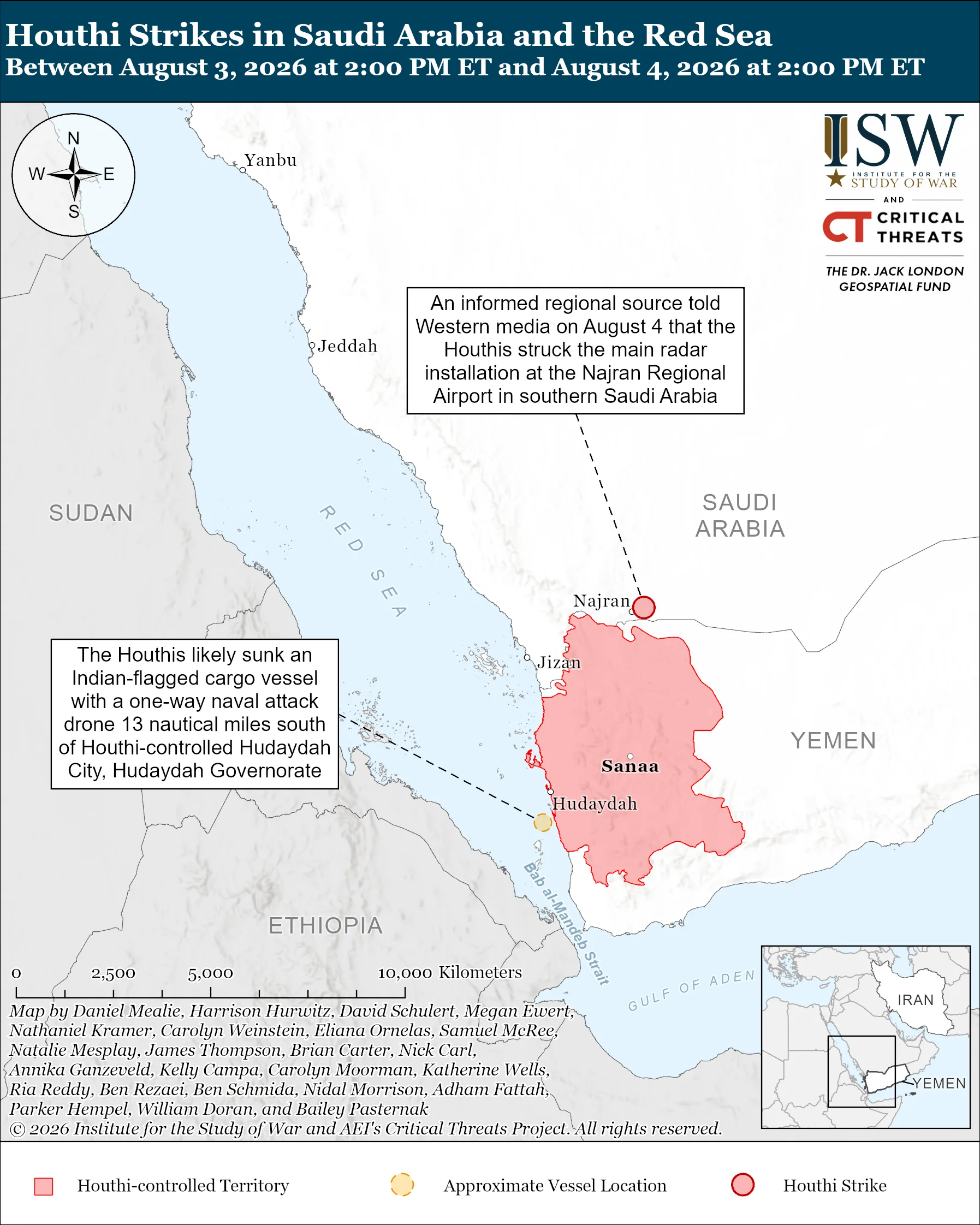
The Houthi military spokesperson Yahya Sarea claimed that a Houthi drone struck a “sensitive target” at Najran Regional Airport, southern Saudi Arabia, on August 4.[86] An informed regional source told AFP on August 4 that the Houthis struck the Najran Regional Airport's main radar installation, which has affected airport operations.[87] Commercially available flight data indicates that the airport suspended inbound and outbound flights on August 4.[88] Saudi officials have not confirmed the strike at the time of this writing, however. The Houthis claimed that the strikes were in response to recent Saudi “violations” of Yemeni airspace with drone overflights in the Saada and Hajjah governorates.[89] Sarea stated further Saudi “violations” would not go “unpunished.”[90] The Houthis previously shot down two Saudi drones over Houthi-controlled territory on July 26 and 28.[91]
The Houthis likely sank an Indian-flagged cargo vessel with a one-way naval attack drone near the Bab al Mandeb Strait. Indian Minister of Ports, Shipping, and Waterways Sarbananda Sonowal announced on August 4 that an unspecified projectile struck and sank the Indian-flagged MSV FAIZE NOORE OLIYA “near Yemeni waters.”[92] UK-based Saudi-owned media reported on August 4 that a water-borne improvised explosive device, possibly a one-way naval attack drone, struck the vessel 13 nautical miles south of Houthi-controlled Hudaydah City, Hudaydah Governorate.[93] The Houthis have utilized one-way naval attack drones to attack US Navy and civilian commercial vessels since 2024.[94] Yemeni military sources told Saudi media on August 3 that the IRGC helped the Houthis reinforce launch sites on high ground overlooking the Bab al Mandeb Strait and the Houthis’ main port at Hudaydah.[95]
more + maps: https://understandingwar.org/research/middle-east/iran-update-special-report-august-4-2026/
Comment: Someone (Russia?) disclosed the coordinates of the radar station at Najran Regional Airport to the Houthis.
2,329
posted on
08/04/2026 11:59:42 PM PDT
by
AdmSmith
(GCTGATATGTCTATGATTACTCAT)
Former CIA Iran Expert: US-Iran War in an “Operational Pause”- But Next Move Could Trigger Wider War
Cipher Brief Executive Editor Brad Christian sits down with former CIA senior intelligence officer and Cipher Brief Expert Norm Roule to examine where the Iran crisis is headed, why diplomacy may be running out of time, and what signals national security professionals should be watching next.
Topics include:
• Why Norm Roule believes this is an “operational pause,” not a ceasefire
• President Trump’s diplomatic strategy and growing impatience with Iran
• The strategic importance of the Strait of Hormuz—and why shipping fees matter far beyond energy markets
• The role of the Gulf States in preventing wider regional escalation
• Iranian cyber operations targeting U.S. infrastructure
• What could trigger a broader U.S. military response
• The intelligence indicators that matter more than public rhetoric
https://www.youtube.com/watch?v=uvpkv8VL8JU
2,330
posted on
08/05/2026 12:36:26 AM PDT
by
AdmSmith
(GCTGATATGTCTATGATTACTCAT)
The UAE has become the Gulf's dominant investor in Africa. This chart shows a remarkable shift over the past decade.
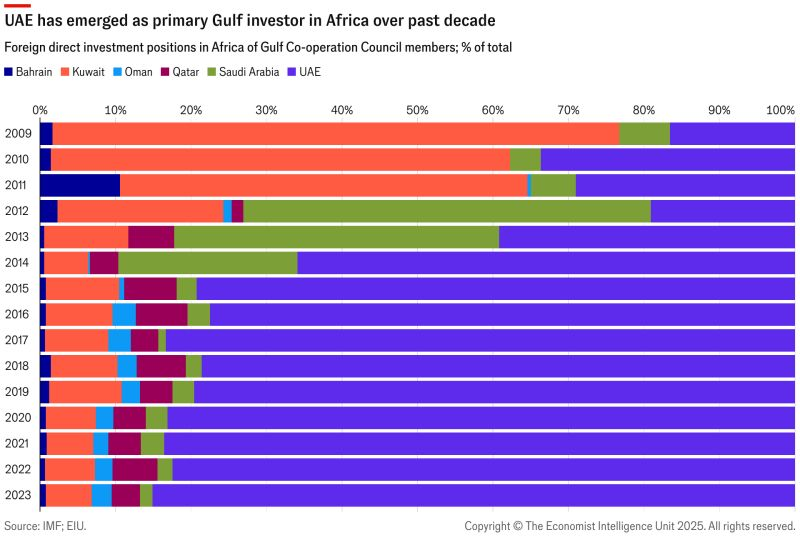
The UAE now accounts for the vast majority of Gulf foreign direct investment in Africa, overtaking Saudi Arabia, Qatar, Kuwait, Oman and Bahrain combined.
This isn't just about capital. It is a long-term strategy built around:
⚓ Ports and logistics
🛢️ Energy and critical minerals
🌾 Food security
🏗️ Infrastructure and industrial zones
The result is a growing network stretching from the Red Sea to the Atlantic, giving the UAE increasing influence over some of the world's most important trade and energy corridors. The UAE is positioning itself at the center of future global trade flows.
https://x.com/jackprandelli/status/2083983514039459842
The UAE foreign policy is very interesting, especially when we look at their investment policy in Africa
In 10 years, the UAE became the 1st Gulf investor in the region. The country is also at the top positions of world direct investors, often in front of many traditional powers, depending on the different counts.

Where are they investing ?
🔹Eastern Africa (Kenya, Ethiopia, Uganda...)
🔹Central Africa (DRC, Angola, Gabon...)
🔹Western Africa (Guinea, Mali, Nigeria...)
🔹Northern Africa (Morocco, Algeria, Egypt...)
What are their priorities ?
🔹Agricultural lands
🔹Ports
🔹Mining industry, in particular gold
🔹Defense (especially with RSF in Sudan)
🔹Financial investments
This strategy of financial and direct investments is making the UAE one of the most influential states in Africa, which also goes with the UAE strategy in Sudan and Ethiopia in recent years.
https://x.com/clement_molin/status/2084377514609172854
2,331
posted on
08/05/2026 1:53:19 AM PDT
by
AdmSmith
(GCTGATATGTCTATGATTACTCAT)
Iran Update Special Report, August 5, 2026
The factional nature of Iranian decisionmaking is likely slowing Tehran’s approval of the draft Iran-Oman agreement covering vessel traffic in the Strait of Hormuz. There are conflicting reports of whether the regime has finalized the draft agreement. Axios reported on August 4 that Iran's leadership approved the agreement.[1] Two unspecified regional officials told the Associated Press on August 5, however, that Supreme Leader Mojtaba Khamenei had not approved the agreement.[2] This round of negotiations — like the others before it — has reportedly taken place without the presence of the Islamic Revolutionary Guards Corps (IRGC).[3] A faction of anti-concessions Iranian leaders, likely from the IRGC and led by IRGC Commander Major General Ahmad Vahidi, are close to the supreme leader and have consistently won policy arguments since the war began. One of the few times the IRGC did not win this argument was when Iranian President Masoud Pezeshkian successfully convinced the supreme leader to accept the Memorandum of Understanding (MoU) in June by offering his resignation as president. The repeated insistence of Iranian officials that the Iran-Oman talks only cover technical transit arrangements further indicates that the regime has not yet reached consensus on the agreement.[4]
This lack of consensus on the agreement likely reflects the regime's internal divisions over negotiations.[5] ISW-CTP assessed on July 28 that three groups are competing to shape Iran's negotiations policy: an anti-concessions faction likely led by Vahidi that supports talks but rejects any agreement that limits Iranian control over the strait; a pro-concessions faction that includes Iranian President Masoud Pezeshkian, Foreign Affairs Minister Abbas Araghchi, and Parliament Speaker Mohammad Bagher Ghalibaf and is more willing to compromise to reduce economic pressure; and the ultra-hardline Paydari (Stability) Front, which opposes negotiations with the United States altogether.[6] All these factions agree that Iran must maintain a certain level of control over the strait; their differences are related to tactics, not strategic objectives.
The emerging Iran-Oman arrangement will reportedly give Iran a greater role in controlling traffic through the strait than Iran had before the war. Axios reported on August 4 that the agreement stipulates that inbound vessels will travel through Iranian waters, while outbound vessels will use a route through Omani waters “in coordination with Iran” for sixty days while mines are cleared from the recognized transit scheme.[7] Iranian Deputy Foreign Affairs Minister for Legal and International Affairs Kazem Gharibabadi described a broader Iranian role on August 5, however.[8] Gharibabadi stated that vessels would also travel through Iranian waters during part of their outbound passage before continuing through Omani waters.[9] Gharibabadi added that the new arrangement would replace both existing temporary routes, referring to the US-facilitated southern route through Omani waters and the route through Iranian waters that Iran has coerced vessels by force to use in recent months.[10] Gharibabadi’s description therefore suggests that Iran is seeking more direct control over outbound traffic than what Axios described on August 4.[11] A regional source told Reuters on August 5 that the unspecified ”parties” had already accepted some form of Iranian control over the strait but did not provide further detail.[12] Iran is likely seeking to convert the temporary leverage it gained by disrupting maritime traffic into a lasting role in managing the waterway, which would allow the Iranian regime to monitor vessel traffic, pressure adversaries, and threaten renewed disruption of the strait during future crises. ISW-CTP previously assessed that Iranian control of the strait is detrimental to global commercial interests because it enables Iran to selectively determine which vessels may pass through the strait and at what cost.[13]
Iran is likely linking any lifting of restrictions on traffic through the strait to both US economic and strait-related concessions. Lifting restrictions on the strait without US concessions would weaken Iran's bargaining position in negotiations while leaving the US blockade, sanctions, and other economic pressure in place. Unidentified Iranian sources told Iranian media on August 5 that Iran would not reopen the strait unless the United States ended its attacks on Iran, addressed the alleged US MoU “violations,” met Iran's conditions, and provided guarantees that the United States military would not attack Iran.[14] Iran notably viewed any strait transit that crossed without its approval as a violation of the MoU, which suggests that Iran is seeking even more significant strait-related concessions. Iran likely calculates that restoring normal traffic through the strait before securing economic benefits and its concessions to its control of the strait would reduce the costs that the conflict imposes on the United States and regional states and thus weaken the US incentive to make concessions. The Financial Times reported on August 4 that the United States would lift its naval blockade and ease restrictions on Iranian oil exports if Iran agreed to reopen the strait, according to a person briefed on the recent talks.[15] Axios also reported on August 4 that the temporary Iran-Oman arrangement concerning the strait could facilitate renewed ceasefire and nuclear negotiations.[16] The regime likely views the strait agreement as an initial step as part of a broader and more comprehensive agreement related to the strait and will not give up substantive leverage without a broader agreement.
The Israel Defense Forces (IDF) issued an evacuation order ahead of conducting airstrikes in Mansouri, Tyre District, on August 5, after announcing that Hezbollah violated the ceasefire.[17] The IDF has not issued evacuation orders ahead of strikes in southern Lebanon since July 11.[18] The IDF did not provide details of the reported Hezbollah ceasefire violation.[19] Hezbollah-aligned Lebanese media reported on August 5 that an improvised explosive device killed two IDF soldiers operating in Majdal Zoun, Tyre District, which neighbors Mansouri, however.[20] Hezbollah has not claimed this attack at the time of this writing.
Iraqi Prime Minister Ali al Zaydi’s anti-corruption and militia disarmament efforts are reportedly deepening divisions within the Shia Coordination Framework. An Iraqi political source told Saudi media on August 5 that unspecified Iraqi officials who initially supported Zaydi’s disarmament and anti-corruption initiatives have “begun to back down” in recent weeks.[21] The source claimed that some framework leaders have withdrawn support for Zaydi’s efforts out of concern that Iraqi authorities will investigate and hold their own political networks and associates accountable.[22] Unidentified framework leaders also reportedly refused Zaydi’s request to arrest senior Iranian-backed Iraqi militia leaders as part of the campaign.[23] ISW-CTP previously assessed on July 8 that some framework members may be attempting to limit the scope of Zaydi’s anti-corruption campaign by making “settlements” with individuals accused of corruption and manipulating prosecution procedures.[24] Iraqi authorities have primarily arrested Sunnis and allies of former Prime Minister Mohammed Shia al Sudani during the campaign as of the time of this writing.[25] The Iraqi political source claimed that some framework members have begun to assert conditions and reservations concerning their militias’ disarmament amid regional tensions and claimed threats to Iraqi internal security.[26] Multiple Iraqi militias, including groups closest ideologically to Iran and most kinetically active in recent months, have continued to refuse to disarm.[27] Unspecified Iraqi militias are also attempting to circumvent the disarmament process, including by handing over “scrap” missiles and inoperable drones.[28]
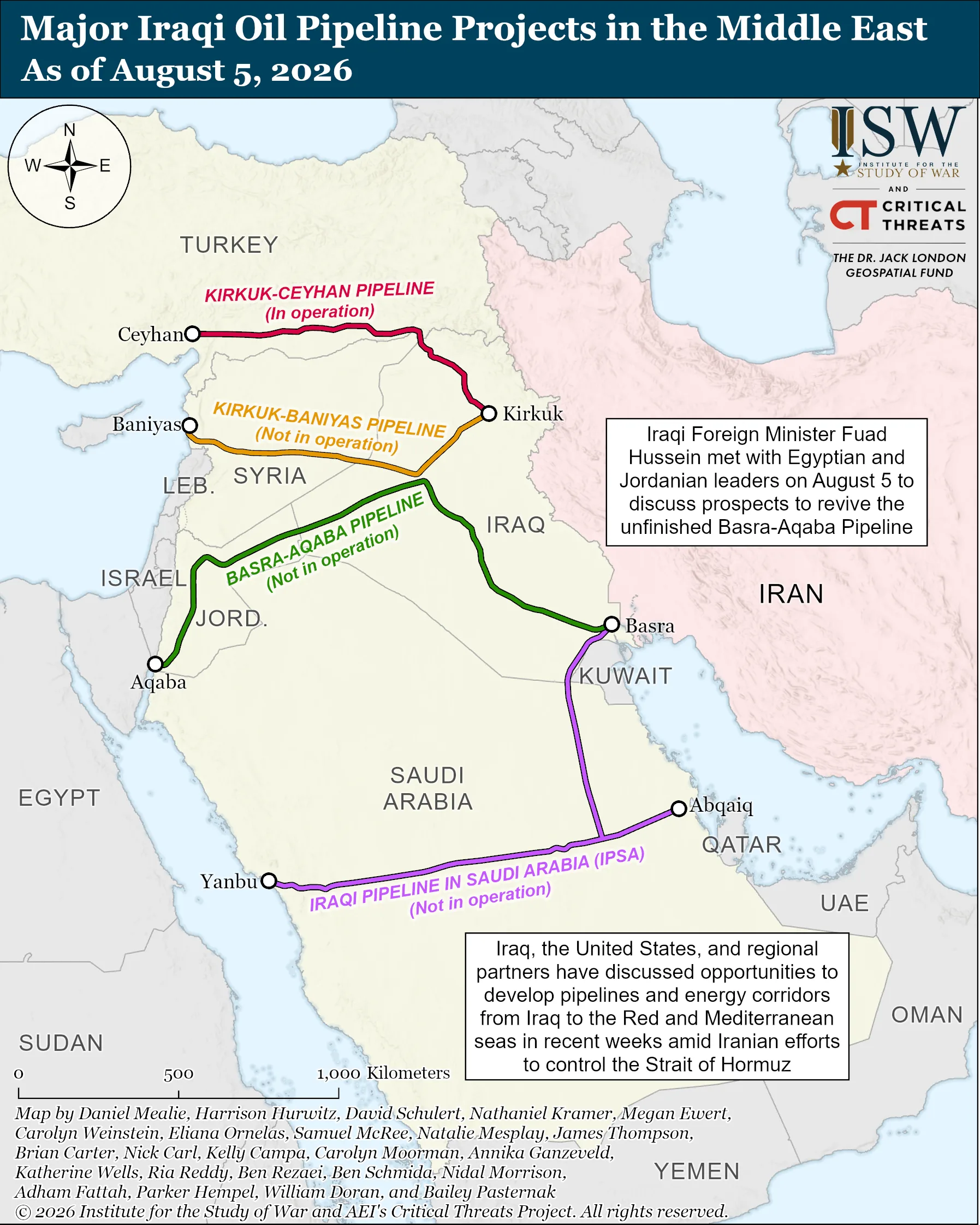
Iraqi Foreign Minister Fuad Hussein discussed prospects to develop a pipeline that would link Iraq with the Red Sea during meetings with Egyptian and Jordanian leaders in Amman, Jordan, on August 5.[29] Hussein held separate meetings with Jordanian Foreign Minister Ayman Safadi and Egyptian Foreign Minister Badr Abdelatty, in which the ministers discussed the possibility of developing a planned oil pipeline that would extend from Basra to the Jordanian Red Sea port of Aqaba.[30] Iraq and Jordan began planning the Basra-Aqaba Pipeline in 2013 but never completed the project.[31] Iraq, the United States, and regional partners have discussed proposals in recent weeks to develop alternative routes to the Strait of Hormuz for Iraqi oil exports, amid Iranian efforts to control traffic in the Strait and the Persian Gulf.[32] A US State Department official told Reuters on July 14 that the United States supports joint Iraqi-Syrian efforts to redevelop and operate the defunct Kirkuk-Baniyas Pipeline between northern Iraq and Syria's Mediterranean coast, for example.[33] Gulf and regional states have increasingly relied on alternative energy export corridors toward the Red and Mediterranean Seas during the war in order to circumvent Iran's controls on maritime traffic. Saudi Arabia in particular has depended on its Red Sea port at Yanbu and the East-West Pipeline, which extends from Saudi oilfields and refineries in eastern Arabia to Yanbu, to avoid exporting oil through the Persian Gulf.[34]
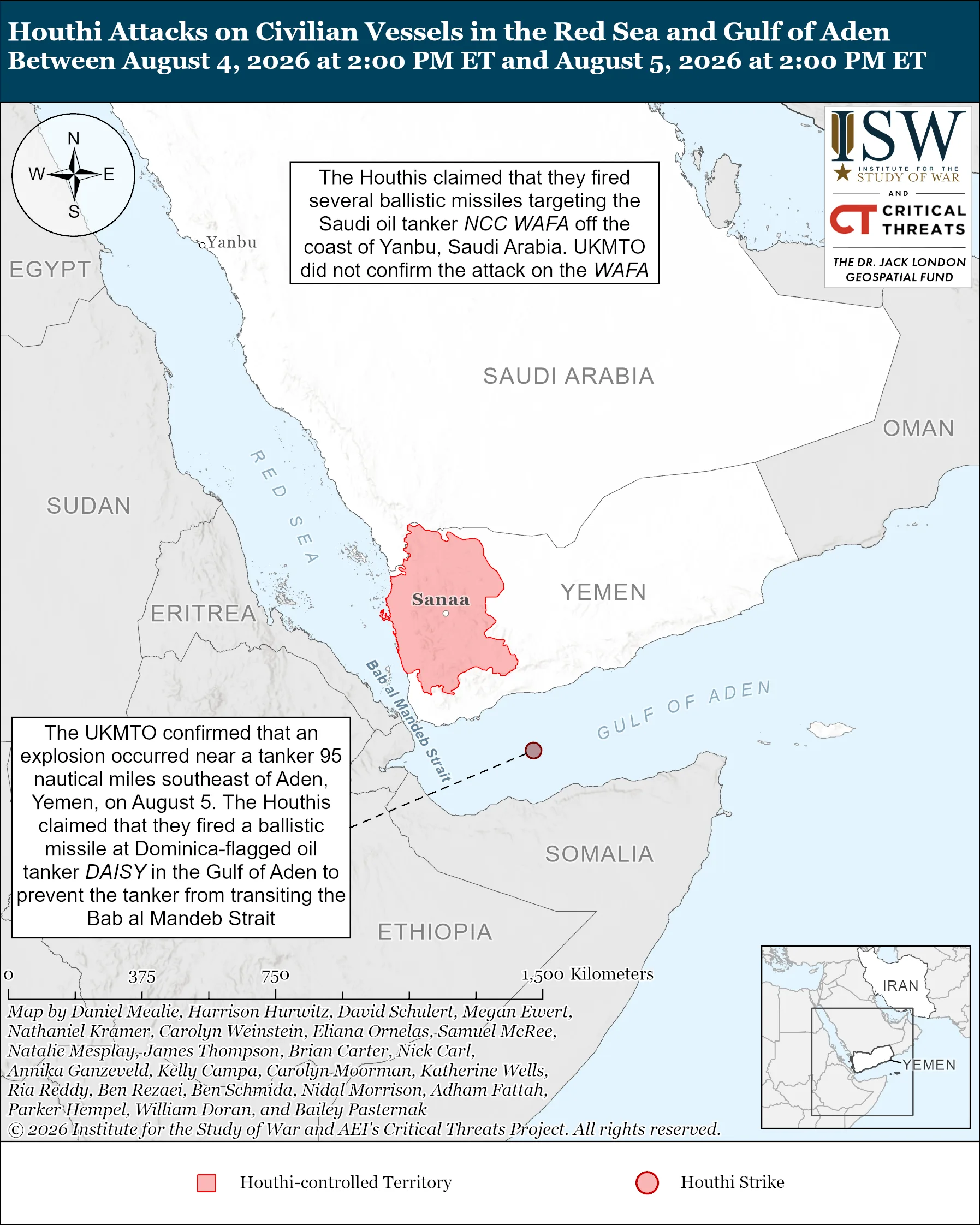
The Houthis claimed attacks against two Saudi oil tankers in the Red Sea and Gulf of Aden on August 5.[35] Houthi military spokesperson Yahya Sarea claimed on August 5 that the Houthis fired several ballistic missiles targeting the Saudi-flagged, Saudi-owned NCC Wafa oil tanker off the coast of Yanbu in the Red Sea.[36] United Kingdom Maritime Trade Operations (UKMTO) has not confirmed the attack on the NCC Wafa at the time of this writing. The Houthis also claimed on August 5 that they fired one ballistic missile targeting the Dominica-flagged, Saudi-operated Daisy oil tanker in the Gulf of Aden to prevent the vessel from transiting the Bab al Mandeb Strait.[37] UKMTO confirmed on August 5 that an unspecified tanker master reported hearing an explosion near the vessel in the Gulf of Aden.[38] These attacks follow a likely Houthi one-way naval drone attack against an Indian-flagged cargo tanker near the Bab al Mandeb Strait on August 4.[39] The Houthis have claimed several attacks on Saudi vessels since July 22 as part of their efforts to enforce a blockade on Saudi ports.[40]
https://understandingwar.org/research/middle-east/iran-update-special-report-august-5-2026/
2,332
posted on
08/05/2026 10:10:01 PM PDT
by
AdmSmith
(GCTGATATGTCTATGATTACTCAT)
An Islamic Republic official openly discusses swift military victories over Arab states, dismissing them as little cause for concern. Former Iranian Ambassador to Afghanistan and Italy Abolfazl Zohrevand said: “Of the countries willing to join America in this war… Kuwait will be taken care of by the PMF. Iranian forces can finish the job in Bahrain. Saudis are not built for combat.”
He went on to claim that during the Saudi-led war in Yemen, Saudi Arabia relied on foreign mercenary pilots, adding that Saudis are “not built for combat” but for “partying.” While not explicit, the remarks hint that Kuwait and Bahrain are viewed as ripe for takeover in the event of a wider regional conflict.
https://x.com/TheIranWatcher/status/2084994746636706081
2,333
posted on
08/05/2026 11:45:31 PM PDT
by
AdmSmith
(GCTGATATGTCTATGATTACTCAT)
To: nuconvert; gleeaikin; BeauBo; blitz128
Saudi source to “Al Hadath”: Coordination between the Houthi militias, the Iraqi militias, and the Iranian Revolutionary Guard to target the Kingdom, and we will not hesitate in dealing with any aggression
https://x.com/AlHadath/status/2085459664481751248
2,334
posted on
08/06/2026 3:07:49 PM PDT
by
AdmSmith
(GCTGATATGTCTATGATTACTCAT)
To: AdmSmith; BeauBo; dennisw; nuconvert; adorno
If this russian ship can do business in South Africa, or any other African ports, that may work out OK for them. I don’t know how naphtha fits into the overall fuel market, or if it is a completely different market, but those who follow the oil market may have a clearer explanation to make.
In other Iranian based news, if you have been following the distressing story of tampering with water supply in one of our Great Lakes states, there was new info today. Apparently the meddling was Iran based and occurred 3 months before Trump and company bombed Iran this year. So far nothing was done to poison or kill people, but this is a new type of trouble we will need to remain alert for.
2,335
posted on
08/06/2026 5:56:12 PM PDT
by
gleeaikin
(Question Authority: report facts and post their 'links" in your messages.I)
To: AdmSmith; BeauBo; dennisw; nuconvert; adorno
If this russian ship can do business in South Africa, or any other African ports, that may work out OK for them. I don’t know how naphtha fits into the overall fuel market, or if it is a completely different market, but those who follow the oil market may have a clearer explanation to make.
In other Iranian based news, if you have been following the distressing story of tampering with water supply in one of our Great Lakes states, there was new info today. Apparently the meddling was Iran based and occurred 3 months before Trump and company bombed Iran this year. So far nothing was done to poison or kill people, but this is a new type of trouble we will need to remain alert for.
2,336
posted on
08/06/2026 5:56:12 PM PDT
by
gleeaikin
(Question Authority: report facts and post their 'links" in your messages.I)
To: AdmSmith; BeauBo; dennisw; nuconvert; adorno
If this russian ship can do business in South Africa, or any other African ports, that may work out OK for them. I don’t know how naphtha fits into the overall fuel market, or if it is a completely different market, but those who follow the oil market may have a clearer explanation to make.
In other Iranian based news, if you have been following the distressing story of tampering with water supply in one of our Great Lakes states, there was new info today. Apparently the meddling was Iran based and occurred 3 months before Trump and company bombed Iran this year. So far nothing was done to poison or kill people, but this is a new type of trouble we will need to remain alert for.
2,337
posted on
08/06/2026 5:56:12 PM PDT
by
gleeaikin
(Question Authority: report facts and post their 'links" in your messages.I)
To: AdmSmith; BeauBo; dennisw; nuconvert; adorno
If this russian ship can do business in South Africa, or any other African ports, that may work out OK for them. I don’t know how naphtha fits into the overall fuel market, or if it is a completely different market, but those who follow the oil market may have a clearer explanation to make.
In other Iranian based news, if you have been following the distressing story of tampering with water supply in one of our Great Lakes states, there was new info today. Apparently the meddling was Iran based and occurred 3 months before Trump and company bombed Iran this year. So far nothing was done to poison or kill people, but this is a new type of trouble we will need to remain alert for.
2,338
posted on
08/06/2026 5:56:13 PM PDT
by
gleeaikin
(Question Authority: report facts and post their 'links" in your messages.I)
Iran Update Special Report, August 6, 2026
Iranian regime media claimed that the emerging Iran-Oman deal would enable Iran to maintain control of the Strait of Hormuz. Any agreement that grants Iran control over the strait would be detrimental to US and global commercial interests. An informed source told Islamic Revolutionary Guards Corps (IRGC)-affiliated media on August 6 that the Iran-Oman deal stipulates that ships will enter the strait through Iranian territorial waters and exit through Omani territorial waters for a “certain period.”[1] Four industry sources similarly told Reuters on August 6 that the proposed deal between Iran and Oman would give Iran “control” over ships entering the Persian Gulf through the strait.[2] All ships would then, after this period, pass through a central route, with Iran managing ships’ entrances and Iran and Oman jointly managing ships’ exits.[3] The source added that the deal includes “insurance, fueling, and environmental fees,” which are effectively tolls.[4] The arrangement described by IRGC-affiliated media would enable the Iranian regime to retain control over both inbound and outbound traffic in the strait and earn revenue through charging tolls. This Iranian media report contradicts an August 6 Saudi media report in which a “senior source” claimed that the agreement does not include transit fees or service charges, however.[5]
Achieving international recognition of its control over the strait would enable Iran to use the strait as a deterrent against its adversaries in potential future conflicts. The Supreme Leader's website newspaper, Voice of Iran, argued in an op-ed on August 5 that the regime views the strait as a central pillar of its security architecture rather than just bargaining leverage in negotiations with the United States.[6] This argument is consistent with ISW-CTP’s ongoing assessment that one of the regime's strategic objectives is to secure long-term and permanent control over the strait.[7] Voice of Iran's argument also comes after some “pragmatist” elements have questioned how much effort the regime should expend in enforcing its control over the strait. Former Foreign Affairs Minister Mohammad Javad Zarif, for example, argued on August 3 that Iran has a time-sensitive window of opportunity to capitalize on its control of the strait and argued that Iran should use the strait as leverage in negotiations to recover economically and avoid further US military action.[8]
Iran continues to use force to consolidate its control of the strait. United Kingdom Maritime Trade Operations (UKMTO) reported on August 5 that a vessel's crew heard two explosions while passing through Omani territorial waters.[9] Iran has repeatedly targeted vessels in the strait using the Omani route because traffic through this route undermines Iranian efforts to assert full control over the strait.[10]
Iran and its Axis of Resistance are likely attempting to deter the Syrian government from disrupting smuggling routes used to support Hezbollah.[11] A UK-based Saudi-owned outlet reported on August 4 that numerous Iranian cells in Syria have prepared to launch attacks on Syrian government and civilian targets if the Syrian government decides to take unspecified action against Hezbollah.[12] Iran and its Axis partners in Iraq and Lebanon have consistently attempted to infiltrate Syria with clandestine cells and recruit former pro-Assad fighters who remained in Syria after the fall of the Assad regime in 2024.[13] The Syrian government has thwarted several Iranian-supported smuggling attempts to equip Iranian cells in Syria as well as attempts to move Iranian-backed fighters across the Syria-Lebanon border in recent weeks.[14] Many Iraqi and Syrian fighters have already entered Lebanon to fight alongside Hezbollah.[15]
Iran likely believes that continued Syrian government efforts to disrupt Hezbollah smuggling routes in Syria represent Syrian cooperation with Israel and the United States against Hezbollah when, in reality, Syria is exercising its sovereign right to secure its borders. Iran likely views Syrian efforts against Hezbollah and weapons smuggling as threats to Iranian supply lines to Hezbollah and evidence of Syrian support for Israeli objectives, as reflected in Axis of Resistance media reports.[16] Iran and its partners and proxies have surely observed Western reports claiming that US President Donald Trump has repeatedly asked Syria to take action against Hezbollah, which would reinforce Iranian and Axis of Resistance perceptions. These Syrian government efforts instead address broader threats to Syrian sovereignty, including continued Axis of Resistance activity and smuggling in Syria after years of Iranian and Axis support for the Assad regime.[17] Iran has historically viewed Syria as a critical component to its ability to support Axis of Resistance operations throughout the region and has utilized Assad-era Syria to support Hezbollah with weapons and funding via Iraq.[18]
ISW-CTP is considering two possible courses of action for Iran in Syria:
Most Likely Course of Action (MLCOA): Iran uses clandestine cells in Syria to conduct spectacular attacks within Syria that force Syrian security forces to divert resources from border regions to respond to such attacks. This would both divert resources away from the border regions (thereby making counter-smuggling efforts less effective) and could act as a deterrent against future border security efforts. Spectacular attacks would force already strained Syrian security forces to divert resources and personnel from monitoring active smuggling routes in border regions. Iran and the Axis could take advantage of these gaps in security to smuggle equipment, funds, and personnel across the Syrian border. The attacks would also create political challenges for Ahmad al Shara’s government.
Most Dangerous Course of Action (MDCOA): A major Syrian counter-smuggling operation on the Lebanese border against Hezbollah triggers a coordinated Iranian-backed response involving clandestine cells, cross-border attacks, and possibly Iranian strikes to deter further Syrian government action. A major Syrian counter-smuggling operation—perhaps against Hezbollah warehouses in Lebanon or an operation that kills a significant number of Hezbollah fighters—could create a volatile situation that triggers a wider Iranian and Axis response. Iranian cells could conduct a series of coordinated attacks against Syrian forces supported by Axis and possibly Iranian drone, rocket, and missile strikes in response to such an operation. Such a campaign may result in broader Hezbollah objectives beyond deterring the Syrian government once the campaign begins.
The Syrian government has deployed an increased number of forces to the Syria-Iraq border to support border security in response to Iranian and Axis of Resistance threats and activity.[19] The UK-based Saudi-owned outlet reported that Iranian-backed Iraqi militias and Hezbollah have reinforced positions along Syria's borders.[20] This deployment reportedly prompted the Syrian Defense Ministry to mobilize forces along the Iraq-Syria border.[21] The Syrian government reportedly informed the Iraqi and Lebanese governments that Iranian and Axis activity on Syria's borders threatens Syria's internal stability and warned both governments that Syrian forces would respond to any Hezbollah or Iraqi militia attacks.[22] The Iraqi Border Forces commander told Iraqi media on August 4 that the Syria-Iraq border situation is normal and Syria's border security measures are being coordinated with Iraq.[23] This statement indicates that both Iraq and Syria interpret the Syrian deployment of forces to the border as part of a border security operation to prevent smuggling.
The activities of Iran and the Axis of Resistance across the region, including their reported actions in Syria, are likely causing an increasing alignment of interests between different regional states. Iran has increasingly threatened Syrian security both through the reported Iranian and Axis of Resistance cells and strikes on Syrian territory, including the Islamic Revolutionary Guards Corps (IRGC) strikes on the former US base in al Tanf, Syria, on July 17.[24] Iran and the Axis of Resistance have repeatedly struck multiple regional countries, including Saudi Arabia and the United Arab Emirates (UAE).[25] Syria has increased its coordination with Saudi Arabia and the UAE in recent weeks. Syrian President Ahmed al Shara held two phone calls with Saudi Crown Prince Mohammed bin Salman and UAE President Mohammed bin Zayed Nahyan on July 30 to discuss regional developments and condemn Iranian attacks on Saudi energy infrastructure, for example.[26] These activities have spurred increased cooperation between Arab states as they have become more frustrated with Iran.
The Houthis conducted missile and drone attacks against the Republic of Yemen Government (ROYG) military camps in Marib and Hadramawt governorates on August 6, possibly in response to ROYG ground movements near Houthi frontlines.[27] The Saudi-backed, ROYG-affiliated Yemen Emergency Forces confirmed that the Houthis attacked several of its camps and other ROYG-affiliated units on August 6.[28] The Houthi attacks killed at least 45 ROYG soldiers, according to unspecified sources speaking to Saudi media on August 6.[29] The Houthis claimed on August 6 that they conducted the attacks in response to a recent mobilization of ROYG and “Saudi” forces in Marib and Hadramawt governorates.[30] Anti-Houthi and Saudi media indicated in late July that ROYG forces were mobilizing in Marib Governorate. Anti-Houthi media reported on July 31 that ROYG security forces in Marib Governorate arrested several individuals for filming military movements on public roads.[31] Saudi-owned UK-based media also noted on July 25 that an unspecified actor conducted airstrikes on Houthi positions in Marib and al Jawf governorates, which coincided with ROYG military movements.[32] The immediate trigger for the recent Houthi attacks remains unclear, however. These attacks come after unspecified Yemeni sources told The Guardian on July 30 that Saudi Arabia is preparing for a naval and possible land offensive against the Houthis to end the group's “chokehold” on Saudi Red Sea oil exports.[33]
The Houthi attacks on ROYG military positions also come after the Yemen Emergency Forces raided a Houthi-linked explosives manufacturing factory and seized Houthi military equipment in Hadramawt Governorate on August 3.[34] The Houthis may have also conducted their attacks on ROYG positions on August 6 to deter future ROYG actions targeting Houthi logistics and military procurement networks.
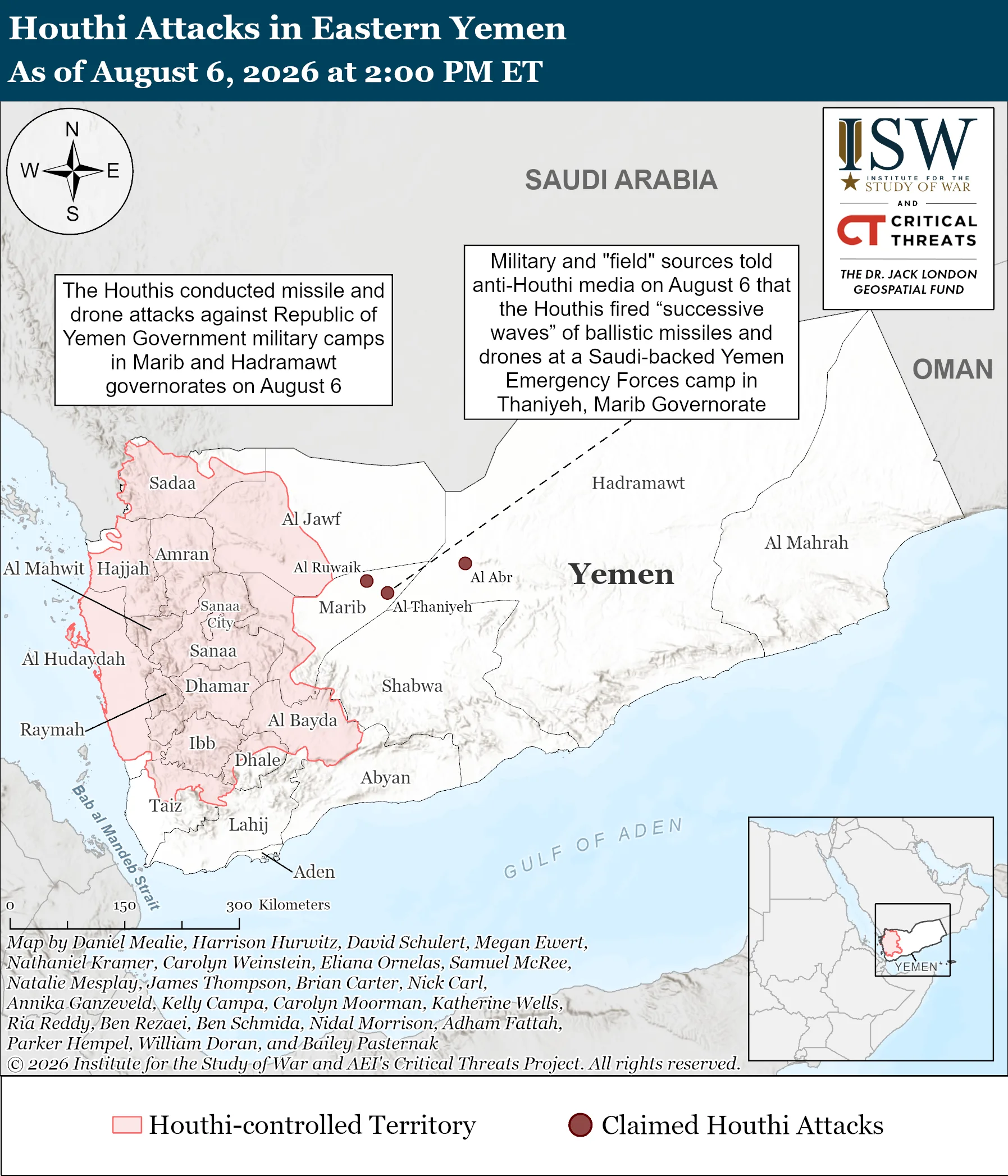
The Islamic Revolutionary Guards Corps (IRGC) Ground Forces thwarted a reported planned militant attack in Sistan and Baluchistan Province.[35] The IRGC Ground Forces Quds Operational Base announced on August 6 that its forces dismantled an unspecified militant cell before it could conduct an attack in southern Sistan and Baluchistan Province.[36] IRGC forces reportedly ambushed the cell and killed two of its leaders during the operation.[37] Sistan and Baluchistan Province is a hotspot for anti-regime activity, including by anti-regime Baloch separatist groups that frequently attack Iranian security forces in the province.[38]
Iranian-backed Iraqi militias have reportedly threatened to respond to the recent US-Saudi strikes on militia sites in Iraq if Saudi Arabia fails to meet the militias’ demands, which include an official apology.[39] The Islamic Resistance in Iraq, which is a coalition of Iranian-backed Iraqi militias, previously said it would respond to the strikes after August 6.[40] An informed source said that the militias’ demands include an official apology from Saudi Arabia, compensation for the victims’ families and damage caused to Iraqi property, and limiting anti-militia discourse in Saudi media.[41] The United States and Saudi Arabia conducted joint strikes on militia positions in Iraq on July 28 in response to Iraqi militia attacks on Saudi oil infrastructure and US interests in Iraq and the region.[42] The Popular Mobilization Forces (PMF) said that the US-Saudi strikes killed at least 20 PMF members and injured 30 members.[43] The PMF is an Iraqi state security service that includes many Iranian-backed Iraqi militias that answer to Iran instead of the Iraqi prime minister.[44]
The militias’ decision to make their response contingent on Saudi Arabia meeting their demands, instead of immediately responding kinetically, may be in response to Iraqi federal government pressure on the militias to de-escalate. The militias could still resort to using force, however, particularly if Saudi Arabia does not agree to their demands. Informed sources told independent Iraqi Kurdish media on August 5 that the militias are “serious” about a military response to Saudi Arabia, but high-level government and political pressure is preventing them from responding militarily.[45] It is unclear what form of pressure the federal government has applied to the militias or whether the pressure will be sufficient to prevent the militias from responding kinetically. Previous Iraqi governments, including under former Prime Minister Mohammad Shia al Sudani, frequently attempted to halt the militias’ kinetic activity in moments of high regional tension, most of the time to no avail.[46] Sudani constantly pressured the militias to stop attacks on US forces in Iraq and Syria between October 2023 and January 2024, but the militias only stopped these attacks after receiving direct orders from IRGC Quds Force Commander Brigadier General Esmail Ghaani to do so.[47]
The Iraqi militias continue to take security precautions due to concerns over further US strikes.[48] Security sources in Baghdad told Qatari-owned, UK-based media on August 6 that Iraqi militias evacuated their bases and established new positions following the US-Saudi airstrikes last week.[49] A senior security official also said that the militias transferred weapons, sensitive equipment, and commanders to the new positions after the strikes.[50] This report follows the PMF Ninewa Operations Command reportedly ordering the complete evacuation of its headquarters and formations in Ninewa Province on August 2 in anticipation of future strikes.[51]
The Saudi Defense Ministry appointed a commander for the Saudi-led multinational “maritime defense coalition” on August 6 to plan and coordinate coalition activities to protect international shipping from Houthi threats to the Bab al Mandeb Strait, the Red Sea, and the Gulf of Aden.[52] Fourteen countries, including the ROYG, Kuwait, Bahrain, Qatar, Pakistan, Turkey, Egypt, Djibouti, Jordan, and Sudan, as well as other African and South Asian countries, joined the alliance on July 30.[53] Saudi Arabia formed the coalition in response to the ongoing Houthi blockade on Saudi Arabia that began on July 20.[54]
https://understandingwar.org/research/middle-east/iran-update-special-report-august-6-2026/
2,339
posted on
08/07/2026 5:16:02 AM PDT
by
AdmSmith
(GCTGATATGTCTATGATTACTCAT)
Pezeshkian may have unintentionally revealed who’s really in control.
Notice the order. He says, “We [the presidency] are in full coordination with the armed forces”—not “the armed forces are in full coordination with us.”
https://x.com/KasraAarabi/status/2085354619954196986
2,340
posted on
08/07/2026 6:29:16 AM PDT
by
AdmSmith
(GCTGATATGTCTATGATTACTCAT)
Navigation: use the links below to view more comments.
first previous 1-20 ... 2,301-2,320, 2,321-2,340, 2,341-2,360 ... 2,401 next last
Disclaimer:
Opinions posted on Free Republic are those of the individual
posters and do not necessarily represent the opinion of Free Republic or its
management. All materials posted herein are protected by copyright law and the
exemption for fair use of copyrighted works.
FreeRepublic.com is powered by software copyright 2000-2008 John Robinson